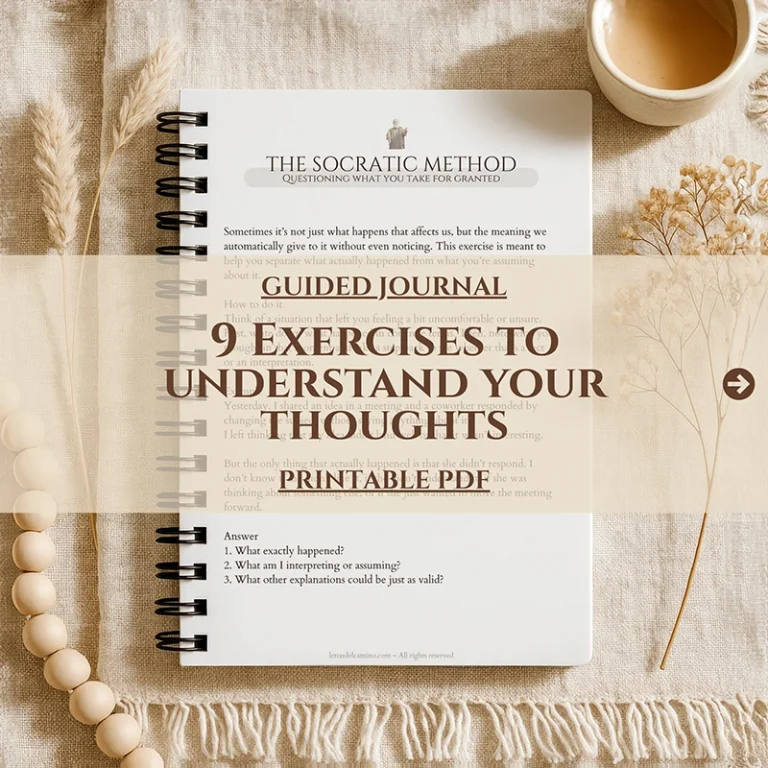
The Socratic Method for Asking Better Questions in Your Journaling
The Socratic method of questioning is a way to pause and examine what you’re thinking, asking yourself whether it is really as true as it seems. Instead of automatically accepting the first thought that comes to mind, it invites you to look at it carefully, search for evidence, and consider other possibilities.
Applied to journaling, it turns your journal into more than just a place to record what happens to you. It becomes a space to better understand your ideas, recognize assumptions, and look at your thoughts from a different perspective.
In this article, we’ll look at how to use it step by step and which questions can help you go deeper when you want to explore what you’re thinking.
IN THIS ARTICLE
01 · UNDERSTAND THE METHOD
What the Socratic method of questioning is and how it works
The idea behind the Socratic method is fairly simple: don’t automatically accept a thought as an absolute truth. Instead, question it in ways that help you examine it more closely.
The first step is to clearly write down what you’re thinking. Not something vague like “everything is going wrong,” but a specific statement you can actually look at.
“I’m not ready for this change.”
“This is going to go badly.”
“I must have done something wrong.”
The more specific the thought is, the easier it becomes to work with. Vagueness protects a thought; precision exposes it.
From there, writing stops being just a place where you state things and becomes a place where you examine them.
JOURNALING PROMPT
What am I basing this thought on?
Don’t immediately try to defend your idea. Simply write down which facts, experiences, or interpretations have led you to think this way.
As you begin answering, you may notice details you hadn’t seen before. You might discover that not everything supports your original thought. There may be exceptions, details that contradict it, or explanations you haven’t considered yet.
Looking for alternatives does not mean arguing with yourself for the sake of it. It simply means looking at the bigger picture before reaching a conclusion.
Then comes a part we often overlook: noticing what happens when you continue believing the thought you’re having.
- How does thinking this way affect me?
- Does this thought help me move forward or hold me back?
- How does it influence my decisions?
- What might happen if I keep acting as though this is true for the next six months?
At that point, the focus changes. It is no longer just about deciding whether an idea is true or false, but about understanding where it comes from, how much evidence supports it, and what effect it has on your life.
Writing down what you think allows you to see it. Asking yourself why you think it allows you to understand it.
02 · PUT IT INTO PRACTICE
How to use the Socratic method in your journal step by step
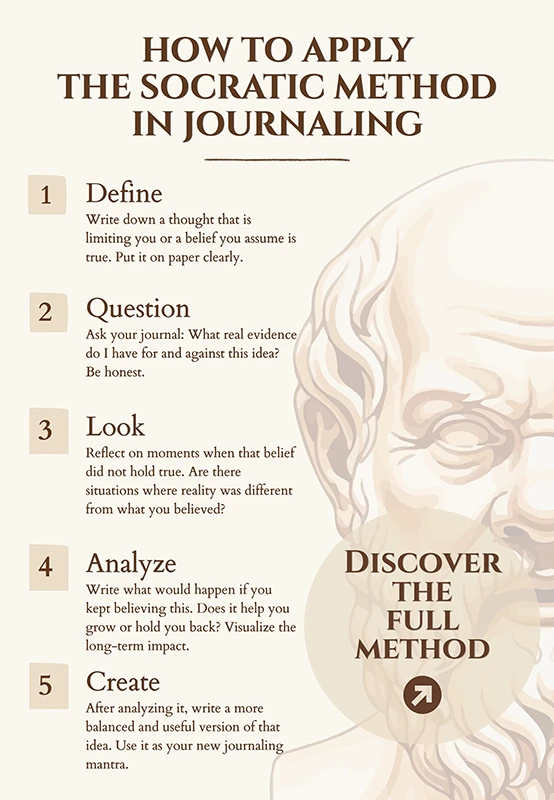
The easiest way to understand how it works is through an everyday situation.
Imagine you’ve sent someone a message and they haven’t replied. Some time passes, and you start thinking about it. Before you actually know what is happening, you may already begin interpreting their silence.
“I must have said something wrong. I always manage to mess things up.”
Instead of continuing to feed that interpretation, you can bring it into your journal and work through it.
The goal is not to convince yourself that everything is fine. It is to separate what you know from what you are assuming.
From here, you can work through the thought step by step.
1
Write the thought exactly as it appears
Don’t soften it or try to correct it yet. Write it down as it is so you can look at it with a little distance.
In this case, it might be: “I must have said something wrong. I always manage to mess things up.”
2
Look for the evidence
Ask yourself: “What evidence do I actually have that I did something wrong?”
In this example, probably none. The only fact you have is that you haven’t received a reply yet. Everything else, for now, is an interpretation.
3
Look for other explanations
They might be working, driving, resting, talking to someone, or simply using their phone much less than you do.
The fact that another explanation exists does not mean it is necessarily the right one. But it does show you something important: your first interpretation is not the only possibility either.
4
Reframe the thought
After examining it, write a new version that takes everything you now know into account.
“I don’t have any evidence that I did something wrong. There could be many reasons why they haven’t replied yet. And if there really is a problem, I’ll be able to deal with it once I actually know.”
Important: this is not about forcing yourself to think positively. You are not automatically replacing a negative thought with a pleasant one. The goal is to think with more perspective and less from fear, anticipation, or assumptions.
03 · GO DEEPER
Socratic questions you can ask yourself to use the method
There is no single correct list of questions. Depending on the thought you want to explore, some will be more useful than others.
You can use the following categories as a guide and choose only the questions that make sense in that particular moment.
01
Clarifying questions
These help you define what you are thinking more clearly and remove ambiguity.
- What exactly do I mean when I think this?
- Could I explain it another way?
- What is really at the heart of the problem?
- How does this connect with what I’ve written before?
02
Questions that challenge assumptions
These help you notice the “truths” you may have accepted without actually checking them.
- What am I assuming in this thought?
- Why am I assuming this will always be the case?
- How would my perspective change if this assumption were false?
- Am I interpreting the situation through fear or through concrete facts?
03
Questions about evidence
These help you examine how much real support there is for what you believe.
- What facts actually support this idea?
- What evidence points against it?
- Is this evidence enough for me to be completely certain?
- What specific example proves that this is true?
04
Questions about other perspectives
These are useful when you feel as though you are seeing the situation from only one point of view.
- How would someone who was not emotionally involved see this?
- What might someone who disagreed with me think?
- Are there other explanations I haven’t considered yet?
- What would my ten-years-older self think about this problem?
05
Questions about consequences
These help you notice the impact of continuing to hold a particular thought.
- If I accept this idea as true, what happens next?
- How does continuing to believe it affect my mood?
- Where does acting on this assumption lead me?
- Does this belief help me move toward my long-term goals?
06
Questions about the question itself
These help you notice how you are approaching the reflection itself.
- Why am I asking myself this question right now?
- What am I really trying to resolve?
- Am I reaching any new understanding, or am I simply going over the same thing again?
You don’t have to answer all of them. One well-chosen question can help you far more than trying to work through an entire list automatically.
TRY IT IN YOUR JOURNAL
Think of something you’ve recently accepted as true without checking it
Write it down in a single sentence and ask yourself: “What do I actually know, and what am I assuming?”
04 · CLEAR UP COMMON QUESTIONS
Common questions when you start using the Socratic method
At first, it can feel strange to question thoughts you would normally accept without giving them much attention. You do not need to do it perfectly. The practice is really about learning to create a small amount of space between what you think and what you decide to believe.
Do I need to spend a lot of time on this exercise?
No. A few minutes can be enough if you actually pause and pay attention to what you are thinking. The goal is not to write a lot, but to ask questions that help you look at the thought with a little more distance.
Do I always need to reach a conclusion?
No. Sometimes you will realize that you were interpreting a situation too quickly, while other times you still will not have a clear answer. Part of the value of the exercise is recognizing what you do not yet know.
Is it only useful for negative thoughts?
No. It works especially well with negative thoughts, self-critical thinking, or recurring worries, but you can also use it to examine decisions, conflicts, expectations, beliefs, or patterns that keep showing up in your life.
Do I need to practice it every day?
No. You can make it part of your regular journaling practice or use it only when you notice that a thought is worrying you, keeps repeating itself, or is influencing the way you act.
What if I realize that many of my thoughts were not completely true?
That is actually one possible outcome of the exercise. Our first interpretation of a situation does not always contain all the information. Recognizing that can help you respond with more perspective before turning an impression into a certainty.
IN A NUTSHELL
- Write the thought down clearly and specifically.
- Separate facts from interpretations.
- Look for evidence for and against it.
- Consider other explanations and perspectives.
- Notice the consequences of continuing to hold that belief.
- Reframe the thought based on everything you have discovered.
With practice, this process begins to feel more natural. You may still have the same initial thought, but you no longer have to accept it immediately as an accurate description of reality.
And that small space between thinking something and deciding that it is true can change a great deal about the way you write, make decisions, and understand what is happening to you.
TO KEEP PRACTICING
Practice the Socratic method
If you want to explore this kind of reflection in a more guided way, you can continue with exercises designed to help you question your thoughts, look at them from different perspectives, and write your own conclusions.