12 Quotes About Life to Make You See Things Differently

You can open a book at a random page and find yourself thinking about something that has little to do with the story. Perhaps a line about time reminds you of a visit you’ve been putting off for weeks. Or a remark about friendship brings back a conversation you had on Tuesday.
The same happens with quotations we come across on calendars, in old letters or scribbled in the margin of a notebook. Some strike us as true; others unsettle us precisely because we disagree. Both reactions can be worth exploring.
The 12 quotes about life collected here come from writers, thinkers and poets of different eras. We haven’t gathered them as rules to live by. Instead, we’ll look at what their authors meant, which nuances matter and how their words might connect to ordinary situations.
Read them in order, choose a theme or stay with the one that stirs a memory. You don’t need to agree with Seneca, Machado or Epictetus to find a worthwhile question in their words.
IN THIS ARTICLE
Quotes to reflect on
01 · TIME AND LIFE’S STAGES
Three quotes about time, opportunities and growing older
Time is easy to measure and much harder to value. We know how many hours there are in a week, but we don’t always remember where they went. And although our birthdays arrive right on schedule, every new stage of life brings situations we haven’t practised for.
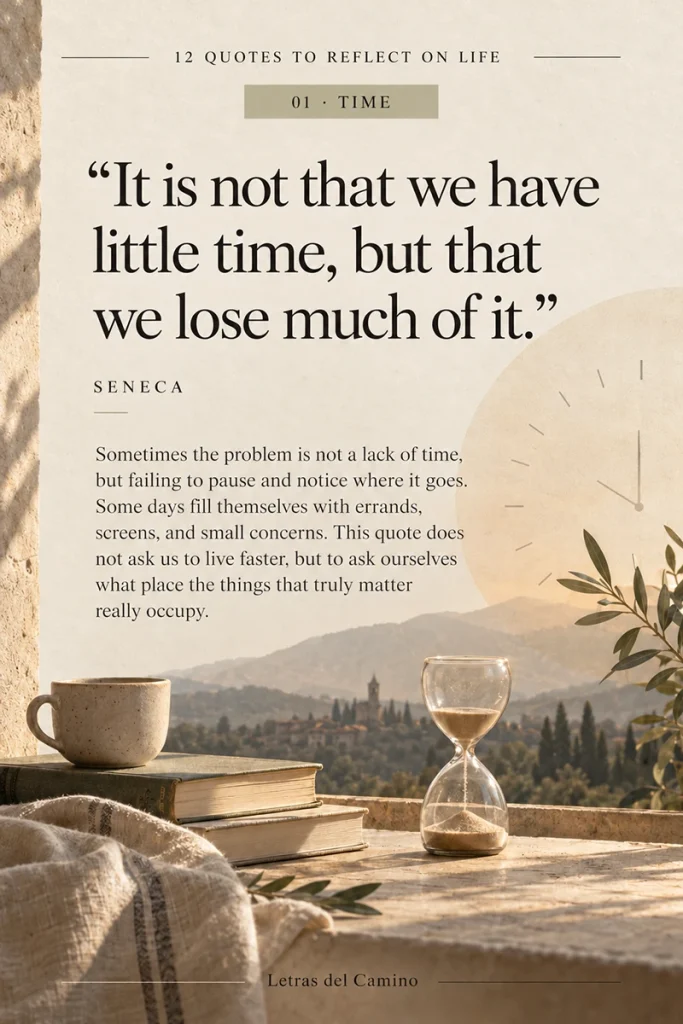
1. Do we really have too little time?
“It is not that we have too little time, but that we waste much of it.”
— Seneca
In On the Shortness of Life, Seneca notices how readily we give our hours to commitments and activities we rarely stop to examine. His words can sound harsh, especially when we think of days filled with responsibilities we haven’t chosen.
But wasting an afternoon isn’t the same as spending it resting because you need to. Imagine you’ve been saying for three weeks that you’ll call a friend. Every Sunday you find half an hour to browse shops online but never a moment to dial their number. Perhaps the clock isn’t the real issue. Then again, perhaps you need to switch off, and the call would be better at another time. The quote asks us to look at our choices, not to feel guilty about every minute.
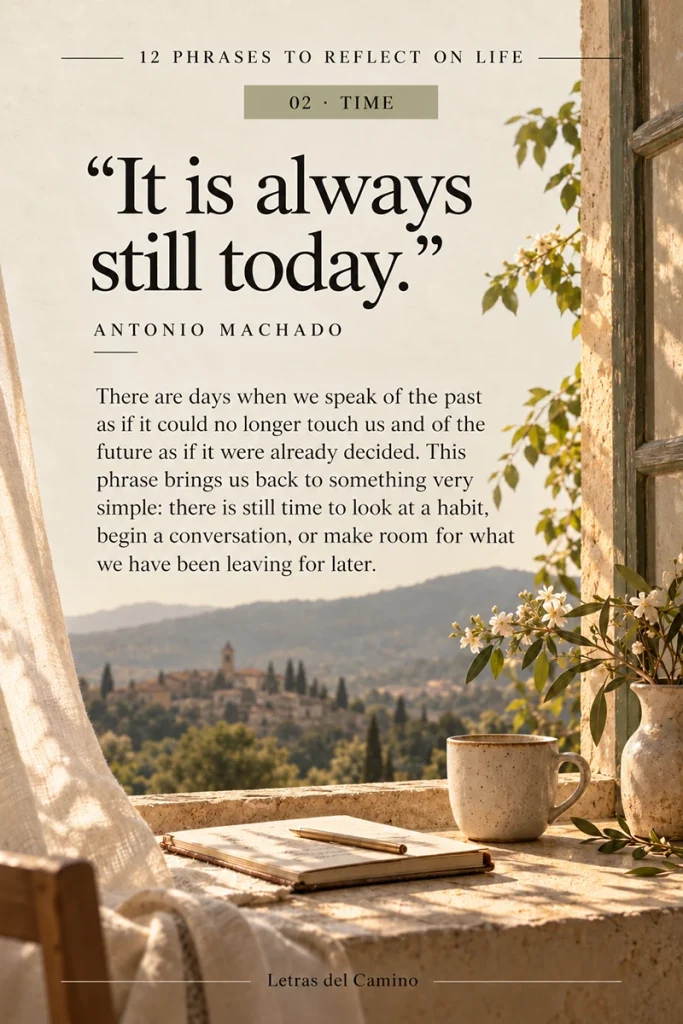
2. What “still” can mean
“There is always still time today.”
— Antonio Machado
Machado wrote this line in the Proverbios y cantares poems from Nuevas canciones. A brief line that promises very little and yet leaves something open: as long as there is a present, some possibilities remain.
For years, a woman keeps an old box of watercolours because she thinks she’s too old to learn to paint. One day she takes her nephew to a workshop, tries a few colours and discovers she’s still curious. She doesn’t have to become a painter or make up for lost time. Perhaps she’s simply found something she enjoys now. Some opportunities really do pass us by. That’s why it’s worth telling the difference between doors that have closed and those we’ve assumed were closed without checking.
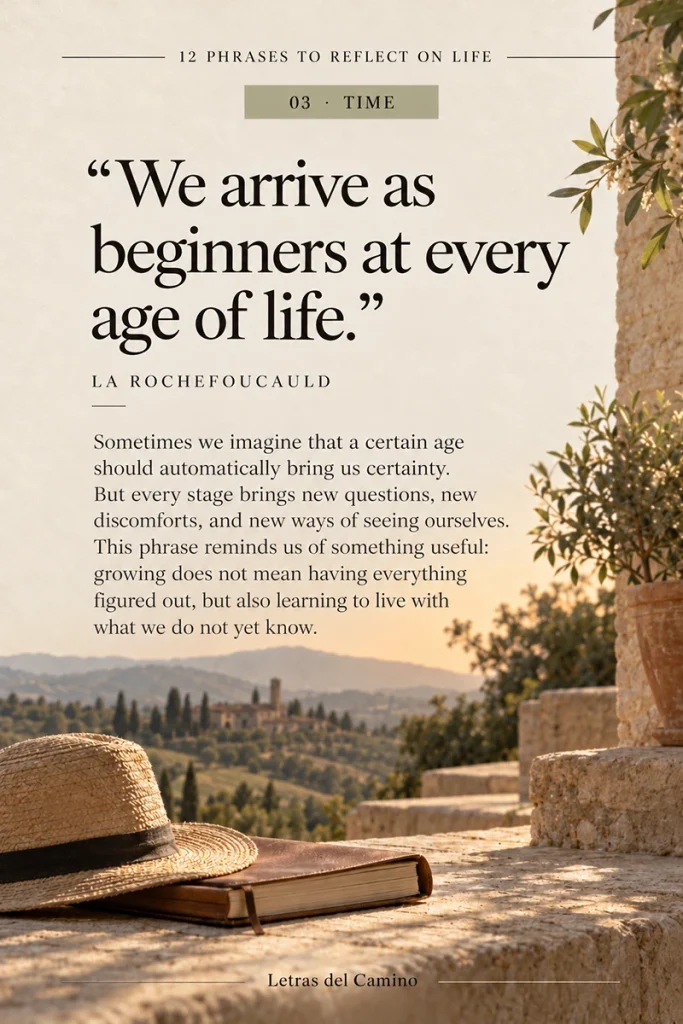
3. Nobody has lived through their next age before
“We arrive as beginners at every age of life.”
— François de La Rochefoucauld
In his Maxims, La Rochefoucauld observed that growing older doesn’t automatically prepare us for everything ahead. We may be thoroughly competent at work and feel like complete beginners when we retire, become grandparents or start living alone.
Sometimes we talk about age as though every birthday came with an instruction manual. But someone moving to a new city at fifty-eight still has to learn the bus timetable, meet the neighbours and find a good bakery, just like any newcomer. Experience helps; it doesn’t erase unfamiliarity. Perhaps that’s why someone can feel sure of themselves in one area and need help in another, without any contradiction.
A detail that changes the reading: these three quotes look at time from different angles. Seneca asks what we do with it; Machado, what is still possible; La Rochefoucauld, what we have yet to learn. They don’t offer the same answer.
02 · CHOICES AND DIRECTIONS
Three quotes that offer another way to look at decisions
Sometimes we ask for advice before we’ve considered what we want. At other times, we know exactly what we want to leave behind but can’t say what we hope to find next. That’s the nature of decisions: we make them with incomplete information, changing wishes and people who don’t always respond as we imagined.
4. Before choosing a direction
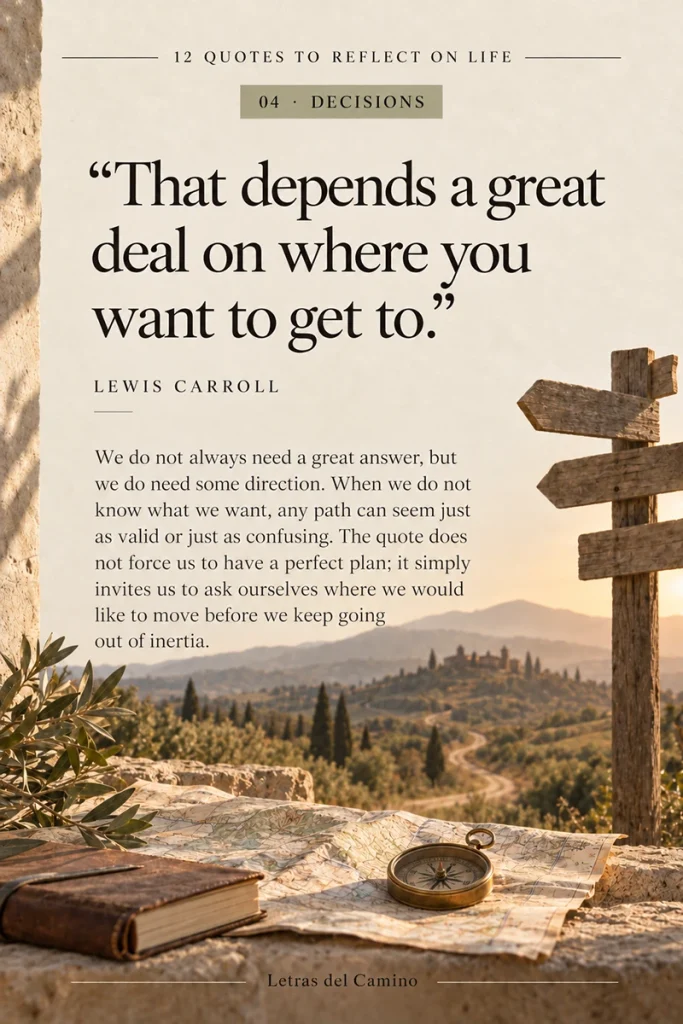
“That depends a good deal on where you want to get to.”
— Lewis Carroll
In Alice’s Adventures in Wonderland, the Cheshire Cat says this when Alice asks which way she ought to go. She doesn’t really know her destination yet, which makes it rather difficult to recommend a route.
Think of someone who has spent two weeks comparing language courses. They study timetables, prices, teachers and reviews, but none seems quite right. When a friend asks why they want to learn, the answer is that it might be for travel, perhaps for work abroad, or simply to read novels. They don’t need a fixed plan for their entire life. But sorting out those different wishes helps more than opening another twenty tabs of course offers.
5. Leaving one place isn’t the same as finding another
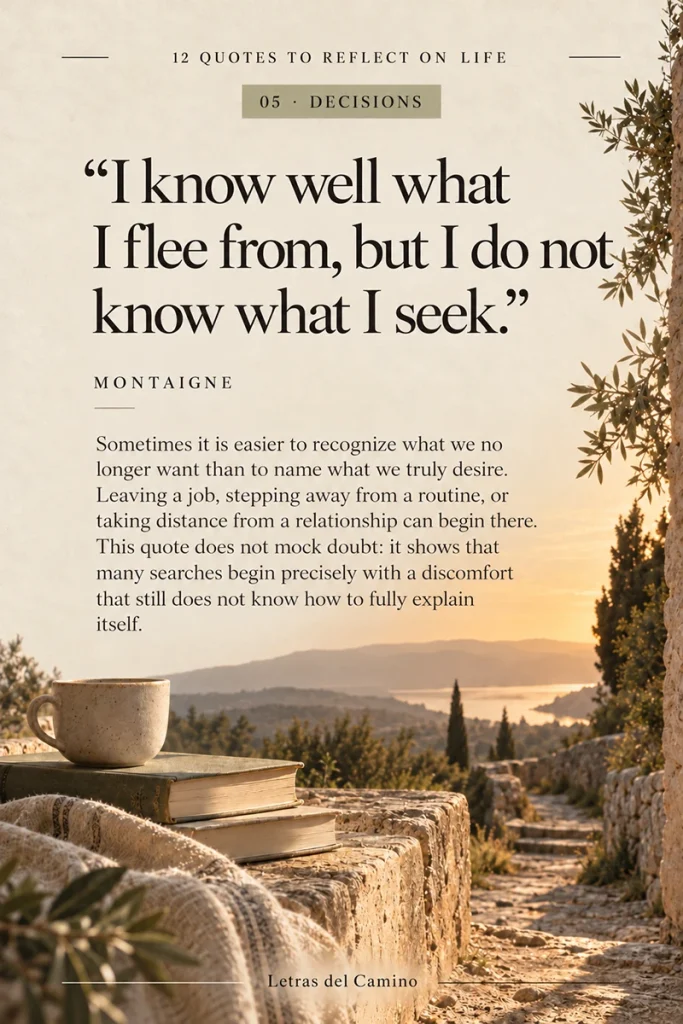
“I know well what I am fleeing from, but not what I am seeking.”
— Michel de Montaigne
Montaigne made this observation in his Essays while writing about his travels. It’s often easier to identify what makes us uncomfortable than to describe the life we’d like instead.
Perhaps you decide to leave a group because every gathering ends in an argument, but you still don’t know whether you want to meet new people or spend a while with fewer plans. Leaving may be a sensible decision even if you don’t know what comes next. Not knowing doesn’t make your discomfort any less real. What may help is separating two questions: why do you want to leave, and what do you hope to find beyond it? They don’t always have the same answer.
6. What is up to you, and what isn’t
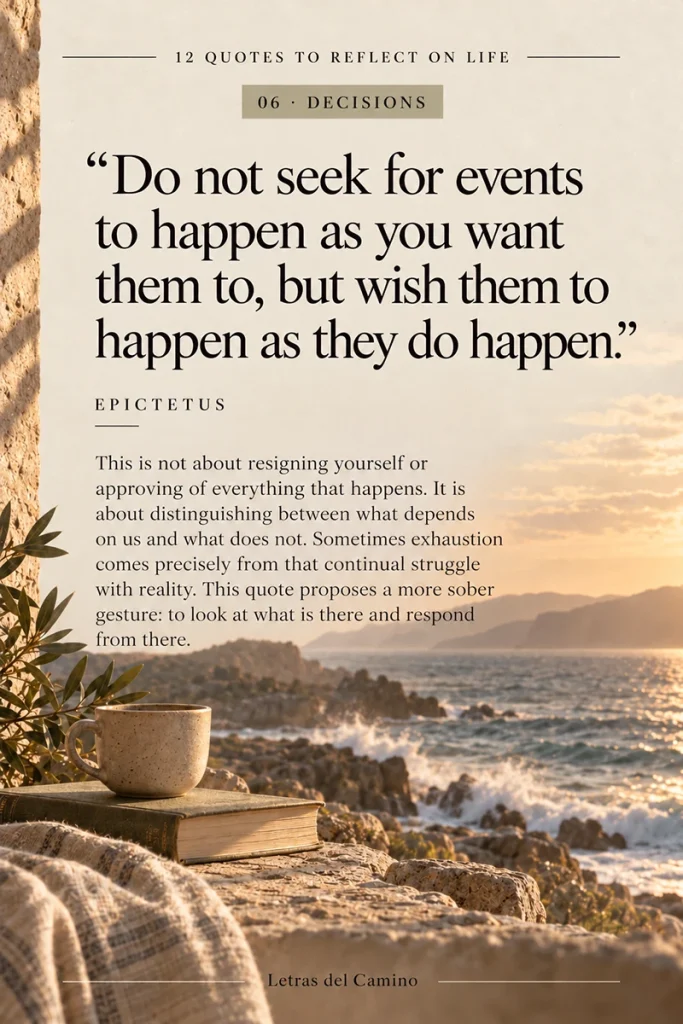
“Do not demand that events happen as you wish, but wish them to happen as they do.”
— Epictetus
In his Enchiridion, Epictetus asks us to recognise the limits of our control. We can’t decide what another person will think or guarantee that a project will go to plan. Read too quickly, his advice might sound like a call to put up with everything. That would be too narrow an interpretation.
You might carefully prepare an apology, only to find that the other person doesn’t want to talk. You chose how to approach them, but you can’t choose their response. You can try again later, wait or accept some distance. Not controlling the outcome doesn’t make the first gesture pointless. Nor does it mean you have to consider everything that happens fair.
A decision can be reasonable even when you don’t yet know how the story will end.
03 · RELATIONSHIPS
Three quotes about living together and what we expect of others
Good intentions are plentiful when it comes to other people. We want to help, offer the right advice and make those around us feel comfortable. The difficulty starts when someone needs something different from what we had planned to give.
7. Making life a little less difficult
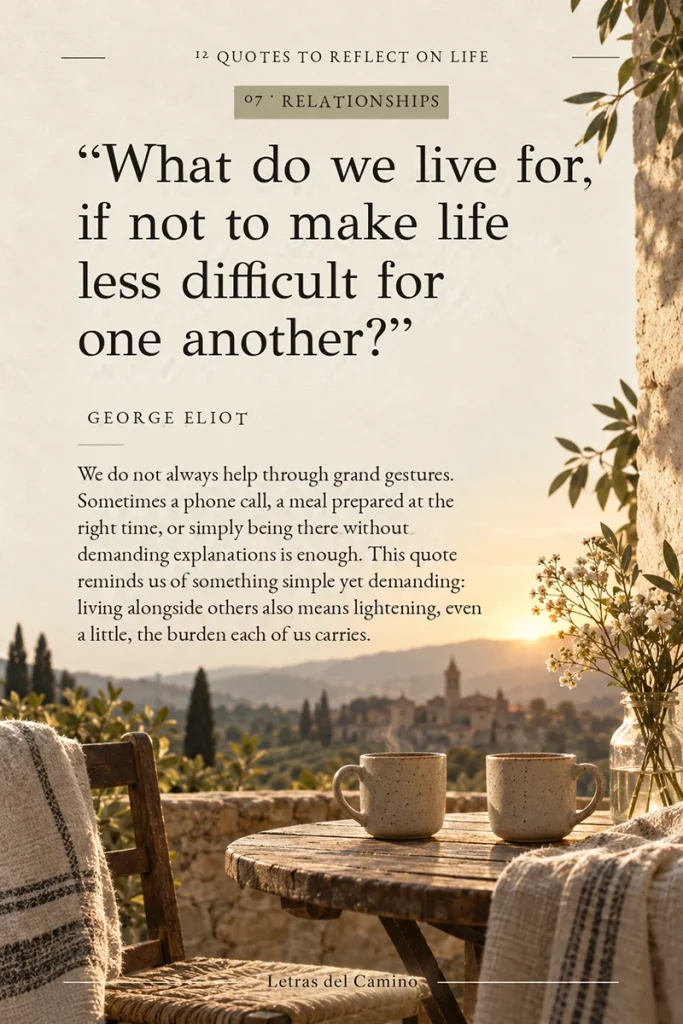
“What do we live for, if it is not to make life less difficult to each other?”
— George Eliot
In Middlemarch, these words appear when Dorothea defends someone whom others have been making assumptions about. It isn’t about fixing somebody else’s entire life. The first step is simply refusing to make it harder for them for no good reason.
Over a meal with friends, someone says a colleague has seemed distant for months. You could join in the speculation or point out that no one knows what she’s going through. You could also change the subject without making a grand statement. Sometimes helping means doing something visible; at other times, it means not repeating a story we haven’t even checked.
8. How readily we give advice
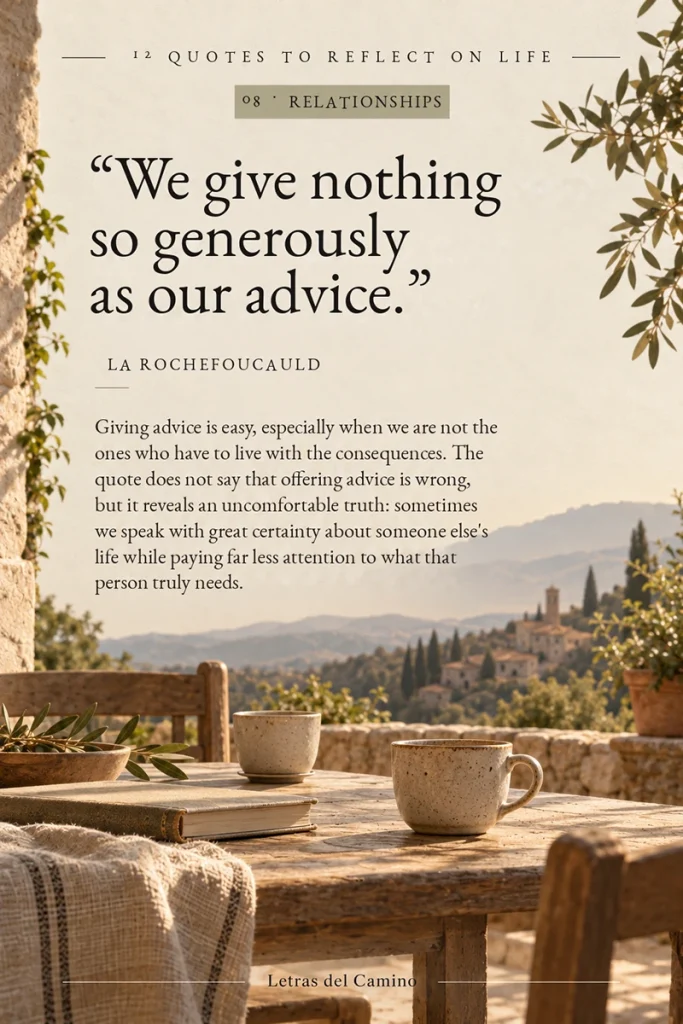
“We give nothing so freely as our advice.”
— François de La Rochefoucauld
In his Maxims, La Rochefoucauld pokes fun at a rather inexpensive kind of generosity: telling other people what they should do. It’s a sharp observation because we all recognise the urge to solve someone else’s problems from the outside.
A friend tells us she’s tired of handling all the household admin. Before she’s finished, we’ve suggested shared calendars, apps and a family meeting to divide up the chores. Perhaps one of those ideas would help. But maybe she just needed to tell someone about her day. Asking whether she’d like a suggestion or simply someone to listen can prevent quite a few misunderstandings.
9. When company can feel lonely too
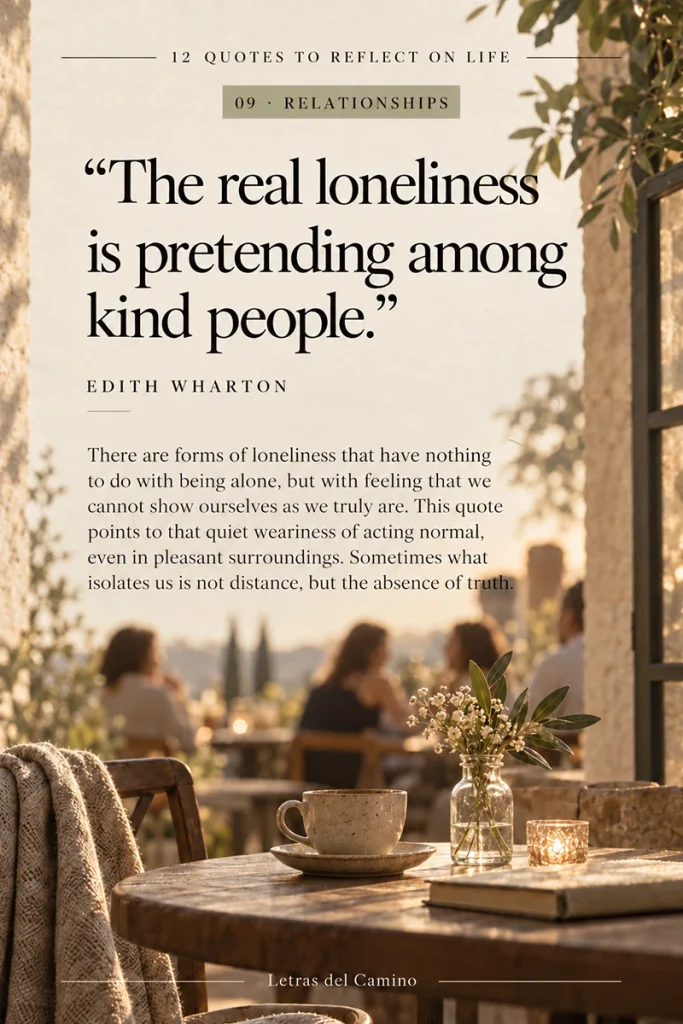
“True loneliness is pretending among kind people.”
— Edith Wharton
In The Age of Innocence, Edith Wharton portrays a society with impeccable manners but far less tolerance for people who don’t meet its expectations. Courtesy alone doesn’t guarantee that someone can speak freely.
Imagine someone who announces a promotion and receives congratulations at every family gathering. Everyone is delighted, while she still isn’t sure she wants to accept the new conditions. She doesn’t fear being insulted; she fears disappointing those who are so pleased for her. Sometimes expressing a different opinion is hardest among people who genuinely want the best for us.
A useful distinction: helping, advising and being there for someone aren’t the same thing. Sometimes practical action is exactly what’s needed; at other times, listening before offering a solution is the most considerate thing we can do.
04 · ORDINARY THINGS
Three quotes that find questions in everyday life
Not every quote worth reading twice is about a life-changing decision. An object we’ve kept, a skill we’ve learnt by watching someone or a sound that makes us look up can also change the way we see an ordinary afternoon.
10. What something costs and what it’s worth
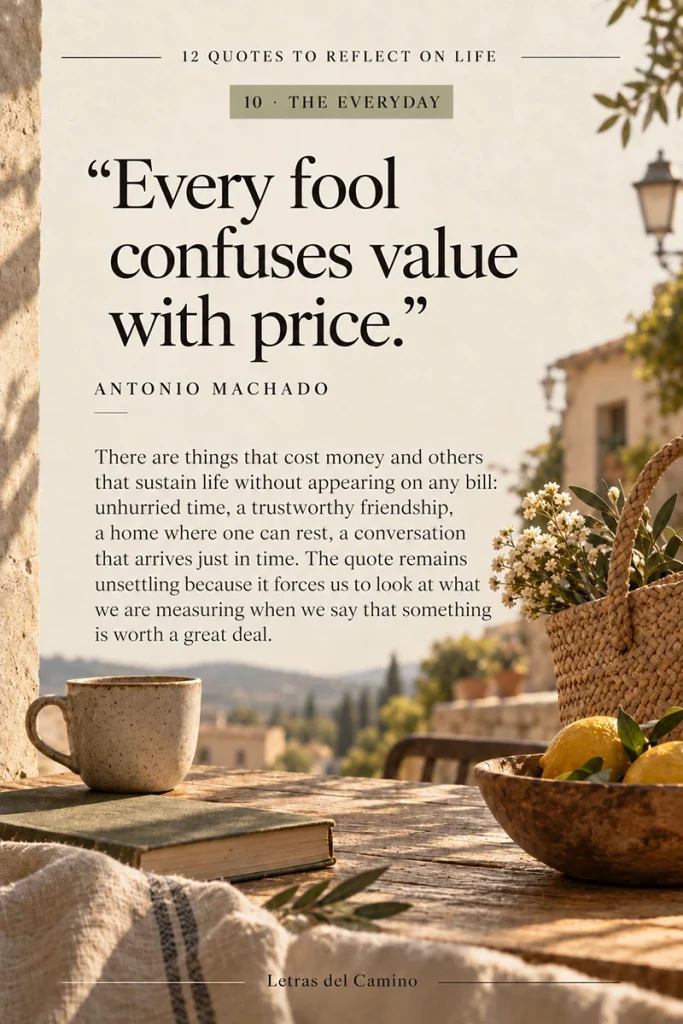
“Every fool confuses value with price.”
— Antonio Machado
In his Proverbios y cantares, Machado distinguishes between two measures we often mix up. A price can be printed on a tag; the value of something can also depend on memories, uses, relationships and circumstances that don’t fit into a number.
Some people keep a worn jacket from their first job, though they haven’t put it on in years. Someone else might see only a garment taking up space. The person who keeps it may remember a city, colleagues or the excitement of their first pay cheque. That doesn’t mean we must keep everything forever. It simply shows why two people might make very different calculations about the same object.
11. Intelligence belongs in the kitchen too
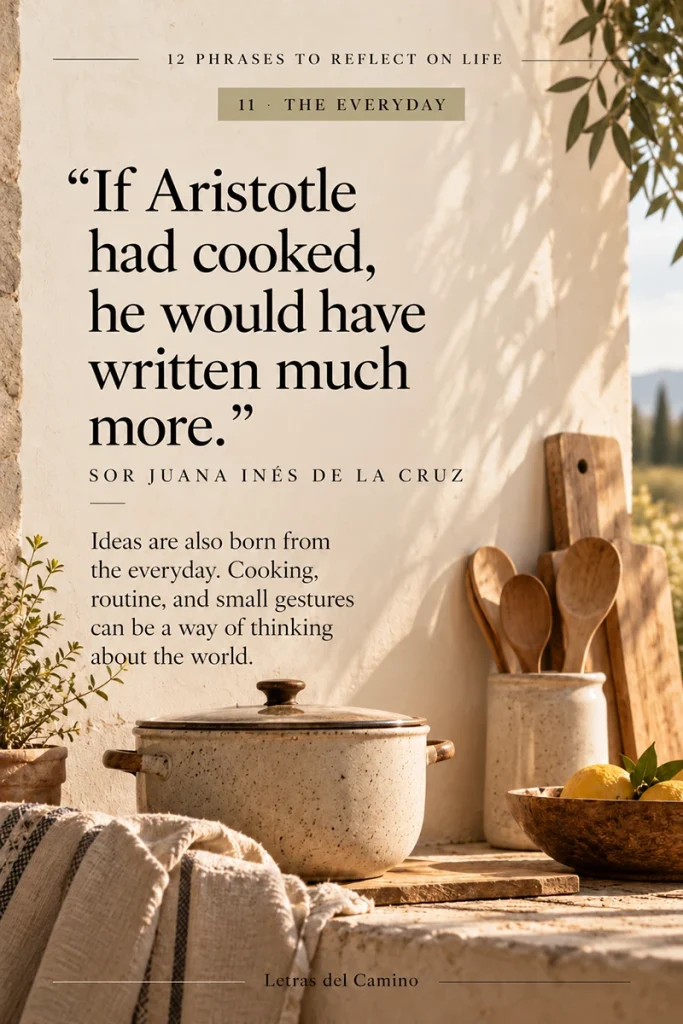
“Had Aristotle cooked, he would have written a great deal more.”
— Sor Juana Inés de la Cruz
Sor Juana wrote these words in her Reply to Sister Filotea of the Cross, recalling questions that occurred to her while cooking. Her irony is aimed at those who thought important knowledge could only be found in certain books and places.
It’s easy to recognise this when someone tries to teach us a recipe without exact measurements. “Until the dough feels right” can sound vague, but someone who has baked bread for thirty years can recognise things by touch that a beginner still has to learn. Every craft contains knowledge that takes time to put into words. Sometimes the person who does something best has never stopped to explain everything they know.
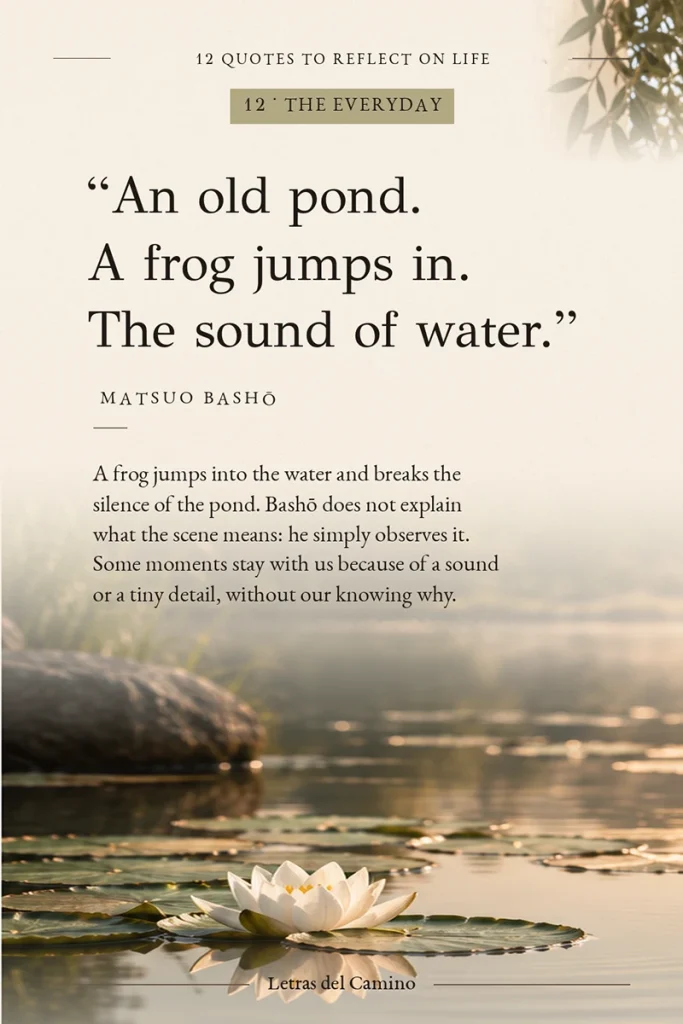
12. A sound in the middle of silence
“An old pond. A frog jumps in. The sound of water.”
— Matsuo Bashō
This haiku by Bashō does little more than describe a scene. It doesn’t tell us what to feel or tack a lesson onto the end. A pond, a frog, a sound: three details are enough for us to imagine a place and a moment.
Perhaps you remember something similar: waiting at a bus stop as leaves fall, hearing a shutter close across the courtyard, or watching a cloud briefly dim the light in your living room. These memories don’t have to be important. Sometimes they stay with us without asking for an explanation. The poem reminds us that simply noticing something can be enough.
AFTER READING THESE TWELVE QUOTES
They don’t all ask the same thing of us: some point to a contradiction, others to a decision, and others simply help us pay attention. You can choose one, argue with it or leave it unresolved. A quote doesn’t have to be right to be useful.
05 · TURNING TO WRITING
How to turn a quote into a personal reflection
We can love a quote and leave it at that: a line underlined in a book. If we want to write from it, it helps to bring things down to a smaller scale. Instead of trying to write about “life” in general, we look for a moment we know firsthand.
Montaigne’s line about knowing what we’re running from, for example, might bring to mind moving house, but also a conversation we’ve been avoiding or an activity we no longer enjoy as much as we once did.
1
Choose a quote that stirs something in you
It doesn’t have to be the prettiest one. It could be a line you disagree with, one that makes you laugh or one you remember without quite knowing why.
2
Find a specific situation
Think of a person, a place, a conversation or a recent choice. The clearer the scene, the less you’ll need to rely on general ideas.
3
Start by telling what happened
Include details: what you said, what the other person did and what happened next. You don’t need to explain the meaning of everything as you write.
4
Return to the quote, if you feel like it
See whether you understand it differently now. You may agree, disagree or leave the matter open. You’re not trying to prove the author right.
AN EXAMPLE OF PERSONAL WRITING
“I know well what I am fleeing from, but not what I am seeking”
For weeks I’ve been saying I want to quit my French classes. Every Wednesday I leave work late and resent having to rush to get there. Yesterday I skipped class and stayed home watching a film. I enjoyed the rest, but afterwards I missed talking with the others. I don’t think I want to give up French; I want to stop arranging my Wednesdays as if they were a race. I’ll ask whether there’s a Saturday group. If there isn’t, I’ll have to think it through again.
This entry doesn’t prove Montaigne was right, and it doesn’t end with a grand life lesson. It describes what happened, reveals a contradiction and considers a practical possibility. Personal writing can be that simple, even when the words that inspired it were written centuries ago.
One last suggestion: date what you write. If you return to the same quote in a few months, you may remember something different or discover that your opinion has changed. You don’t need to erase the first version.
TO KEEP REFLECTING
When a quote stays with you
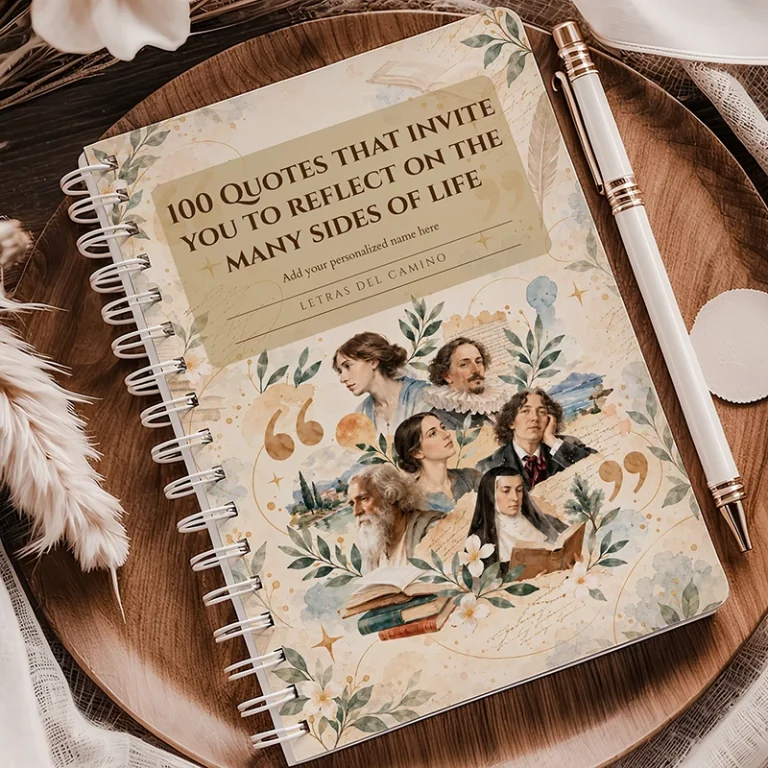
The journal 100 Quotes to Reflect on Life brings together one hundred quotations, each with context, a writing example and space to respond in your own words. You can work through them in order or open it at any page.