Breaking Away from the Flock: The Freedom to Choose Your Own Path

Some decisions seem to be ours for as long as they match what other people had in mind for us. Change direction, and an accusation suddenly appears that nobody had needed to make before: “You’ve become selfish.” An odd way to honour someone else’s freedom: applauding it until it becomes inconvenient.
Alfonsina Storni gave a voice to a she-wolf who broke away from the flock and headed for the mountains. The image suggests the courage it takes to leave, but it raises a less comfortable question too: are we free when we choose a different path, or when we no longer need the group’s approval of our choice?
IN THIS ARTICLE
01 · WHERE THE LINES COME FROM
Alfonsina Storni’s she-wolf: more than an act of defiance
The lines come from “La loba”, a poem by Alfonsina Storni published in La inquietud del rosal (1916), her first book. Born in Switzerland and raised in Argentina, Storni worked as a teacher and journalist. She wrote at a time when a woman who chose to live outside certain conventions had to offer explanations that were rarely demanded of men. Her experience as an unmarried mother is part of that context, but it does not define the limits of her work.
“I am like the she-wolf.
Alfonsina Storni, “La loba”, La inquietud del rosal (1916; translated here from Spanish, with the original spelling modernised)
I broke away from the flock
And went up to the mountain,
Weary of the plain.”
It is worth reading what surrounds those four lines. The speaker speaks of a child, the work by which she earns her living, and the looks of those who point her out. Her break is no elegant pose: it means sustaining an actual life under other people’s judgement. Storni also dedicates the poem to the memory of a friend identified by the initials J. C. P.; it would be hasty to read the poetic voice as a literally autobiographical confession.
One word in the passage is particularly revealing: weary. The she-wolf leaves, exhausted by rules that judge her for refusing the prescribed path. But the poem does not end with her exhaustion: the speaker also mocks the sheep and admits she enjoys frightening them. That sharp edge stops us from turning her into a flawless emblem of freedom. It reminds us that a justified break can coexist with the urge to defy those who have singled us out.
02 · BELONGING AND BOUNDARIES
Belonging without obeying: when affection comes with conditions
The flock has a poor reputation in metaphors about freedom. In real life, though, belonging to a family, a community or a circle of friends can mean support, shared memories and help on difficult days. Distrusting everyone does not make anyone more perceptive. The difficulty begins when closeness turns into an unspoken right to decide for somebody else.
Imagine a woman who has spent many afternoons helping her parents in their small shop. When she finishes her studies, she wants to move to another city. She never promised to take over the business, yet the people around her have imagined her future in such detail that her decision feels like a betrayal. Conversations about her move invariably become conversations about everything the family has sacrificed to keep the shop open.
Her mother fears losing the help she relied on; her father feels the shop carries a family history worth continuing. Those concerns deserve a conversation. The problem begins when they become an obligation the daughter never agreed to. All those afternoons behind the counter have come to resemble a contract nobody ever showed her before asking her to sign.
Now she has to prove she is not leaving out of selfishness, although nobody ever asked her to justify each time she chose to stay. She is not choosing between loving her family and living her own life; she is trying to prevent one from cancelling out the other.
01
The bond that supports
It may disagree with a decision and still respect it. It asks about the consequences without turning concern into an order.
02
The bond that keeps watch
It treats disagreement as ingratitude or disloyalty. Acceptance depends on your remaining predictable.
That does not make the people who advise us our enemies, either. Sometimes they see risks we have overlooked. The difference becomes clear once they have heard us out: a warning leaves room to think; an imposition demands that we stop.
03 · THE COST OF CHANGE
The cost of not fitting in: not every mountain comes at the same price
Breaking away from convention is often told as a tidy scene: someone discovers their truth, leaves and can finally breathe. What follows stays out of the picture. There may be a painful family conversation, a friendship whose tone changes, or the bewilderment of losing an identity that gave us security for years. Even the right choice can hurt.
Nor is group pressure distributed equally. Someone with savings, a home and a support network is not making the same kind of choice as someone financially dependent on the people they disagree with. Talking about courage without acknowledging that difference can turn a privilege into a moral lesson.
Not every break has to be sudden
Sometimes the first possible step is to set a small boundary, prepare a practical alternative or stop justifying every preference. Caution can protect a decision until it becomes sustainable; it is not always a form of surrender.
And feeling guilty after saying no does not prove we chose badly. We can miss someone’s approval and still believe the disagreement was necessary. Affection does not vanish on command when our priorities change, which is why autonomy rarely arrives accompanied by perfect peace of mind.
04 · THE PARADOX OF NONCONFORMITY
When disagreeing becomes another form of obedience
Some people need to know what the majority thinks before making up their minds. Others need to know too, but for an apparently opposite reason: they want to be sure they can take the other side. Both hand part of their judgement over to the group. The first to agree with it; the second to stand apart.
Rebellion can become a role that demands loyalty. Someone who has made independence their banner may feel obliged to refuse help even when they need it; to scorn a tradition they actually enjoy; or to cling to a mistaken opinion because changing their mind in front of others would feel like defeat. They have escaped one expectation only to settle into another, this time of their own making.
If you always need to oppose the group, it is still making your decisions for you.
Thinking for ourselves also includes the possibility of agreeing. We can keep a family custom because we like it, accept advice after weighing it up, or admit that someone we often disagree with was right. None of that makes us less free. Having to be exceptional on every occasion is exhausting; sometimes even the self-proclaimed enemy of the flock ends up working full-time to maintain that image.
05 · THINKING BEFORE CHOOSING
How to recognise a choice of your own, beyond approval or rejection
There is no infallible test of whether we are acting freely. We live among attachments, duties and circumstances that shape what we want; it would be strange if an important choice were entirely untouched by them. The question is whether we can recognise those influences and decide how much weight to give them.
A personal decision need not be comfortable or incomprehensible to everyone else. Its most important quality is different: being able to explain our reasons without simply repeating what others expect of us, or boasting that we are against everyone.
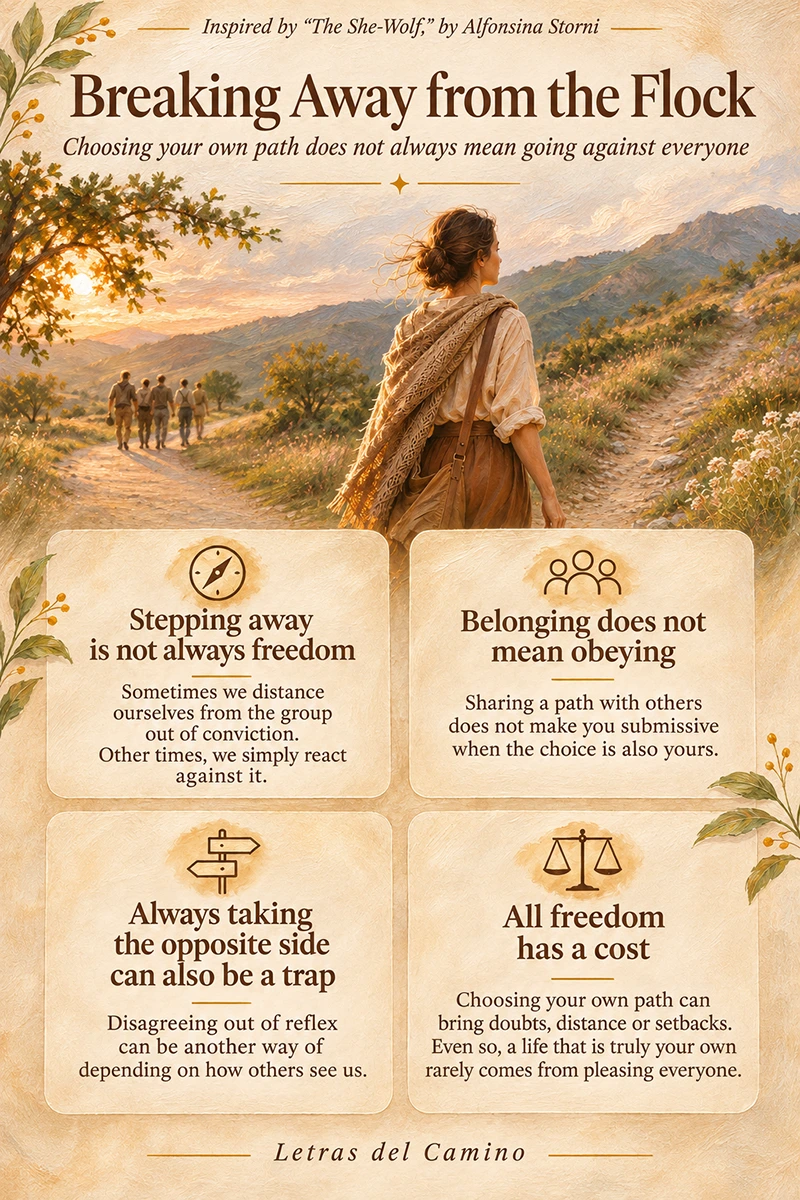
Our relationship with a group has more than two possible forms. We can belong and still choose for ourselves; we can also be physically far away and remain preoccupied with what others think. Distance does not guarantee autonomy, just as closeness does not necessarily mean submission.
That is why proving we are different matters less than understanding where each response comes from. A decision gains in integrity when we allow ourselves to reconsider it without feeling that we have betrayed a part we were playing.
Before a difficult choice, it can help to put a few questions on paper. They are not meant to deliver an instant verdict, but to untangle motives that become confused when we want to keep someone’s affection while living in accordance with what we believe.
- If nobody knew what I had chosen, would I still want to do it?
- Am I acting from conviction or reacting to a provocation? What actually happened to make me want to change course?
- What consequences am I prepared to accept? Which would I need to prepare for more carefully before acting?
- If I discovered tomorrow that I was wrong, could I change my mind without feeling that I had lost my identity?
Answering these questions cannot guarantee that we will get it right. But it helps us distinguish a dramatic gesture from a considered decision, and avoid calling every well-founded delay cowardice.
06 · A WAY OF BEING IN THE WORLD
A freedom that needs no enemies
We often imagine independence as a landscape empty of other people. Yet even those who choose to step away still need relationships, conversation and somewhere they need not defend themselves every minute. Solitude can be a valuable choice; making it a condition of authenticity would be yet another rule as arbitrary as the last.
Perhaps the hardest change is not leaving an entire group, but changing how we remain within it. Someone learns to speak to their parents without asking permission to live; someone returns to a gathering without pretending to share every opinion; someone discovers that disagreement need not end in a permanent break. Staying can be a free choice too, once we know where our boundaries lie.
A QUESTION TO WRITE ABOUT
What decision are you still defending because you do not want to disappoint someone?
Separate what that person has actually asked of you from what you imagine they expect. Then write down what you would need in order to choose more clearly.
In Storni’s lines, the she-wolf leaves, weary of the plain. That weariness deserves to be heard, but it does not oblige us to idealise the mountain. Going away can make room for thought; staying can make it possible to change a relationship from within. Neither movement, on its own, proves courage or insight.
Freedom begins to feel like our own when we can choose our direction without waiting for applause and, above all, without needing an audience to defy.
TO KEEP REFLECTING
100 quotations to think about in writing
A quotation can open questions that resist a quick answer. This guided journal brings together literary voices and space to explore them through your own experience.