
14 Common Mistakes When Keeping a Personal Journal

When you start keeping a personal journal, it is easy to think you have to write everything down, remember every detail, write with almost military consistency, and somehow do it all with a clarity you often do not even have in your own head.
And that is where the problem can begin. Your journal stops being helpful and turns into one more thing you have to keep up with, as if you were accountable to someone, when it should really do the opposite: help you slow down, listen to yourself, and better understand what is happening to you.
Some mistakes come up again and again: trying to write too much, doing it out of obligation, using your journal only to vent, trying to make your writing sound beautiful, censoring yourself, comparing yourself with other people, or thinking that using a little guidance somehow means you are doing it wrong.
But perhaps one of the most interesting mistakes is another one: not being completely honest even when you are writing only for yourself. In a space where no one corrects you, no one judges you, and no one even has to read what you write, you can still end up creating a more comfortable version of what you really feel.
IN THIS ARTICLE
01 · WHEN IT STARTS TO FEEL HEAVY
Why so many people start a journal and then give up
Many journals are abandoned for a very common reason: we start with too many expectations.
We buy a notebook, promise ourselves we will write every night, review the entire day, organize our emotions, pull out meaningful lessons, and maybe even do it all in neat handwriting. By the third or fourth entry, what seemed like a pleasant idea starts to feel suspiciously like an obligation.
Usually, the problem is not the person so much as the approach. It is like going to the gym for the first time and trying to do everything at once. The problem is not that you lack consistency. It is that you created a routine that was difficult to sustain from the beginning.
A journal is not a time clock at the office.
Not writing for two days does not cancel what you wrote before, and it does not stop you from returning when you need it again.
There will be periods when you feel a stronger need to write and others when almost nothing comes up. There may even be weeks when all you want to record is one brief anecdote.
The problem begins when you interpret every gap as evidence that you failed.
Something else can happen too: writing starts to feel uncomfortable. At first, easy topics tend to appear—what you did, something that annoyed you, a plan—but sooner or later something comes up that you do not really want to look at too closely.
And perhaps at that point the real problem is no longer a lack of time or inspiration. Maybe your journal was beginning to get close to something you were not ready to examine yet.
02 · A PLACE TO LISTEN TO YOURSELF
Your journal is not an obligation: it is a place to listen
A journal starts to work when it stops feeling like an assignment you have to turn in.
If every time you open it you feel that you have to justify the day, explain everything that happened, reach a neat conclusion, and finish with something insightful, it is only natural that you eventually get tired of it.
Keeping a journal should feel more like talking to someone who does not interrupt you, correct you, or expect you to be consistent all the time.
Some days you may only need to write one sentence. Other days, three pages may come out. And on some days, nothing at all may appear.
Your journal is not there to monitor you. It is there to give you a place to observe what is happening to you without having to make it look better than it really is.
A useful journal does not need to prove anything. It only needs to give you permission to say what you may not yet know how to express any other way.
03 · WHAT OFTEN MAKES IT HARDER
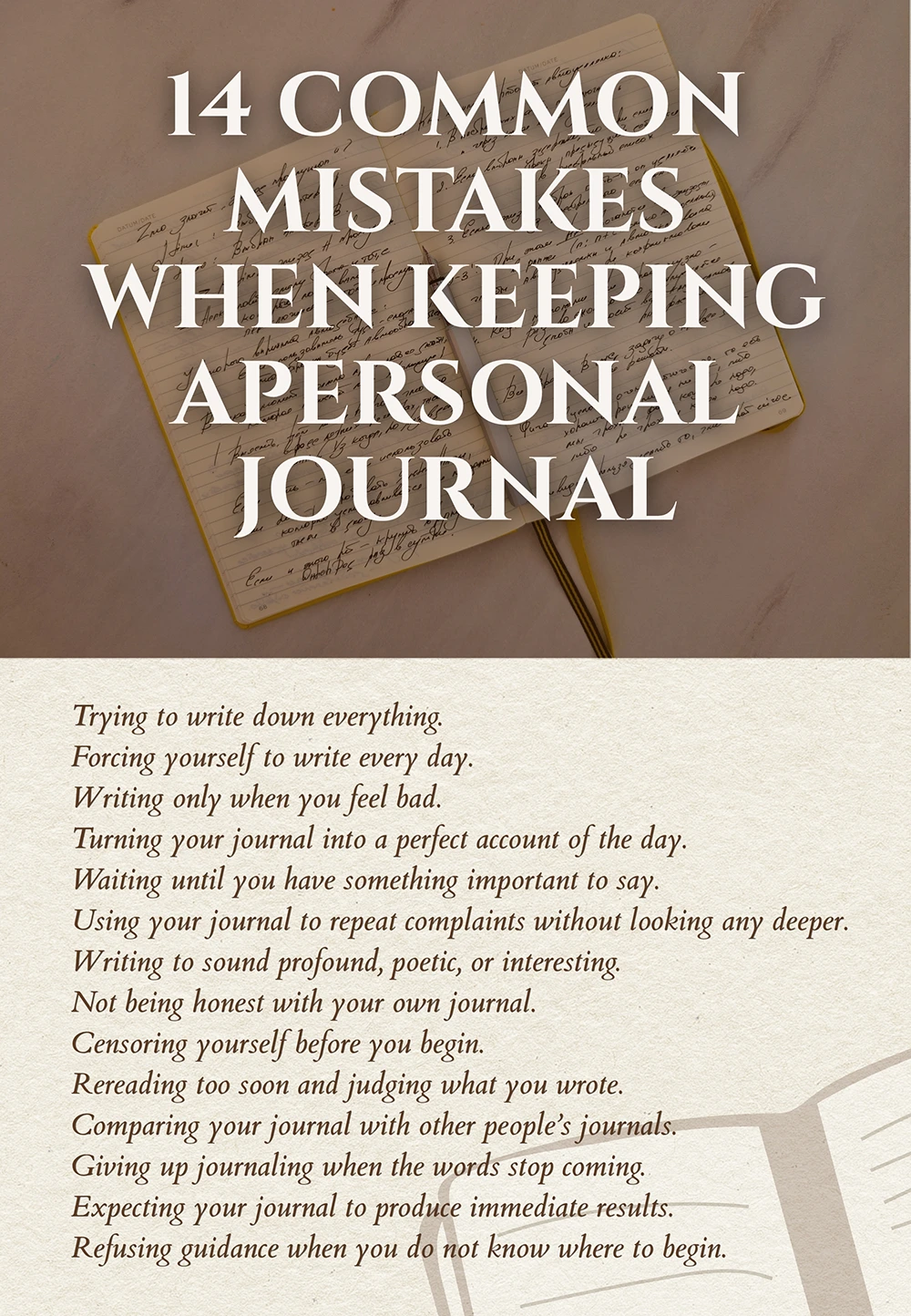
14 common mistakes when keeping a personal journal
Not everyone makes all of these mistakes, and they do not all matter in the same way. Some simply make writing feel tedious. Others can turn your journal into a place where you keep repeating the same version of what is happening.
The point is not to avoid every mistake from day one, but to recognize them when they appear.
1. Trying to write everything down
One of the most common mistakes is trying to fit your entire day into your journal, as if every conversation, thought, and small detail had to be recorded.
That quickly becomes exhausting because writing turns into a kind of inventory.
You might begin by saying that you woke up late, rushed through breakfast, the bus was crowded, you had a meeting, ate pasta, called your mother, and watched a show. By the time you finally reach the thing that actually affected you—maybe something someone said in that meeting—you no longer feel like going deeper.
You do not need to summarize your day. Sometimes one reaction, one conversation, or one specific doubt contains far more than twenty events written down in order.
2. Turning your journal into a perfect record of the day
Some people write as if they were preparing the official summary of their own lives. Everything is organized, explained, and neatly wrapped up from beginning to end.
But life rarely arrives that well organized.
✕
The polished version
“Today I had a small disagreement, but everything is fine.”
✓
The more honest version
“I stayed quiet because I did not want to make a scene, but I am still angry.”
The second sentence may not sound as elegant, but it will probably be much more useful to you.
Your journal does not need to make the day look good. It needs to help you see it more clearly, even if that clarity is still incomplete.
3. Forcing yourself to write every day
Consistency can help, but turning it into a rigid rule often ends up working against you.
Many people start by promising themselves they will write every night. They miss two days in a row, decide they have broken the habit, and end up giving it up completely.
It is like missing one day at the gym and deciding there is no point going back.
Not writing on Tuesday does not erase what you wrote on Monday or stop you from coming back on Friday. Sometimes four lines written after a week can offer more than seven entries written only because you felt obligated to do it.
4. Waiting until you have something important to say
Another common mistake is thinking that journaling is only worthwhile when something major happens: a breakup, a trip, an important decision, or a particularly difficult period.
But many of the things that eventually affect us begin in much quieter ways.
- Feeling nostalgic after seeing an old photograph.
- Noticing that a friend’s comment bothered you more than usual.
- Realizing that you have been saying “I’m fine” for weeks without even thinking about it.
- Noticing that something you used to enjoy is starting to feel like a chore.
All of that can have a place in your journal too. If you always wait for a big topic, you may notice too late that something had already been shifting inside you for a while.
5. Writing only when you feel bad
Your journal can be a good place to vent, but if it only appears when everything is going wrong, it can become associated entirely with distress.
You open it and it feels as though it is time to worry, complain, or analyze what is not working.
It is also worth writing when something went well, when you felt calm, or when you simply had a pleasant day.
Maybe today you laughed through a meal without looking at your phone, took a peaceful walk, someone did something thoughtful for you, or you managed not to react the way you normally would. What is going well is part of your life too.
6. Repeating the same complaints without looking deeper
Complaining in your journal can bring relief. The problem begins when every entry becomes a new version of the same frustration:
“My boss does not appreciate me.”
“My partner does not understand me.”
“My family always does the same thing.”
“Everything goes wrong for me.”
There may be some truth in all of those statements, but if you never go any further, your journal can turn into an echo chamber.
TRY GOING A LITTLE FURTHER
- What part of this can I change?
- Why does this affect me so much?
- What am I avoiding saying?
- What would have to change for me to stop repeating this situation?
This is not about blaming yourself. It is about avoiding getting stuck in the same paragraph for months.
7. Writing to sound deep, beautiful, or interesting
This mistake is more common than it seems. You start writing and suddenly use a tone you would never use even when talking to your best friend.
…
“I felt the absence of other people’s consideration disturb the stillness within me.”
✓
“I was angry that they did not tell me.”
The first sentence may sound deeper, but the second probably says far more accurately what actually happened to you.
Your journal does not need to impress anyone. Sentences like “I’m fed up,” “I felt embarrassed,” “I do not know why I said yes,” or “I wish I had left earlier” can open far more doors than a beautifully written paragraph.
8. Not being honest with your own journal
This is one of the strangest mistakes because, in theory, no one is watching. And yet we can still lie to ourselves.
We minimize what we feel, dress up our decisions, or justify things that deep down we know do not really hold up.
You might write, “I did not care that they did not invite me,” and then spend the whole afternoon looking through photos to see who was there. Or you might write, “I decided to end the relationship because it was for the best,” when in reality the other person was the one who left and you still do not know what to do with the anger.
Being honest does not mean punishing yourself.
It means trying to stop performing in front of yourself.
9. Censoring yourself before you even write
Sometimes the censorship appears before the first sentence:
“This is stupid.”
“I should not feel this way.”
“I am overreacting.”
“I’d better not write this down.”
And then your journal ends up missing exactly the thing that might have been most interesting to observe.
This can happen with envy, resentment, contradictions, or emotions that do not feel especially presentable. You can love someone deeply and still feel jealous. You can be genuinely happy for a friend and still feel behind when you compare yourself with them.
Writing something down does not turn it into a permanent truth. It simply allows it to appear so you can look at it more clearly.
10. Rereading too soon and judging what you wrote
Rereading immediately can interrupt the process. You start checking whether it sounds good, whether you repeated yourself, whether you were too dramatic, or whether what you wrote seems childish.
And you end up editing your journal as if it were an assignment someone was going to grade.
Some entries need time to settle. Something that seems exaggerated today may teach you something two weeks from now. And a sentence that embarrasses you today may simply seem human a month from now.
Not everything needs an immediate review. Sometimes writing is enough. You can come back later, when you have a little more distance.
11. Comparing your journal with other people’s journals
Social media has created a very specific image of what a journal is supposed to look like: perfect notebooks, beautiful handwriting, matching highlighters, spotless pages, habit trackers, motivational quotes, and carefully arranged drawings.
And suddenly your journal full of crossed-out words seems somehow less valuable.
A useful journal is not always beautiful. It can contain messy lists, unfinished sentences, repeated words, a coffee stain, or “I do not know what is wrong with me” written three times.
Comparing yourself with a journal designed to be photographed means losing sight of the point. Yours does not need to look good in a picture. It needs to be useful to you.
12. Giving up when your journal feels silent
There are moments when you open your journal and do not know what to write. Nothing seems important, everything sounds repetitive, or you simply do not feel much like listening to yourself.
That silence can feel like a sign that journaling no longer works, but often it is simply a normal part of the process.
IF YOU DO NOT KNOW WHAT TO WRITE TODAY
- What tired me out today?
- What brought me some relief?
- What am I avoiding?
Or simply write: “I do not know what to say today” and continue from there if something begins to appear.
13. Expecting your journal to be useful immediately
Many people expect quick results: write for three days and feel more organized, calmer, or more confident.
But a journal does not work like a switch.
Sometimes it helps in the moment. Other times, it seems as though nothing is happening and then, a month later, you look back and discover that you mentioned the same concern five times in different words.
Then something begins to appear that you had not seen before: a pattern, an excuse, a need, or a recurring fear.
Part of the value of journaling appears precisely over time, when what once looked like simple disorder begins to take on a shape.
14. Refusing guidance when you do not know where to start
Some people reject guided journals because they feel that writing should always come completely spontaneously.
But that does not always happen.
Sometimes one question, one opening sentence, or a little direction can keep you from spending ten minutes staring at a blank page.
?
What am I putting up with simply out of habit?
?
What conversation am I putting off?
?
What part of myself am I struggling to accept?
A question does not make your writing any less authentic. You still decide what to answer, how deeply to go, and where to take the reflection.
04 · REMOVE THE PRESSURE
How to make journaling easier
After reading through so many mistakes, journaling may sound more complicated than it did at first. In reality, the idea is exactly the opposite: remove some of the pressure.
IN A NUTSHELL
- You do not need to write every day.
- You do not have to record everything that happened.
- A short entry still has value.
- Do not write only when you feel bad.
- Let uncomfortable thoughts appear without judging them too quickly.
- Do not try to make your journal sound beautiful.
- Rereading can be useful, but it does not always need to happen immediately.
- A guided question can help when you do not know where to begin.
Keeping a journal should not become another way to demand more from yourself. We already spend enough time trying to do so many things correctly without making our notebook demand punctuality, depth, and good handwriting too.
An entry can be short, messy, awkward, repetitive, or even uncomfortable. It can begin with an ordinary sentence and end somewhere you did not expect. It may mean nothing special to you today and make perfect sense when you return to it months from now.
A useful journal is not the one that looks best. It is the one that lets you listen to yourself without performing.
IF YOU NEED SOME GUIDANCE
Start with a question
You do not always need to know what to write before you begin. One simple question can be enough to open a reflection that would never have appeared while staring at a blank page.