What to Write in a Personal Journal: 30 Ideas and Realistic Examples

You open your notebook, take the cap off your pen and suddenly have nothing to say. You wanted to start keeping a journal, but facing the blank page makes it seem as if nothing worth mentioning happened today. There was work, messages, shopping and a conversation or two. Still, you cannot find a place to begin.
The difficulty often lies in thinking that a journal needs important events. You can write about an ordinary afternoon, a decision you keep putting off, something you overheard or a memory that turns up uninvited. Your entry does not have to end with a lesson.
If you are wondering what to write in a personal journal, you will find 30 ideas arranged by theme. Each comes with an explanation and a first-person example showing how a page can begin without becoming a grand declaration.
The examples are original, fictionalised everyday situations, not excerpts from private diaries or accounts collected from other people. Use them as starting points, change whatever you need and write in your own words.
IN THIS ARTICLE
01 · BEFORE YOU BEGIN
Your day does not have to be interesting to write about it
Some journal entries describe a move, a goodbye or a big piece of news. Others are about building work outside, the smell of a family meal or a trip to the supermarket that took an unexpected turn. Writing is less about the scale of an event than the attention you give it.
When you do not know what to put down, a specific suggestion usually works better than being told to “write about your life.” The next thirty ideas cover five areas: everyday events, feelings, relationships, decisions and memories.
| Where to start | Ideas | What you might write about |
|---|---|---|
| An ordinary day | 1–6 | Scenes, surprises and objects |
| Feelings and worries | 7–12 | Reactions, doubts and happy moments |
| People and relationships | 13–18 | Conversations, gestures and connections |
| Decisions and habits | 19–24 | Changes, mistakes and priorities |
| Memories and the future | 25–30 | Places, photographs and plans |
TO START A PAGE
A useful rule: begin with what you saw, heard or did. You can think about what it means later. An entry can end simply because you have reached the end of the scene.
02 · 30 IDEAS TO WRITE ABOUT
What to write in a personal journal: 30 ideas to try
Choose an idea that fits your day or pick one at random. These are not assignments, and you do not have to complete one in a single sitting. The examples show what an entry might sound like, with people, places, dates, doubts and thoughts that never quite reach a conclusion.
1. Everyday life: nothing extraordinary required
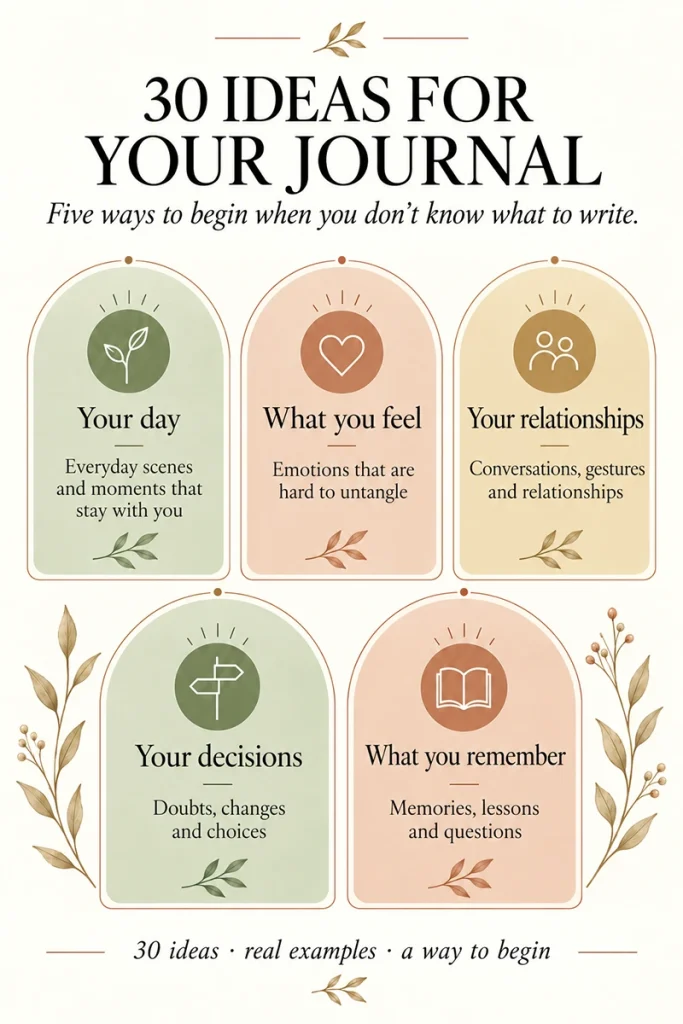
Your journal can begin very close to home: in the kitchen, on a journey or in a conversation you had today. You do not need to recover the whole day or tell it in order. Choose one scene and stay with it long enough to remember the details.
These first ideas are for days when it seems, at first glance, that you have nothing to write about.
1. Tell the story of an ordinary day without calling it “the usual”
Start with a simple route through your day: leaving home, seeing someone, having lunch or getting distracted. When you reduce everything to “work and errands,” the scenes disappear. Choose two moments and spend a little time with them.
Example journal entry: “I missed the bus this morning because I was looking for a key that turned out to be in my coat pocket. Nothing much happened at work. On my way home I bought some tangerines, then ate dinner standing in the kitchen with the radio on. Writing it down now, I think the best part was those twenty minutes when nobody needed anything from me.”
2. Describe a moment you wish had lasted longer
Maybe it was a conversation cut short by the lift doors or a family lunch interrupted by other plans. Describe what was happening and why you wanted to stay. You do not have to turn it into an important life event.
Example journal entry: “Dad started telling me about his first job, but just then my phone rang and I said I had to leave. He never got past the bit about a colleague everyone called the Frenchman. I kept thinking about it all afternoon. I’ll ask him on Sunday how the story ended.”
3. Write down something that surprised you today
An unexpected response, news from your neighbourhood, an unfamiliar word or something another person can do might give you an opening. Try to describe what you thought would happen and what happened instead.
Example journal entry: “I was sure the bookshop on the corner was closing. The shutters were down and there were boxes outside. It turns out they are expanding. I was absurdly pleased for someone who goes in there about once every two months. I suppose I just like knowing it is still there.”
4. Write about what changed your plans
An interruption can make for a funny story, a frustration or a pleasant surprise. Take it from the original plan through to how the day actually ended. There is no need to draw a lesson from it.
Example journal entry: “We had arranged to walk along the beach, but the rain started as soon as we parked. We took shelter in an almost empty café and spent two hours talking about houses we would never move into. The rain never let up. We never went for the walk, and neither of us particularly minded.”
5. Record something you have finally finished
Some tasks occupy your thoughts for weeks and take half an hour to sort out. Recording when you finished one helps you remember what came before the result. It might be paperwork, a repair or a conversation you had been avoiding.
Example journal entry: “I finally took my bike to the repair shop. I’ve been saying “I’ll call tomorrow” since June. The mechanic adjusted the brake right in front of me and it took less than ten minutes. I walked home with the bike, feeling rather embarrassed that I had put it off for so long. Still, it feels good to see it back in its place.”
6. Choose an object and explain why you still have it
An entry can begin with something close at hand: a chipped mug, a ticket inside a book or an old set of keys. Describe the object before you tell its story. Sometimes the memory arrives while you are looking at it.
Example journal entry: “I have a blue mug with the glaze worn away around the rim. I bought it on my first holiday alone and it was never particularly beautiful. I use it for Saturday coffee. When my brother comes over, he asks why I don’t throw it away. I can’t really explain that I like it because it is worn.”
If you cannot get started: begin as if you were telling a friend on the phone: “Something happened today…” You do not need a literary opening.
2. Feelings, worries and moments worth remembering
Writing about your feelings is not just a matter of naming an emotion. Sometimes the situation behind it tells you more: what happened, how you responded and what you still cannot quite explain.
7. Write about something that made you angry, without stopping at “I was angry”
Describe the moment as precisely as you can: what the other person said, what you expected and when the mood changed. You might find other feelings mixed in, or you might still just be annoyed. Both belong in a journal.
Example journal entry: “I was irritated when they moved the meeting at the last minute. My first thought was that nobody respects anyone else’s time. But I’m also annoyed with myself for saying “no problem” when it really did cause me trouble. I spent the rest of the morning replying to emails in a terrible mood.”
8. Put a recurring worry into words
When the same concern keeps returning, writing down the facts can help separate what has happened from what you are imagining. You do not have to solve it on the same page; you can leave several questions unanswered.
Example journal entry: “I keep thinking about Thursday’s conversation with my manager. She said they would review everyone’s responsibilities in November. That is what I know. The rest—that my hours might change, that someone might lose their job—is guesswork. Tomorrow I’ll ask whether there’s a date for discussing it. For now, I’m writing whole imaginary stories in my head.”
9. Remember a happy moment you nearly overlooked
Good things do not always arrive as celebrations. Some happen in the middle of a day crowded with other tasks. Look for a specific moment of pleasure, even one you never mentioned to anyone.
Example journal entry: “The plant on the balcony has grown a flower after doing absolutely nothing for months. I spotted it while hanging out the towels and stared at it for a ridiculous amount of time. I haven’t told anyone, because what would I say? “Guess what, the plant has flowered.” Still, it made my morning.”
10. Describe how you notice tiredness before admitting it
Rather than writing “I’m exhausted,” look for the signs: losing track of words, finding noise unbearable or cancelling plans. Recounting a particular afternoon may show you when you started needing a rest.
Example journal entry: “Today I had to read the same message three times before I understood it. Then I opened the fridge and stood there without knowing what I wanted. I thought I’d put on a film, but even choosing one felt like too much. I think I’ve been sleeping less than I admit. I’m not finishing that chapter tonight.”
11. Write about two feelings that arrived together
You can be happy for someone and envious at the same time, miss a period of your life while being glad it ended, or want a change while fearing the loss of stability. You do not have to explain the contradiction perfectly. Just describe when it happened.
Example journal entry: “Marta has been offered the job she wanted, and I was genuinely delighted when she told me. Then I hung up and felt sad, which annoyed me. I don’t want her job. I think it reminded me that I’ve been talking about making a move for months without doing anything. Both feelings are real.”
12. Recall a time when you felt comfortable with yourself
You do not have to fill every page with what is weighing on you. An afternoon when you solved a problem, a conversation you handled calmly or an hour spent doing something you love deserves recording too.
Example journal entry: “Yesterday I fixed the hallway lamp using a fairly terrible video tutorial. It took an hour and a half, I lost two screws and found one under the sofa. When the light came on, I stood there grinning to myself. It had been ages since I had finished something with my hands. I liked that feeling.”
Something to keep in mind: if writing about something makes you increasingly distressed, you can change the subject, stop or talk to someone you trust. Keeping a journal does not mean forcing yourself to revisit painful experiences.
3. People and conversations that stay with you
Much of our time is spent exchanging messages, talking, falling silent and making plans with other people. Some relationships deserve a page now and again, even when there has been no argument or special occasion.
13. Reconstruct a conversation you still remember
You do not need to reproduce every word. Recall where you were, a line that stuck with you and what you thought afterwards. If you cannot remember the precise wording, do not invent a flawless quotation. Tell it as you remember it now.
Example journal entry: “I ran into my old music teacher at the supermarket. She recognised me before I recognised her and asked whether I still played. I said hardly ever. She laughed and said something like, “You can always pick things up again.” When I got home, I opened the cupboard where I keep my guitar. I didn’t take it out, but I spent a while looking at its case.”
14. Write a message you do not intend to send
Some things make more sense once written, even when nobody will ever read them. You can address someone directly, begin with “I wanted to tell you” and change your mind halfway through. You are not preparing a final speech.
Example journal entry: “I wanted to tell you that I didn’t like the joke you made in front of everyone. I laughed at the time because I couldn’t think what else to do. I don’t think you meant to hurt me, but I don’t want that to happen again. I still don’t know whether I’ll say anything. I needed to write it down first without being interrupted.”
15. Thank someone for something specific, without making a grand declaration
An everyday action often says more than “thanks for being there.” Describe what someone did, when it happened and why you remember it. Afterwards, you can decide whether to share those words or keep them in your notebook.
Example journal entry: “On Tuesday Lucia dropped off a container of lentil stew because she knew I had a fever. She didn’t stay long: she left the bag at the door, asked whether I had any painkillers and went to work. It reminded me of Mum doing the same when we lived together. I still need to give Lucia her container back.”
16. Describe a disagreement that ended differently from what you expected
We often remember arguments in terms of who was right. Try another angle: what each person wanted, what became clearer and what remained unsettled. You do not have to take anyone’s side.
Example journal entry: “I thought our holiday argument would end in silence again. This time I explained that booking everything months in advance makes me anxious, and she said she didn’t want to arrive somewhere with nowhere to stay. In the end we booked two nights and left three open. It still feels too organised to me, but at least we listened to each other.”
17. Describe a routine you share with someone
Relationships are built partly out of habits: a call on the way to work, Friday films or a monthly coffee. You might write about how the ritual began and what has changed since.
Example journal entry: “My sister sends me a photo of her dog every Monday. It started as a joke after I said he looked like a tired office manager. Now Mondays without the photo feel strange. Today he was sitting in front of the oven as though supervising dinner. I replied with the same photo I always send of my breakfast.”
18. Remember something you learned by watching another person
It does not have to be a major life lesson. Maybe you saw someone apologise without making excuses, bargain at a market or really listen. Describe what they did first, then what struck you about it.
Example journal entry: “At the residents’ meeting, Omar let even the man who had been complaining about the entrance for ten minutes finish speaking. Then he asked what specific repair the man was suggesting. The whole conversation changed. I was already getting ready for an argument. I hope I remember that question next time.”
A remembered conversation is not a transcript. It is the version of events you carry with you today.
4. Decisions, habits and changes of mind
A journal can also record the way you choose. What you put off, the things you keep insisting on and the decisions you make out of habit often say more than a list of goals.
19. Put a decision you have been postponing on the table
Write down your actual options, rather than those that appear only when you imagine the worst outcome. You can separate what appeals to you, what concerns you and what you still need to find out.
Example journal entry: “I still haven’t decided whether to take the photography course. I’m interested, it’s expensive and it ends at nine at night. I’ve spent weeks telling myself I probably won’t have time, without even checking my calendar. Today I found out it’s just six Thursdays. The money is still a question; the schedule, not so much.”
20. Notice what you do when you are avoiding a task
Procrastination has familiar scenes of its own: tidying an already tidy desk, opening five tabs or hunting for the perfect pen. Describing the sequence without judging yourself may help you see which part of the task you resist.
Example journal entry: “I needed to call the dentist and somehow ended up cleaning the kitchen drawers. Then I looked up a bread recipe I have no intention of trying. The call would have taken two minutes. It wasn’t a lack of time: I dread being told I’ll need to rearrange something at work. Tomorrow I’ll call before breakfast.”
21. Write about a time you changed your mind
A change of opinion usually has a story behind it. Perhaps you heard a convincing argument, met someone or found yourself in different circumstances. Record what you used to think and what made you question that certainty.
Example journal entry: “For years I said working from home wasn’t for me. I thought I’d get distracted by everything. Then I did it for three months and found that concentrating wasn’t the problem; knowing when to stop was. Now I prefer two days at the office and three at home. Neither option is the one I used to insist on.”
22. Record a choice you made out of habit
Not every decision is deliberate. We repeat meals, routes, replies and commitments without thinking. Describe one automatic choice and consider what might have happened if you had paused before making it.
Example journal entry: “I agreed to organise the birthday dinner again. I didn’t even check my calendar when they asked. It’s funny: afterwards I complain that I’m always the one who does it. Nobody demanded it of me, at least not this time. I say yes and then get cross. Perhaps next time I should say, “Let me check.””
23. Describe an everyday mistake that turned out all right
A journal need not be a record of achievements. A domestic mishap or a simple misunderstanding can make a more honest story than a list of successes. Tell what happened and how it ended, without needing a moral.
Example journal entry: “I put a red jumper in the wash with the white sheets. Now two pillowcases are an odd shade of pink. At first I was furious; then my partner said they looked like something from a 1970s hotel and we both laughed. The jumper has shrunk too. Note to self: use cold water, although I suspect I’ll forget.”
24. Look at where your time actually went this week
The priorities we talk about do not always match our diaries and calendars. Instead of writing “I need to get organised,” revisit three or four choices from the past few days. You may find an imbalance, or discover that something deserves more time than you usually admit.
Example journal entry: “I keep saying I want to read more, but I watched shows four evenings this week and only opened my book on Sunday. That’s fine; I wanted to watch them. What bothers me is saying I never have time to read. There was time. I think I’ll leave the book next to the sofa and see what happens.”
You do not need to find “the right decision” on the same page. Sometimes writing down your options is enough for now. You can return to them another day.
5. Memories, curiosities and plans still taking shape
You do not always have to write about today. You can revisit a memory, describe somewhere that has changed or explore an idea you have yet to try. Your journal has room for things you do not yet know how to make happen.
25. Revisit a childhood memory through a smell or sound
Memories do not always come back in date order. Sometimes a detergent, the sound of a shutter or the taste of a dish brings something back. Describe that sensory detail and follow it into a scene, even if parts are missing.
Example journal entry: “The stairwell smelled of toast this morning and I suddenly remembered my grandparents’ kitchen. Grandpa used to lean his newspaper against the sugar bowl while he ate breakfast. I can’t properly remember the colour of the tiles, but I can hear his spoon tapping the glass. Strange that it is still so clear.”
26. Describe a place you have visited again after a long time
Streets, squares, shops and houses change, and so do we. Start with what looked different, then notice what seemed untouched. Comparing two versions of the same place can fill an entire entry.
Example journal entry: “I went back to the park where I learned to ride a bike. The dirt path is concrete now, and there are exercise machines where the fountain used to be. The trees are still there, though taller than I remembered. I was surprised how close the bench was where Mum used to shout at me to look ahead.”
27. Choose a photograph and write about what happened outside the frame
A photograph keeps the moment somebody chose to capture. It cannot show how hot it was, why someone was smiling or what happened five minutes later. Find an old photo and record what only you remember about that day.
Example journal entry: “Everyone looks perfectly calm around the cake in the birthday photo. You would never guess that the oven broke and I had to order a sponge cake from the bakery downstairs twenty minutes beforehand. My cousin is smiling because we have just noticed they added an extra letter to my name on the icing. I like the story behind that photo more than the photo itself.”
28. Devote a page to something you would like to learn
Every curiosity does not need to become a goal with a deadline. Write about where the interest came from, what attracts you and what has held you back. It might be an instrument, identifying birds, a recipe or a subject you have never studied.
Example journal entry: “I’ve spent months watching videos of people restoring furniture. I love seeing an old chest of drawers brought back to life. I don’t have the tools, the space or any idea where to start, but today I found a beginners’ workshop nearby. I’ve saved the address for now. If I’m still thinking about it next month, perhaps I’ll sign up.”
29. Write about how you would like an ordinary day to look one year from now
Rather than imagining an entire future life, picture an ordinary date next year. Where do you wake up? What do you do in the morning? Who do you speak to? Details help distinguish your own wishes from plans that just sound impressive.
Example journal entry: “I imagine a Tuesday next October. I don’t need to be on holiday or living in another country. I’d like to leave work with a clear head, get to swimming on time and eat dinner without checking my emails again. Written down like that, it seems far less impossible than my grand January resolutions.”
30. Write a letter to yourself a few months from now
You can record doubts, news you are waiting for or something you hope to remember. Avoid addressing your future self like a stranger or demanding results. Write as though leaving a note you will find by chance.
Example journal entry: “Hello, April me. I still don’t know whether they’ll approve my shift change. I hope you have an answer by the time you read this, but mostly I hope you’re not spending so many afternoons imagining what it will be. I almost forgot to ask: did you finish that book or leave it on your bedside table again?”
ONE THING TO REMEMBER
Not every entry has to be about the present. A photograph, an old address or something you would like to try can also say a lot about the stage of life you are in.
03 · FROM TOPIC TO PAGE
How to start writing once you have an idea
Suppose you choose “write about a conversation.” Your first line might be “I talked to a friend and felt better.” That is a perfectly good start. But to keep going, move closer to the moment: where you were, what your friend asked, what you said and what stayed with you when you got home.
It is not about making your writing prettier; it is about describing something that happened. You can also begin with a list, a letter, a remembered exchange or a description. Your journal does not have to take the same form every day.
01
Choose one scene
Do not try to describe the whole day. Return to a moment with a place, an action and perhaps another person.
02
Write without editing
If you get stuck, keep going with an ordinary sentence: “I don’t know why I remembered this, but…”
03
Leave the ending open
You can stop because you are tired or because the phone rang. Not every page needs a conclusion.
You do not have to write every day to keep a journal. If you do not feel like writing for a week, you can return whenever you want. A habit can be regular without turning into another box to tick.
You can use a notebook or write in the Letras del Camino app if you prefer keeping your entries digitally. And when you run out of ideas, guided questions can offer a different starting point. What matters is that the words remain yours.
ONE ENTRY FOR TODAY
Which moment from today could I describe using five details?
Remember where you were, what you saw, what you heard, what you said and what happened next. Begin with any one of those details, however ordinary it seems.
04 · COMMON QUESTIONS
Common questions before you start a journal
Sometimes the obstacle is not a lack of topics but the belief that there is a right way to keep a journal. These answers may clear up a few practical questions.
What can I write if nothing special happened today?
Try an object in your home, your usual journey, something you ate or a short conversation. Ordinary days contain details worth writing about.
Do I have to date every entry?
A date helps you place the entry when you reread it later, but it is optional. You could also add a location or a line that helps you remember the day.
How much should I write each time?
Anything from three sentences to several pages. If a scene takes six lines to tell, there is no need to stretch it. Some days you will have more to say.
Is it better to make lists or write paragraphs?
You can use both. A list is handy for facts or loose ideas; a paragraph lets you reconstruct a scene. You can even combine them in one entry.
What if I reread an entry and no longer agree with it?
Leave the original words as they are if you want to preserve that moment. Add a dated note about what has changed in the way you see it.
Some days will stay in your journal because something happened; others because a thought needed putting into words. Over time, rereading those pages can bring back details you might otherwise have forgotten.
A FREE GIFT TO GET STARTED
21 Days to Start Your Journal
After exploring these thirty ideas, you might want to keep writing but still wonder how to make it a regular part of your life.
At Letras del Camino, we have created 21 Days to Start Your Journal, a free digital guided journal you will receive when you subscribe. Each day includes a question, a short explanation and a writing example to help you get started.
The questions take you through everyday experiences, memories, conversations and details that are easy to overlook. You can answer them at your own pace and discover what you would like to put into words.