Journaling Prompts for Self-Discovery

You open your journal and write, “Today was a strange day.” It’s true, but it doesn’t tell you very much. You went about your day, talked to a few people, and nothing particularly unusual seemed to happen. Yet a conversation from this morning is still on your mind.
You could carry on describing how your day went. Or you could stop at that conversation and ask yourself: What exactly bothered me? Perhaps you’ll realize it wasn’t what the other person said, but when they said it. Maybe you were expecting a different response. You might even discover that you still don’t know why it affected you so much.
That’s one of the most valuable possibilities of journaling for self-discovery: using writing not only to record what happens to us, but also to explore how we think, what we feel, and why we behave in certain ways. Prompts can give us a place to begin when we’re not quite sure where to start.
In this article, we’ll explore the benefits of guided journaling, offer a few practical tips for getting started, and share 10 journaling prompts to help you get to know yourself better, each with an explanation and sample journal entries. This isn’t a questionnaire to complete or a test that tells you who you are. It’s an invitation to notice parts of your everyday life you may never have stopped to examine.
IN THIS ARTICLE
01 · WRITING TO UNDERSTAND YOURSELF
What is journaling for self-discovery, and why use prompts?
Journaling simply means using writing to record personal thoughts, experiences, feelings, or ideas. It can look much like a traditional diary where you describe what you did, but it doesn’t have to be limited to recounting the day’s events.
When we use journaling to get to know ourselves better, our focus shifts slightly. We’re no longer interested only in remembering what happened, but also in understanding how we experienced it, what meaning we gave it, and what looking back can tell us about ourselves.
For example, imagine coming home from a family lunch in a bad mood. You could write that down and record how you felt. But you could also ask yourself a question that helps you explore one detail of what happened.
01
Describing what happened
“We all had lunch together today. I was enjoying myself at first, but then I got irritated. I came home not wanting to talk to anyone. I don’t know why these family meals always leave me feeling so drained.”
02
Exploring it with a question
At what point during lunch did my mood change?
“I think it was when they asked about work again. I said things were much the same, and everyone immediately started giving me advice. What bothered me was that nobody asked whether I actually wanted any.”
In the second entry, the bad mood hasn’t vanished, and the family situation hasn’t been resolved. But a new detail has emerged: the discomfort of being given advice when perhaps all you needed was someone to listen. That gives you somewhere to take your reflection, if you want to explore it further.
Journaling prompts give your writing a sense of direction. They help you pay attention to one particular aspect of your experience. Some invite you to recall events; others encourage you to examine your habits, relationships, or beliefs about yourself.
This can be especially helpful when you’re facing a blank page. A prompt narrows the possibilities: instead of trying to write about your whole life, you can begin with a conversation on Tuesday, a recent decision, or something you’ve been putting off for weeks.
You don’t always need a prompt. Some days, simply describing what happened or writing without any direction is exactly what you want to do. Prompt-based journaling doesn’t replace those approaches; it gives you another option when you’d like to explore something more closely.
02 · WHAT YOU MIGHT DISCOVER
Six benefits of using journaling prompts for self-discovery
When we talk about the benefits of journaling, words like clarity, well-being, and self-awareness often come up. They’re worthwhile ideas, but they can feel rather vague until we connect them to real situations.
A well-chosen prompt might encourage you to revisit a decision, recall a reaction you didn’t understand, or recognize something you genuinely enjoy. That doesn’t mean every answer will lead to a revelation. Sometimes the benefit is much simpler: spending a few minutes noticing something you would normally overlook.
1. Notice patterns in your behavior
Perhaps you always end up organizing plans with your friends, even though you then complain that nobody else suggests anything. Or you agree to take on tasks that aren’t yours and end up working late. When these things happen separately, they can seem like coincidences. Writing about them over time can help you see what they have in common.
Prompts encourage you to pay attention to the circumstances: when the behavior shows up, who you’re with, and what you hoped to achieve by acting that way. You might notice a habit you want to change—or understand a little better why you keep it.
2. Understand your emotions and reactions
Some feelings are easy to recognize as we experience them. Others take more time. You might leave a meeting feeling upset and assume someone treated you badly. When you write about it, you may remember that you were barely allowed to finish a sentence, or that you arrived already worried about something else.
The point isn’t to search for a complicated explanation behind every emotion. Sometimes reconstructing the context is enough to distinguish what happened, how you interpreted it, and how you responded. That distinction can make an experience that felt confusing at the time easier to understand.
3. Discover what really matters to you
It’s easy to say we value friendship, peace and quiet, or having time to ourselves. The interesting part is noticing how much room those things actually have in our everyday lives.
Imagine writing about an afternoon you remember with particular affection. Nothing remarkable happened: you made dinner with someone, listened to music, and talked without watching the clock. Perhaps that memory helps you recognize something you especially enjoy but don’t make as much time for as you’d like.
The opposite can happen too: you may discover that an activity you spend hours on no longer means as much to you as it once did.
Something worth keeping in mind
We don’t always spend our time doing what we value most. Work, money, family responsibilities, and other circumstances shape our choices too. If you realize that something important to you barely appears in your week, it doesn’t necessarily mean you’ve made the wrong choices. It may be an opportunity to understand what has been taking up that space.
4. Question the labels you give yourself
We all use labels to describe ourselves: “I’m really shy,” “I have no patience,” or “I never finish what I start.” Some contain a grain of truth, but they can become too narrow as time goes by.
If you think of yourself as unsociable, for instance, a prompt about the times you enjoy being around others might bring back memories that don’t quite fit that description. Perhaps you don’t dislike meeting people at all—you just dislike large gatherings. Or maybe you need to get to know someone before you feel at ease.
Writing about specific experiences lets you reconsider these ideas without having to replace one label with another. You may discover that you behave differently in different settings, that you’ve changed, or that your first description never told the whole story.
5. Organize your thoughts before making a decision
When we face an important decision, several concerns often get tangled together. Perhaps you want to change jobs because you’re exhausted, but you’re also afraid of losing stability. A new opportunity appeals to you, though you’re not sure whether you actually want the role or simply need to leave your current situation.
Prompts can help you separate those concerns. What makes you uncomfortable is one thing; what you hope to find is another; and the risks you’re willing to take are something else again. Writing can’t guarantee the right decision, but it can make the different motives behind your choice easier to see.
6. Recognize changes you might otherwise miss
Not every personal change arrives with a major decision. Sometimes we stop worrying about things that once kept us awake at night. We learn to express an opinion without overthinking it, begin enjoying a new activity, or change the way we relate to someone.
Because these changes happen gradually, we don’t always notice them. A journal preserves small snapshots of how we thought at a particular time. When we reread them months later, we can meet an earlier version of our worries, wishes, or priorities.
And you might discover something else: some things you thought were temporary have been part of your life for years, and they still matter.
IN A NUTSHELL
- Prompts can help you recognize recurring habits and patterns in your behavior.
- Writing about specific situations can help you examine your feelings and reactions.
- Looking back at your experiences can reveal what matters to you and how your priorities have changed.
- You can challenge assumptions about yourself and organize your thoughts before making decisions.
- Saving your responses lets you revisit them and notice changes over time.
All these benefits have something in common: they begin with paying attention to experiences that are already part of your life. You don’t need to go looking for extraordinary events or ask sweeping questions about the meaning of existence. Often, one small incident gives you enough to fill an entire page.
The question is how to start using prompts without turning writing into yet another obligation. Having a good question in front of you is one thing; finding the first words to answer it is quite another.
03 · BEFORE YOUR FIRST PROMPT
How to start journaling with prompts without overcomplicating it
Imagine someone asks you what you need to change in your life. You might spend quite a while thinking about it. The question covers so much that it’s hard to know where to begin. You might think of your job, your relationships, how you spend your time, or something you can’t even put into words yet.
Now imagine a different question: “What moment this week do I wish I’d handled differently?” It’s still personal, but much more specific. It might bring to mind a conversation, an especially exhausting afternoon, or a plan you agreed to even though you didn’t really feel like going.
A good journaling prompt doesn’t have to be complicated to be thought-provoking. In fact, the easier it is to connect the question to something you’ve experienced, the easier it will be to find a way into your answer.
You don’t need to set aside a special session, either. You might write for ten minutes before bed, take advantage of a quiet moment at the weekend, or open your journal whenever a question catches your attention. Some people fill several pages; others find that a paragraph is enough.
01
Choose a prompt
You don’t have to start with the first question or answer them all. Pick one that reminds you of something you’ve experienced or makes you curious. If none appeals to you today, you can always come back another time.
02
Start with a specific moment
Instead of trying to explain what you’re generally like, describe something concrete: where you were, what happened, what you said, or what you thought afterward. A small moment can give you plenty to write about.
03
See where it leads
As you write, you might remember another detail, change your mind, or realize you’re unsure of the answer. You don’t have to correct everything or reach a conclusion. Follow whichever thread interests you.
There’s something else worth remembering: you’re writing for yourself. You don’t need impressive words, a justification for how you feel, or a polished piece that would impress a reader. You can contradict yourself, cross something out, or begin by admitting you have absolutely no idea what to say.
If you draw a blank, try starting here: “I’m not really sure how to answer this, but I remember a time when…” Then describe what happened without worrying too much about connecting it to the prompt. Sometimes the connection becomes clear as you write; other times you’ll simply have a memory worth keeping in your journal.
To see how this works in practice, let’s explore ten prompts for self-discovery. Each focuses on a different aspect of life and comes with an explanation and two sample journal entries.
The examples aren’t answers you’re supposed to copy. They feature imaginary people remembering different situations and writing through their own uncertainties. They’re there to show possible ways to begin, not to tell you what you should discover about yourself.
04 · TEN PROMPTS TO EXPLORE
10 journaling prompts for self-discovery, with explanations and sample entries
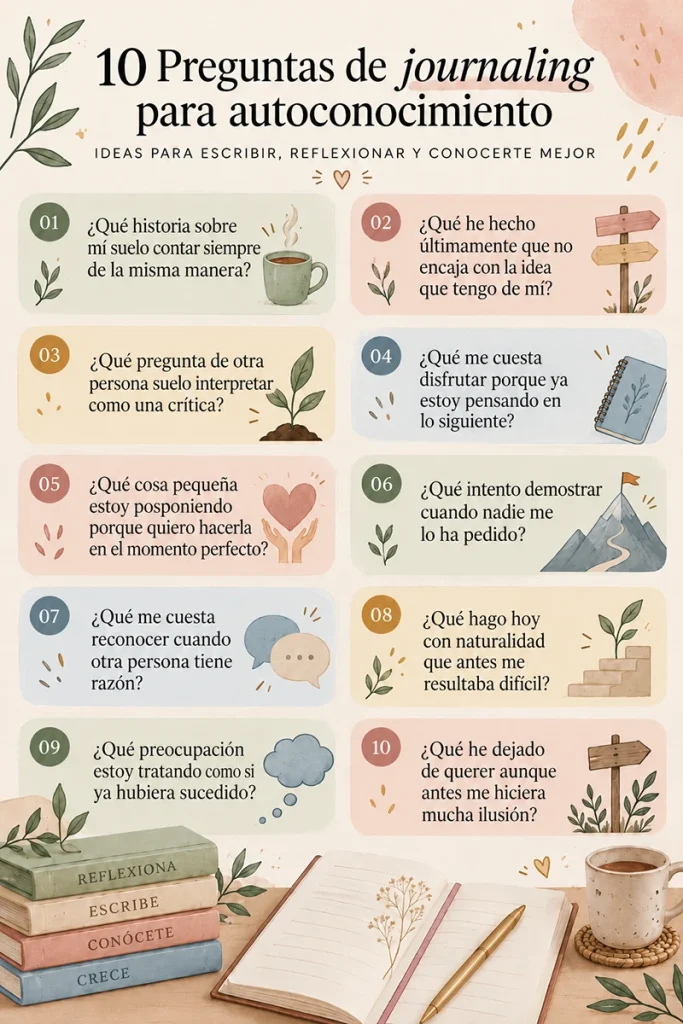
Getting to know yourself isn’t just about finding out what you like or dislike. It also means recognizing the stories you tell about yourself, the situations in which you react unexpectedly, and the small decisions you make almost without thinking.
The following prompts approach those topics through everyday experiences. Some may bring back recent memories; others may point to habits you’ve had for years. You can read them all before choosing one, or stop as soon as a question catches your attention.
PROMPT 01 · THE STORIES WE TELL
What story about myself do I always tell the same way?
We all have stories we’ve told so many times that we can almost recite them. How we met our partner, why we chose a particular career, what happened when we moved to a new city, or why we gave up something we used to enjoy.
Over time, these stories tend to get shorter. We leave out details, choose the moments that best explain what happened, and eventually tell much the same version whenever someone asks. There’s nothing necessarily wrong with that. It would be exhausting to recount twenty years of your life every time someone asked why you work in a particular field.
But sometimes that shortened version becomes the explanation we give ourselves, too. We say we stopped doing something because we didn’t have time, even though we remember losing interest months earlier. Or we say we accepted a job for its benefits, without mentioning that we also wanted to prove something.
Think of a personal story you’ve told many times. Try to remember how you usually tell it, then consider which parts you leave out. The point isn’t to uncover some hidden truth, but to notice whether your usual version leaves out important shades of meaning.
01
Sample journal entry
“When people ask why I stopped playing in the band, I always say I didn’t have time. It’s true that I started working Saturdays and rehearsals became difficult. But I also remember that I wasn’t very enthusiastic during those last few months. The songs didn’t interest me as much, and I felt embarrassed to say so because everyone else was still excited. I suppose it was easier to say I was too busy with work. I’m not sure I’d want to play with them again, even if I had my evenings free now.”
02
Sample journal entry
“I always say I moved because I found a good job opportunity. And it was a good opportunity. But I’d wanted to leave my hometown for a while, and I never said so because it sounded as though I was rejecting my life there. I remember how excited I was to find an apartment, even before I knew whether my work hours could be adjusted. Now I miss a lot about that time. Both things can be true, even though I usually only tell the part about the job.”
PROMPT 02 · SURPRISING OURSELVES
What have I done recently that doesn’t fit my idea of who I am?
We can spend years describing ourselves with the same words. We say we’re cautious, impatient, reserved, spontaneous, or not very adventurous. These descriptions help us make sense of ourselves, but they don’t always explain how we act in every situation.
Perhaps you think of yourself as shy, yet the other day you spent half an hour chatting with someone you’d just met. Or you’ve always said you love being spontaneous, but on your last trip you discovered you needed things to be much more organized than you expected.
The interesting thing isn’t proving your earlier description wrong. We can enjoy spontaneity in some situations and need reassurance in others. We may also behave differently as our circumstances change.
Think of a recent situation in which your own reaction surprised you. It might have been pleasant, uncomfortable, or simply unexpected. Remember what you did and why it stood out. Sometimes we know our habits better than we know our capacity to act differently.
01
Sample journal entry
“On Friday, I suggested having my birthday party at home. That surprised me because organizing things usually stresses me out, and I always prefer someone else to choose the place. But this time I wanted to cook dinner, put some music on, and get my friends together. I’ve spent years saying I’m not very sociable. Maybe I just don’t like plans that are too last-minute. I still need to decide how many people to invite, because I don’t exactly want twenty people in my living room.”
02
Sample journal entry
“I’ve always said I don’t mind changing plans at the last minute. Yet on Saturday I got pretty irritated when my friends decided to go to a different restaurant. I’d already looked at the first place’s menu and figured out where to park. It bothered me to realize how inflexible I was being. Then again, I’d had a difficult week and wanted a simple night out without having to think too much. I don’t know whether I’m becoming less flexible or I was just tired that day.”
One thing to notice: when an answer contradicts your usual self-image, you don’t have to rush to redefine yourself. You can make room for both experiences. Acting differently today doesn’t erase what you’ve experienced in the past.
PROMPT 03 · HOW WE INTERPRET THINGS
What question from someone else do I tend to take as criticism?
The same question can sound completely different depending on who asks it, when they ask it, and what we’ve experienced with that person before.
“Are you still working on that project?”, “Have you thought about what you’re going to do?”, or “Are you sure that’s a good idea?” could express curiosity, concern, disagreement, or impatience. But those questions can also trigger a reaction rooted in our own doubts.
Imagine you’ve spent weeks worrying that you aren’t making enough progress at work. If someone asks how a project is going, you might launch into a long explanation before they’ve finished speaking. Maybe they were questioning your work. Or maybe they simply wanted an update. We would need more than the question alone to know which it was.
Think of a question that makes you defensive. Recall the exact words, who said them, and what went through your mind right afterward. Then try to distinguish what you actually know about their intentions from what you’re interpreting. You don’t have to make excuses for the other person or dismiss the possibility that they really were criticizing you.
01
Sample journal entry
“When my mother asks whether I’m eating properly, it really gets on my nerves. I hear it as though she’s telling me I can’t look after myself. I snapped at her on Sunday and regretted it later. I think she still talks to me as though I live at home, although it’s also possible she just wanted to know how I was doing. The funny thing is, when a friend asks me the same thing, it doesn’t bother me at all. With my mother, I seem to hear more than she’s actually saying.”
02
Sample journal entry
“My manager usually asks how I’m getting on with my tasks before meetings. As soon as they ask, I start listing everything I’ve done, as though I need to prove I haven’t wasted any time. Today I realized they hadn’t even asked whether the work was finished; they just wanted to know what was left. To be fair, they have made comments in the past that upset me. I suppose I go into these conversations expecting it to happen again.”
PROMPT 04 · ENJOYING THE PRESENT
What do I struggle to enjoy because I’m already thinking about what comes next?
Some people finish one project and immediately start preparing the next. Others spend weeks looking forward to a vacation, only to spend much of it planning what they’ll do when they get home. Even a pleasant meal can become a brief break between all the things still on our to-do list.
Thinking about the future isn’t a problem in itself. Planning can help us stay organized, anticipate difficulties, and look forward to things that haven’t happened yet. The question is what happens when that habit follows us into moments we were genuinely looking forward to experiencing.
Perhaps you passed an important exam and, before celebrating, started worrying about the next one. Or you’d been excited about a concert, but once you got there, you kept checking the time because you had an early start the next morning.
This prompt invites you to remember a pleasant experience you struggled to enjoy—not to blame yourself for failing to be present, but to understand what was occupying your attention. Sometimes it will be a real concern; other times, a habit so ingrained that you barely notice it.
01
Sample journal entry
“Last week, I finished a course I’d been working toward for months. I was thrilled when I got my result, but the feeling didn’t last long. Straightaway I started looking at what other training I could do, which certificates I needed, and whether it would be enough to find another job. My partner suggested going out for dinner, and I still had my laptop open. It’s not that I wasn’t happy. I really was. But as soon as I achieved one thing, my mind was already making a list of everything I still had to do.”
02
Sample journal entry
“On Saturday, I went to the concert I’d been looking forward to since spring. I had a good time, but during the first few songs I kept thinking about where we’d parked and how long it would take to get out. I was annoyed with myself because I’d been listening to that album for months. Eventually I put my phone in my backpack and forgot about the journey home for a while. I don’t know why I find it so hard to leave certain things until later. The car was still exactly where we’d parked it when the show ended.”
PROMPT 05 · THE PERFECT MOMENT
What small thing am I putting off because I’m waiting for the perfect moment?
Some important decisions deserve time, information, and careful preparation. But we also put off much smaller things because the right conditions never seem to come along.
We want to start an activity when work is less busy, invite someone over when the house is tidy, or return to a hobby when we have several free hours. Meanwhile, the weeks go by and we keep imagining what the ideal beginning should look like.
Sometimes there are genuine obstacles: money is tight, family responsibilities get in the way, schedules are difficult, or we’re simply exhausted. Not everything we postpone is caused by our own expectations. But sometimes the conditions we’re waiting for are so specific that it’s hard to imagine when they’ll ever be met.
Choose something you’d like to do but have been putting off for a while. Think about what you believe you need before you can begin. Then consider which of those conditions are essential and which would simply make things easier or more enjoyable. You might uncover a real obstacle you hadn’t considered—or realize you’ve spent a long time preparing for something that could begin much more simply.
01
Sample journal entry
“I’ve been saying for months that I want to invite my cousins over for dinner. First I was waiting to finish painting the living room. Then I needed a bigger table, and now I think the patio looks a mess. The other day, one of them said we could just order pizza and sit wherever there was room. It made me laugh because I’d been imagining this wonderful dinner party without even asking what they’d like. We still haven’t made plans, but maybe I’m overcomplicating something that was really just about seeing each other.”
02
Sample journal entry
“I’d love to start drawing again. I have a folder full of photos saved for when I have time, and I’ve even looked at classes. I always imagine starting on a quiet weekend, with a clear desk and all my materials ready. But Saturdays end up filled with grocery shopping or going for a walk, and I never get around to it. Last week, I sketched a plant in a notebook while waiting for a phone call. It came out pretty crooked, but I enjoyed myself. I hadn’t even taken out my good pencils.”
One way to keep writing: after answering, reread the conditions you say you’re waiting for. If some are genuinely necessary, make a note of them. If not, imagine what it would look like to start without everything being ready. You don’t have to act immediately; this prompt can also help you understand why you’ve been delaying it.
PROMPT 06 · THE PRESSURE WE PUT ON OURSELVES
What am I trying to prove when nobody has asked me to?
Imagine a coworker asks you to help with a presentation. They only need you to double-check a few figures and organize a couple of slides. Two hours later, you’re still at your computer changing colors, finding images, and polishing details nobody is likely to mention.
Maybe you simply enjoy doing things well. But it’s also possible you’ve put in far more effort than necessary because you wanted to show that you’re responsible, capable, and someone others can always count on. Nobody asked for that much, yet you’ve turned a small favor into something like a test.
This can happen in all sorts of situations: cooking dinner for friends, agreeing to help someone, organizing a celebration, or trying to solve a problem another person might have handled much more simply.
This prompt isn’t asking you to stop trying or to give up doing things well. It’s about noticing when your effort comes from something you genuinely want to do and when it comes from needing to prove something about yourself. Think of a recent occasion when you demanded much more of yourself than the situation seemed to require. What did you hope other people would see in you? You may find a clear answer—or realize you simply enjoy paying attention to certain details.
01
Sample journal entry
“Last week, I was asked to organize a small neighborhood meeting. All I needed to do was find a date and book the room, but I ended up making a document with times, discussion topics, and even an attendance list. I spent the whole afternoon on it. I think I tried so hard because I’m new to the neighborhood and wanted people to feel they could rely on me. The meeting went well, although nobody needed half the things I prepared. I do like organizing things, but perhaps I went a little overboard this time.”
02
Sample journal entry
“Whenever friends come over, I end up exhausted. I clean rooms they won’t even use, prepare too much food, and worry about everything being perfect. On Saturday, a friend arrived early and found me in the kitchen, still wearing my apron and feeling pretty stressed. She started slicing the bread, and we began chatting. It turned out to be one of the nicest parts of the evening. I wonder why I still think I have to impress people who are coming over precisely because we’re friends.”
PROMPT 07 · CHANGING YOUR MIND
What makes it hard for me to admit when someone else is right?
Sometimes we can see that someone else has a good argument, yet we struggle to admit it. We keep defending our proposal, pick at some detail that doesn’t quite fit, or change the subject with something like, “Well, we’ll see.”
It can happen with important matters, but also with tiny disagreements. You insist one route is faster even though the GPS says otherwise. You defend a movie that’s starting to bore you halfway through, simply because you recommended it. Or you reject a suggestion that would probably have sounded reasonable coming from someone else.
It isn’t always about pride. Perhaps you’ve worked on an idea for a long time and find criticism difficult to accept before you’ve had the chance to explain it properly. Or perhaps the other person tends to correct you in a way that makes you uncomfortable. Tone, relationships, and timing all affect how we receive what people say.
Remember a time when someone expressed a different opinion and you later recognized they had a point. Try to recall your initial reaction and what happened next. The interesting part isn’t deciding who won the argument, but noticing what made that idea difficult to hear.
01
Sample journal entry
“My brother has been saying for months that we should divide up the responsibilities for our parents differently. I always reply that we’ve got things well organized, but on Sunday he showed me a list of everything he’d handled in September. There were quite a few things I didn’t even know he was doing. I didn’t like seeing it, perhaps because it felt as though he was accusing me of something. Later, I admitted he was partly right. We still haven’t decided how to share the tasks, but I can no longer say everything is perfectly balanced.”
02
Sample journal entry
“Yesterday, a coworker and I disagreed about how to present a budget. I wanted to explain all the details before showing the final figure, while she thought we should lead with the summary. I pushed back quite hard because I’d spent two days preparing the document. I read it again this morning, and I think her approach works better. The funny thing is, it wouldn’t have bothered me nearly as much if I hadn’t written the first version myself. I’m going to change it, though I still find it a little hard to admit her idea was clearer.”
An important distinction: listening to another opinion doesn’t mean you have to agree with it. You can acknowledge that someone noticed a detail you missed and still see the rest differently. Not every disagreement needs to end with one person being right and the other wrong.
PROMPT 08 · QUIET PROGRESS
What do I now do with ease that used to be difficult for me?
The first time we drive along an unfamiliar road, we tend to pay attention to everything. We check the signs and GPS, and worry about missing the right exit. A few months later, we might drive the same route while chatting comfortably with the person beside us.
Something similar happens with many everyday skills: cooking a recipe without checking every step, speaking another language on the phone, handling complicated paperwork, or finding your way around a new city. What once took conscious effort eventually becomes part of our routine.
The trouble, if we can call it that, is that we stop noticing what we’ve learned to do. We get used to our new abilities so quickly that our attention immediately shifts to the next thing we still find difficult.
This prompt asks you to look in the opposite direction. Think of something you now find fairly easy, then remember what it was like a few years—or even a few months—ago. It might be a practical skill, a different way of relating to people, or something you learned out of necessity.
It doesn’t have to be a major achievement. Sometimes it’s enough to notice that something that once took half an hour now takes five minutes, or that a situation that used to make you very nervous has become much more familiar.
01
Sample journal entry
“Today, I fixed my bicycle chain in less than ten minutes. A couple of years ago, I would have had to take it to a repair shop. I remember the first time I tried: my hands ended up covered in grease, I watched three videos, and I still put it back on wrong. Now I keep the tools in a little bag under the seat, and I don’t even think of it as complicated. It’s such a small thing, but I found it funny to realize I can now do something that once seemed impossible.”
02
Sample journal entry
“This morning, I had to explain a proposal in front of six people. I brought my notes, but barely looked at them. Afterward, I remembered my first month at the company, when even asking a question in a meeting made me nervous. I don’t really know when that changed. I suppose it happened through lots of conversations and getting things wrong a few times. I’m still uncomfortable speaking in front of large groups, but six people doesn’t feel like that many anymore.”
To help you find an answer: think of something you did this week almost without effort. Then imagine how you would have approached it the very first time. The contrast may help you recognize something you’ve learned that now feels completely ordinary.
PROMPT 09 · WHAT HASN’T HAPPENED YET
What am I worrying about as though it has already happened?
You’ve sent off a work proposal and haven’t heard back. Three days have passed. You start imagining that they didn’t like it, that perhaps you asked for too much money, or that you should have explained some details more clearly. You even rehearse what you’ll say when they tell you they’ve chosen someone else.
For now, the reality is much simpler: you sent a proposal and haven’t received a reply. Everything else is a possibility. Some of those possibilities may be reasonable, especially if you know the situation well, but you don’t yet know what will happen.
Anticipating difficulties can be useful. It helps us prepare, assess risks, and avoid impulsive decisions. But sometimes we start living with the consequences of something that hasn’t even happened. We become angry about a conversation we haven’t had or abandon plans because we’re convinced they’ll go badly.
To answer this prompt, think of something that’s worried you over the past few days. First, write down the facts you know. Then write what you assume might happen. You may find you have good reasons to remain concerned. Or you might notice that you’re treating an outcome as certain when you still don’t have the information to know.
The aim isn’t to force yourself to think positively. It’s to distinguish what is actually happening from what you imagine will happen, so you can give each the attention it deserves.
01
Sample journal entry
“I’ve spent the whole week thinking I won’t get the transfer I applied for. The available positions haven’t even been announced, and I’m already planning to stay here another year. Yesterday, I even started looking for other jobs. It’s true that a lot of people are interested and there’s no guarantee I’ll get it. But nobody has said no, either. I think I’ve spent days reacting to news that doesn’t exist yet. For now, I’m going to finish gathering the documents I need, because that part is up to me.”
02
Sample journal entry
“We have a family gathering next month, and I’ve spent days imagining we’ll argue about the same old things. I’ve already worked out what I’ll say if my uncle starts asking about my plans, and I’ve even considered not going. The truth is, we got along pretty well at the last meal. We had an argument months ago, but not every gathering ends that way. It might happen again, and I’d rather know which comments I don’t want to discuss. What I don’t understand is why I’ve spent an entire week rehearsing a conversation that may never take place.”
PROMPT 10 · WHEN OUR WISHES CHANGE
What do I no longer want, even though I used to be excited about it?
Some dreams stay with us for years. We want to live in a particular city, get a certain job, take a trip, or learn a skill we imagine will be part of our future.
Over time, some of those desires change. Sometimes they disappear completely; other times, they turn into something different. What’s interesting is that we can keep talking about certain plans as though they still excite us, simply because we’ve identified with them for so long.
Imagine you spent years dreaming of buying a house in the countryside. You saved photographs, browsed listings, and talked about it so often that other people thought of it as a plan you simply hadn’t carried out yet. Now you enjoy living in the city near your friends, and the idea of spending weekends fixing up a house no longer appeals to you quite as much. Yet whenever anyone asks about that dream, you say you’ll do it someday.
It isn’t always easy to admit we’ve changed our minds. Sometimes we’ve invested time or money in a project. Sometimes we’ve talked about a dream so much with people close to us that letting it go feels like something we need to explain. We might even feel sad about losing our old enthusiasm, even when we no longer want quite the same thing.
This final prompt invites you to remember something you wanted badly at an earlier point in your life. Try to distinguish what drew you to it then, what has changed since, and how you feel when you think about it now. Perhaps it still interests you, but in a different way. Or maybe you’ll realize you’ve been pursuing an idea more out of loyalty to your former self than because you truly want it today.
01
Sample journal entry
“For years, I wanted to run my own business. I pictured myself working for myself, setting my own hours, and doing things my way. I even made a small business plan and looked at commercial spaces. Now I have a job I quite like, and I really enjoy finishing my workday without having to think about anything else. I still sometimes say I’ll start something of my own someday, but I’m not sure I want to. It’s hard to admit because the idea used to excite me so much. Maybe it will appeal to me again later, but right now I don’t miss it.”
02
Sample journal entry
“When I was twenty, I wanted to take a very long trip through several countries. I saved itineraries, read travel blogs, and said that one day I’d go away for six months. The other day, I found that old folder on my computer. It was lovely to see it again, but I also realized I don’t want to spend that long away anymore. I still love traveling; I just prefer doing it differently. Perhaps one day I’ll spend a whole month somewhere. I don’t feel as though I’ve given up the trip of a lifetime. I think the trip I imagine now is simply different.”
Worth remembering: realizing a wish has changed doesn’t mean you have to make an immediate decision. You can hold on to a plan while you work out whether you still want it, return to it at another stage of life, or let it become a good memory. Not everything you once wanted has to remain part of your future.
These ten prompts approach self-discovery from different angles. Some focus on how we behave with other people; others explore our expectations, habits, or the ways we’ve changed.
Maybe you found one easy to answer and another left you thinking. You might also have remembered an experience while reading the examples that didn’t seem closely related to the prompt at all. You can write about that too. Personal writing doesn’t have to follow an exact path to be worthwhile.
And once you’ve written something, there’s another possibility: returning to those pages later. Not to correct what you thought back then, but to notice what has happened since and what you now see differently.
05 · AFTER YOU’VE WRITTEN
What to do after answering a journaling prompt
You’ve chosen a prompt, remembered an experience, and written a couple of pages. Perhaps you’ve come away with a clearer understanding of what happened. Or perhaps you ended up writing about something completely different from what you had in mind when you started.
So, what now?
One option is to close your journal and get on with your day. Not every entry needs a second reading or has to lead to a decision. Sometimes we write simply because we want to linger over a memory, make sense of what happened, or preserve what we were thinking at the time.
But if you use journaling to get to know yourself better, there are a few interesting ways to revisit what you’ve written. Not because you need to uncover hidden meaning in every sentence, but because the distance between what you wrote then and what you think now may reveal details you couldn’t see before.
Reread without trying to correct your past self
Imagine finding a journal entry from six months ago. You’d just started a new job and wrote about how difficult it was to ask for help when you didn’t know how to do something. You worried about bothering your coworkers and preferred trying to work things out on your own, even if it meant wasting a lot of time.
Now you’ve been in the job for six months. You still don’t know everything, but asking questions feels more natural, and you’ve even started helping people who have just joined the team.
That old entry might seem exaggerated from where you stand today. Yet at the time, it captured a worry that was real to you. You don’t need to cross it out or add a note saying you were wrong. You can keep it as a record of a period you now see from a different perspective.
01
What you wrote back then
“Every time I have to ask a question at the office, I feel pretty incompetent. Today I spent almost an hour trying to solve a problem that Marta explained to me in five minutes. I’m embarrassed that I have to keep asking. Sometimes I think I should know how to do more by this point.”
02
What you might write six months later
“Today I helped a coworker who just joined the company. He had a question about the same software that used to drive me crazy when I started. It made me smile to remember how hard I found it to ask for help. I still don’t like interrupting people, but I no longer spend an hour searching for an answer when I know someone can explain it.”
Both entries describe the same person at different times. One isn’t right and the other wrong. The second simply makes it possible to notice a change that might otherwise have gone unnoticed among meetings, tasks, and workdays.
Repeating a prompt can be more revealing than you expect
When we come across a question that interests us, we tend to assume that once we’ve answered it, we’re finished with it. But some questions can stay with us for years precisely because our answers don’t stay the same.
“What do I need from my friendships right now?” may lead to one answer just after moving to a new city, and a very different one after living there for several years. “What do I want to keep in my life as it is today?” may not mean the same thing at twenty-five as it does at fifty.
Even if your answer barely changes, that may tell you something too. Perhaps you still appreciate the same habit, think fondly of the same person, or struggle with similar situations. The interesting part is noticing what has changed and what has remained—not proving you’ve made progress.
1
Keep the date
Writing down when you answered a prompt places your response within a particular period of your life. Months later, you may remember what was happening and why the subject mattered so much to you.
2
Read with curiosity
Pay attention to the details you mentioned, the things you worried about, and what you took for granted. You don’t need to judge whether your answer was mature, reasonable, or correct.
3
Answer again if you feel like it
Try writing without constantly checking your earlier response. Afterward, you can compare the two and notice what has changed, what remains, and which new details have emerged.
You don’t have to reread everything. Some pages may feel too personal or bring back moments you’d rather not revisit. You can leave them closed. Keeping a journal also means deciding what you want to preserve, revisit, or simply leave on the page.
06 · KEEP WRITING
Guided journals: another way to get to know yourself through writing prompts
Perhaps you’ve read the ten prompts above and already know which one you’d like to write about. Maybe several situations have come to mind, and you’re thinking of digging out the notebook that’s been sitting in a drawer for months.
But something else happens quite often: today you find an interesting prompt, spend some time writing, and enjoy the experience. Tomorrow you open your journal again and aren’t sure what to do. You think for a while, try to remember something from your day, and end up closing it because you can’t think of where to go next.
That doesn’t necessarily mean you’ve lost interest. Sometimes it’s simply easier to write when someone has already put together a question worth exploring.
That’s where guided journals can help. Instead of always starting with a completely blank page, you have a writing prompt to guide you. Depending on the journal, that might mean a sequence of questions, reflections, exercises, or other material that gives you somewhere to begin.
The difference isn’t that the journal knows what you need to answer. It’s that it introduces topics you might never have thought to write about on your own, along with a structure for exploring them.
What a guided journal offers beyond a list of prompts
A list of prompts can be extremely useful, especially when you’re looking for occasional inspiration. A guided journal can offer something different: context that helps you understand each question and a writing experience that goes beyond choosing a sentence at random.
01
A ready-made starting point
You don’t have to come up with every question yourself. You can spend that time remembering experiences, thinking about what you want to say, and finding your own way to respond.
02
Fresh perspectives
It’s easy to keep writing about the same topics. A journal with varied prompts can bring you back to memories, habits, and questions that might not normally find their way onto your pages.
03
Something to come back to
You can keep what you’ve written, return to a question that interested you, and notice how your answer changes. You don’t have to finish everything at once or follow a strict schedule.
Why explanations and sample entries matter
A prompt may seem simple until we try to answer it. “What do you need right now?” is only a handful of words, yet it opens up so many possibilities that you may not know whether to write about your relationships, work, rest, or something you can’t quite define yet.
A thoughtful explanation can help narrow the focus. It might invite you to recall a recent event, suggest different ways to interpret the question, or draw your attention to a detail you hadn’t noticed.
Sample entries serve another purpose. They show you how someone might turn a broad idea into a personal piece of writing. They aren’t meant to provide the right answers, but to show that you can start with something quite simple: a conversation, a decision, a habit, or a small contradiction.
That’s exactly how the ten exercises in this article are structured. First comes the prompt, then an explanation to help you explore it, and finally two different answers so you can imagine what writing your own might feel like.
A question can give you a place to start. What you write from there is something nobody else can answer for you.
07 · COMMON QUESTIONS
Frequently asked questions about journaling for self-discovery
When we start journaling, questions often come up: how much should we write, what should we do when we can’t find an answer, and is there a better way to keep a journal? Here are a few things worth clarifying before turning a personal practice into a collection of rules.
Do I need to journal every day to get to know myself better?
Not at all. You can write every day if you enjoy that routine, but twice a week—or only when a prompt interests you—can work just as well. What matters is finding a rhythm that fits your life. Writing every day out of obligation doesn’t guarantee more meaningful reflections or a better understanding of your experiences.
What if a journaling prompt feels too personal or uncomfortable?
You can leave it unanswered. You don’t have to explore every subject in a journal or write about experiences you’d rather leave alone. You could also approach the question through a simpler situation or return to it another time. Just because a prompt feels uncomfortable doesn’t mean you have to find an answer.
Can I answer the same journaling prompts more than once?
Yes. In fact, returning to a prompt after several weeks or months can be interesting. You might remember different experiences, have changed your mind, or still feel almost exactly the same. Keeping dated entries lets you notice those differences without having to decide which answer best represents who you are.
Is it better to journal by hand or use an app?
It comes down to personal preference. Some people love using a notebook, the pace of handwriting, and having their words on paper. Others prefer writing on a computer or phone because it’s more convenient and keeps everything in one place. Choose the format you’re most likely to enjoy, or combine the two.
08 · FINAL THOUGHTS
A good question doesn’t have to lead to a definitive answer
At the beginning of this article, we came across a fairly ordinary sentence: “Today was a strange day.” It could have remained just another line in a notebook. But once we asked what had happened, details began to emerge: a conversation, an expectation, and a particular way of interpreting the experience.
That’s what journaling prompts can offer us. Not a definitive explanation of who we are, but a chance to examine experiences that usually pass by too quickly.
Some answers will surprise you. Others will confirm something you already knew. Certain prompts will interest you deeply, while others might not feel relevant right now. You might even return to one months later and find it strange to read what you wrote the first time.
You don’t have to answer all ten prompts to begin. Just choose one—the one that reminded you of a conversation, a habit, or something you haven’t thought about in a while. Open your journal and describe it in your own words.
Perhaps you’ll want to ask yourself another question afterward. Or perhaps, for today, what you’ve written will be enough.
Guided Journals