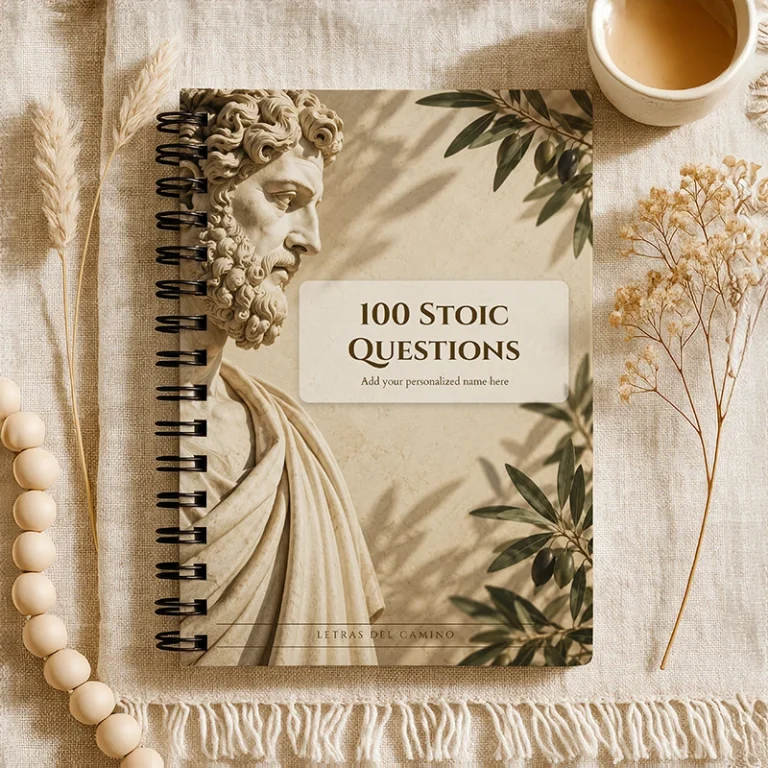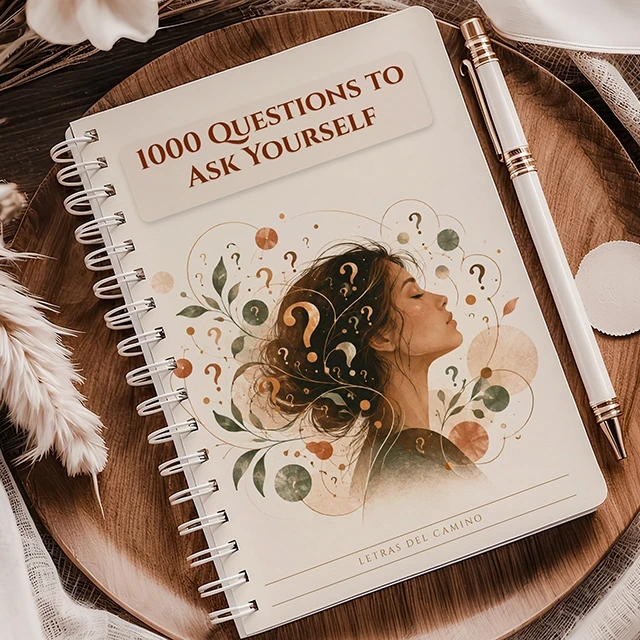
Why Buy a Guided Journal? 5 Reasons to Start Writing

All you need to keep a journal is a notebook. It doesn’t even need a beautiful cover: a file on your computer or a few loose sheets of paper will do. So why would anyone buy a journal that already has the questions written in it?
Because deciding what to write about takes time, too. Some days you feel like writing about something other than work, yet somehow you end up writing about work again. It’s not a lack of imagination. It’s simply the first thing that comes to mind.
Imagine opening a journal and coming across this question: “What habit have you kept from the way things were done in your childhood home, even though you no longer live there?”.
Maybe you think of the way you hang out laundry, a recipe you always make the same way, or your habit of keeping bags inside other bags. As you begin explaining where that habit came from, people and moments you haven’t thought about in years start coming back to you.
That’s part of what a guided journal offers: a collection of questions thoughtfully chosen to help you explore subjects you might not otherwise consider. Of course, some journals are full of questions you can answer in two lines, while others keep you writing for quite a while. And some people would rather decide for themselves what to write about. It’s worth understanding the differences before you buy.
IN THIS ARTICLE
01 · UNDERSTANDING THE FORMAT
What Is a Guided Journal, and How Is It Different From a Traditional Journal?
A guided journal provides questions, reflections, or exercises to give your writing some direction. Some are organized day by day; others explore a particular theme, such as memories, relationships, or decisions. Some have a single question on each page, while others explain the purpose behind each prompt or offer examples to help you begin.
In a traditional journal, you choose the subject. You might describe a conversation, jot down something you noticed from the bus, or write six pages about what happened on Friday. You might even skip the storytelling altogether and make a to-do list. For many people, that freedom is exactly what makes a blank notebook appealing.
| Feature | Traditional journal | Guided journal |
|---|---|---|
| Who chooses the subject | You decide what to write about. | The journal offers a question or exercise. |
| How the writing progresses | Based on your experiences or whatever you feel like exploring. | It may follow a sequence or a particular theme. |
| What you can do | Make notes, tell stories, draw, or write lists. | Answer prompts, change direction, or skip exercises. |
| When it might suit you | When you enjoy writing without instructions. | When you appreciate having a place to start. |
The difference lies in who suggests the starting point, not in who writes the answer. In a guided journal, you might end up writing about something completely different from what the question originally suggested. You don’t have to follow it to the letter or turn the exercise into a test.
Nor are these two approaches mutually exclusive. You can use a prompt to get started and then continue in your usual notebook. Some entries begin with a question and, after a couple of lines, no longer need it.
02 · FIVE REASONS TO TRY IT
5 Reasons to Buy a Guided Journal and Start Writing
Not every reason will matter equally to everyone. If you already journal regularly, you might be looking for fresh questions. If you’ve never kept a journal, you may appreciate someone suggesting where to begin.
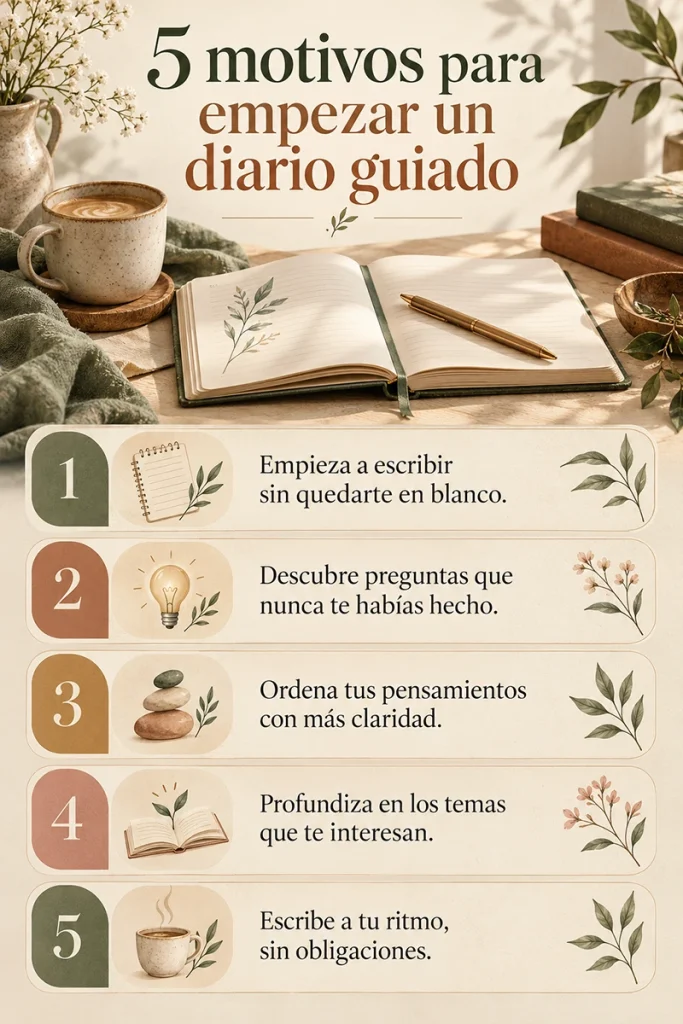
A question can help you get started, lead you to a new subject, or offer a different way of looking at something familiar. These five reasons explore when each of those possibilities can be useful.
The infographic brings all five ideas together in one image; the explanations and examples follow below.
1. A Specific Question Makes It Easier to Begin
“Write about your life” leaves far too many doors open. Which one do you walk through? Something that happened today? Something from ten years ago? A decision you still haven’t made? Even when you want to write, choosing a subject can take longer than writing about it.
The question “What recent conversation has stayed on your mind?” is much more manageable. It doesn’t ask you to take stock of your entire life or recall an extraordinary event. It simply asks you to remember a conversation.
Maybe it was yesterday’s conversation with your brother, when he said you only seem to see each other these days when there’s an errand to run. Or perhaps it was something a neighbor said while you were waiting for the elevator, a remark that took on a different meaning a few hours later.
You might start like this: “My brother said we’re always rushing around. I told him that’s just how life is, but today I realized that the last three times we met, I was the first one to check the time”.
That’s just two sentences, and you already have the beginning of an entry. If you feel like continuing, great. If you stop there, you’ve still captured a conversation you probably wouldn’t have chosen to write about otherwise.
A QUESTION TO TRY
What recent conversation has stayed on your mind?
Remember where you were and one remark that stuck with you. You don’t need to reconstruct the entire conversation.
2. It Introduces Questions You Wouldn’t Have Thought to Ask
An open-ended journal can easily become a record of whatever is demanding the most attention that week: work, a family problem, a move. Meanwhile, other parts of life barely get a mention. Not because they matter less, but because they’re quieter.
An unexpected question changes the subjects available to you. “What have you repaired several times instead of replacing?” might remind you of a saucepan that’s been in the family since your parents’ days. “Whose advice do you often ask for, only to do the opposite?” might bring back a conversation that still makes you laugh.
Then there are questions that feel uncomfortable for much more ordinary reasons. You say you prefer to be spontaneous, yet you plan your vacations in a spreadsheet. You insist you’re not sentimental about possessions, but you’ve kept every train ticket.
None of these contradictions needs a diagnosis. Sometimes it’s enough to describe them and recognize that people aren’t perfectly consistent in everything they do.
01
Habits
What small habit have you carried over from your childhood home?
02
Relationships
Who is the first person you call when you have good news?
03
Decisions
What plan did you dismiss without giving it much thought?
The value of a collection isn’t that every question has to be profound. It’s the variety, and the occasional question that makes you think, “I would never have written about that.”
3. It Helps You Separate What Happened From What You Assumed
On Sunday, someone cancels lunch at the last minute. You’ve already bought the ingredients, planned your morning, and set the table. You’re angry. Really angry.
When you tell someone else about it, you say, “They have no respect for my time.”
But the message you received simply said, “I’m sorry, I can’t make it today.”
That’s an interesting distinction. One statement describes what happened; the other describes your interpretation. You may have good reasons for seeing it that way, but they aren’t the same thing.
A guided journal might ask you to reconstruct what happened without mixing everything together from the first line.
- What happened: lunch was canceled at the last minute.
- What I thought: “They don’t respect my time.”
- What upset me: I had spent the whole morning getting ready.
- What I could ask: whether they could let me know earlier next time.
You might realize that the cancellation itself wasn’t what bothered you most. Maybe it was the fact that this was the third time the person had canceled at short notice. Or perhaps you were hurt that you’d spent the morning preparing something you wanted to share.
The journal won’t resolve the disagreement, but it may help you approach the conversation with a clearer understanding of what you’re feeling. And then there’s still the question of what to do with all that food.
4. You Can Explore One Subject Without Repeating the Same Question
A journal about memories might begin by asking about the house where you grew up. That’s a good start. But if the next page asks you to recall a special childhood moment and the third asks for your happiest memory, you’ll probably end up writing different versions of the same story.
The questions matter. So does their order.
Imagine a different sequence. First, you describe the house. Then you remember which room you spent the most time in. Later, you write about an object that was always there and the person who used it.
You might end up describing your grandfather listening to the radio in the kitchen while making breakfast. Or you might discover that you remember the pattern on the curtains perfectly but have no idea where the bathroom was.
These memories aren’t more valuable than others. They simply come to mind because someone has asked the question differently.
That’s why, before choosing a themed journal, I’d look through several consecutive pages. Fifty independent questions can offer plenty of variety; a thoughtfully designed sequence lets you linger on a subject and explore it from different angles.
And the theme doesn’t always have to be about self-improvement. Perhaps you’d like to write about cities, family traditions, philosophy, or things you’ve stopped doing. Curiosity deserves a few pages, too.
5. It Makes It Easier to Return to Writing Without Starting Over
Some journals ask you to write every day. For some people, having a date and a specific task works well. Others miss Thursday, then Friday, and end up staring at the blank pages as if they owe their notebook an explanation.
If your journal isn’t tied to a fixed calendar, you can pick it up whenever you like. The next question will still be there, right where you left it.
One person might write for ten minutes before leaving for work. Another might spend a long stretch on Sunday, between doing laundry and making lunch. And some people open their journal only when a question catches their interest or they feel like thinking about something different.
Having the prompts ready means you don’t have to decide what to write about every time. That doesn’t guarantee you’ll build a habit, of course. But it removes one of the most common excuses: “I can’t think of anything to write today.”
Before buying a journal with daily exercises, consider whether that commitment appeals to you. An undated format may work better if your weeks are unpredictable or you prefer to write without watching the calendar.
03 · BEFORE YOU BUY
Is a Guided Journal Worth Buying If You Already Have a Notebook?
A blank notebook lets you write exactly the same answers as a guided journal. And questions aren’t a secret reserved for books: you can come up with your own, ask a friend for ideas, or find them in an article like this one.
So why pay for a guided journal? For the work that goes into creating its content. Someone has chosen a theme, considered which questions are worth asking, decided which ones are too similar, and thought about how they fit together. Sometimes they’ve added explanations or examples so a prompt offers more than a nice-sounding sentence.
That work can save you time and lead you along a path you might never have designed for yourself. But it isn’t always worth paying for.
If you enjoy free writing, already have questions of your own, and like deciding what to explore as you go, you probably don’t need to buy anything. If a particular collection interests you, look at a sample. It’s more revealing than a promise that you’ll discover a whole new version of yourself in thirty days.
One important thing to remember: a journal with a hundred questions doesn’t necessarily offer more than one with thirty. Look at whether the prompts are varied and whether you’d actually want to answer them, not just how many there are.
04 · CHOOSING THOUGHTFULLY
How to Choose a Guided Journal That’s Right for You
The cover might be beautiful. The photos might be, too. A journal next to a cup of coffee, a cozy blanket, and a window glowing with afternoon light always looks inviting.
But you’ll spend far more time reading the pages inside than looking at the cover.
When comparing two journals, try reading several pages in a row. A good sample lets you see whether the questions are varied, how they’re explained, and how much room they leave for your own response.
The format matters, too. A PDF designed for printing and a journal you use in an app offer different writing experiences.
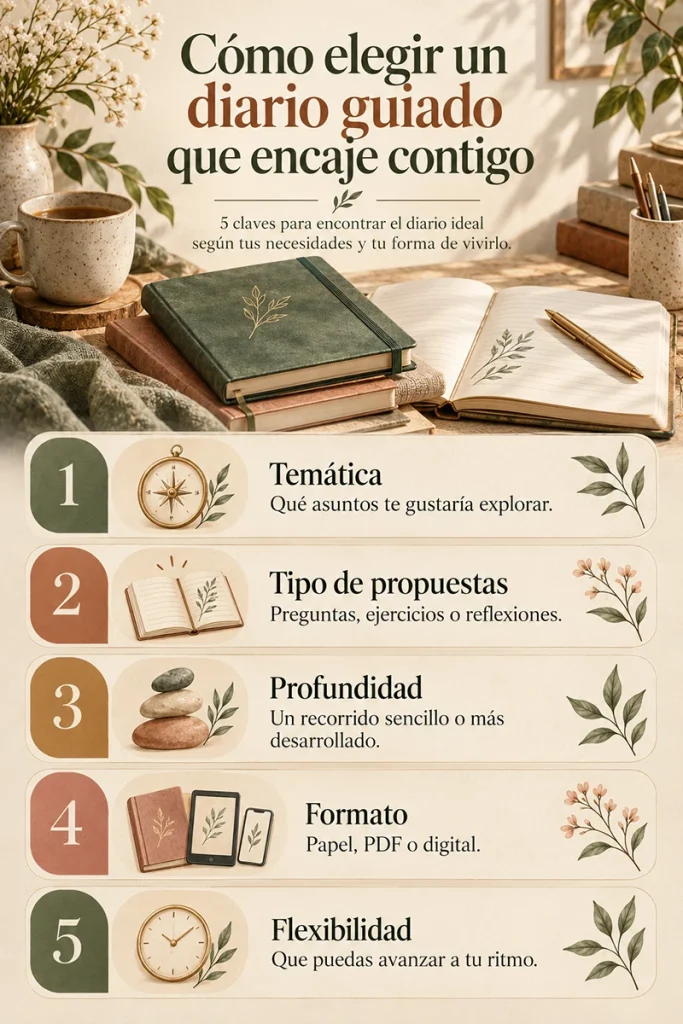
Before you decide, it’s worth checking a few things. The journal doesn’t have to meet an endless list of requirements. You simply need to know what kind of experience you’re buying.
- Theme: would you enjoy writing about memories, relationships, decisions, philosophy, or other subjects?
- Type of prompts: do you prefer straightforward questions, supporting explanations, or multi-step exercises?
- Structure: do the questions follow a sequence, or can you open the journal to any page?
- Format: do you want to write by hand, print a PDF, or use a digital option?
- Flexibility: are there dates to keep up with, or can you return to writing whenever you like?
If sample pages are available, read three or four prompts in a row. Do you feel like answering any of them? Are they different from one another? Do the explanations open up possibilities, or do they seem determined to tell you what your answer should be?
And be wary of guarantees of extraordinary results. It’s hard enough to know what someone will write tomorrow, let alone promise how well they’ll understand themselves three weeks from now.
05 · PUTTING IT INTO PRACTICE
How to Start Using a Guided Journal
You don’t need to set up a special writing space or set aside a full hour. To give it a try, find a question that interests you and spend a few minutes responding in a notebook, on a loose sheet of paper, or in whatever writing app you normally use.
01
Choose a question
Start with one that sparks your curiosity, even if you don’t yet know what you’ll say.
02
Describe something specific
A remark you heard, a place, a situation. It’s easier to continue from a concrete detail than from an abstract idea.
03
Let your answer take its own direction
If you end up writing about something else, there’s no need to steer yourself back to the original question.
You can try it right now. This prompt has two parts: first, it invites you to describe a worry, and then it asks you to distinguish what is and isn’t within your control.
TRY IT NOW
Is there anything you’ve been worrying about more than you’d like lately? What, exactly, is within your control?
Start by describing what’s happening. Then separate what depends on other people from what you can decide for yourself.
An answer might begin like this: “I’ve been waiting several days for someone to confirm a date. Every time an email arrives, I check who it’s from before I finish what I’m doing. I can’t decide when they’ll reply. But I can stop checking my phone while I’m having dinner”.
You could also write that you still don’t know what to do, or that your worry seems exaggerated once you see it on paper. There’s no predetermined answer you’re supposed to reach.
If a question doesn’t interest you, skip it. If you come back to it months later and answer differently, you’ll have two entries written at different points in your life. Comparing them may be more interesting than either answer on its own.
06 · COMMON QUESTIONS
Frequently Asked Questions About Guided Journals
Do I need any writing experience?
No. You can write the way you’d speak to someone you trust, in full sentences or quick notes. No one is going to grade the writing in your journal.
Do I have to write every day?
That depends on the format. Some journals follow a daily sequence, while others let you open to any page whenever you feel like it. Check how the journal is organized before choosing one.
How much time should I spend on each question?
Some prompts take five minutes to answer; others might make you want to continue the next day. A short answer can stay short. You don’t have to expand it.
What if I don’t know how to answer?
You can skip the question, write about why it doesn’t resonate with you, or return to it later. Not every prompt will interest you, and that’s fine.
Can I use it alongside a traditional notebook?
Absolutely. You can save the guided journal for particular themes and use another notebook to record everyday events, or copy your favorite prompts into your usual notebook.
07 · ONE LAST THOUGHT
Before You Buy, Read a Question
There’s a fairly simple way to tell whether a guided journal might interest you: open it to any page and read the prompt slowly. Not to see whether you can answer it, but to notice whether something specific comes to mind.
Maybe you remember a name, a room, or a conversation. Or maybe you think the question is poorly worded and start arguing with it in your head. That’s something you can write about, too.
If it doesn’t spark any curiosity and you’d rather freely describe what happened today, you’ve already found the answer you need: your trusty blank notebook is still an excellent choice.
GUIDED JOURNALS