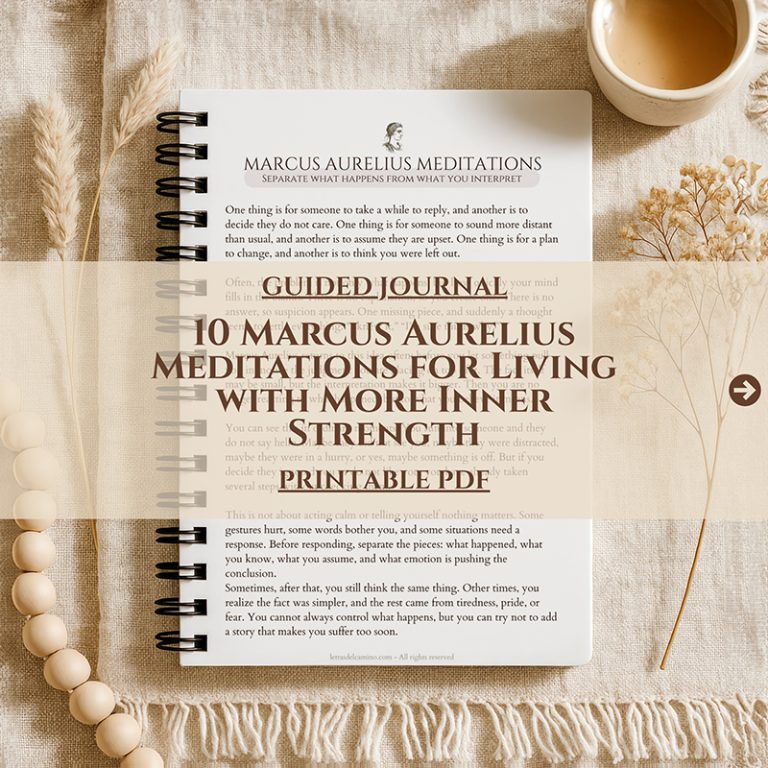
Marcus Aurelius’ Meditations: How to Apply His Philosophy to Your Journaling

Marcus Aurelius’ Meditations still feel relevant for a fairly simple reason: they are not only about grand philosophical theories, but about something you experience too—the difficulty of bringing order to your mind when thoughts, emotions, and worries all appear at once.
You are not reading a book written to impress anyone. You are reading the notes of someone who used writing to watch his thoughts, correct his reactions, and remind himself how he wanted to live.
That is why it connects so naturally with journaling. Writing consciously is not only about getting things off your chest. It can also help you step back from what you think and avoid turning every passing thought or emotion into an immediate truth.
A journal does not make your problems disappear, but it can make you look at them more carefully. It helps you distinguish what actually happened from what you are interpreting, and that difference can completely change how you respond.
That is a large part of why Marcus Aurelius still matters: he does not teach you how to sound profound, but how to think with a little more steadiness when your mind starts exaggerating.
IN THIS ARTICLE
“Our life is what our thoughts make it.”
Marcus Aurelius
01 · WRITE TO OBSERVE YOURSELF
Why Marcus Aurelius’ Meditations works so well with journaling
Because it is not philosophy for decoration. To a large extent, it is a written mental practice that you can easily bring into everyday life.
Marcus Aurelius writes to examine himself, slow himself down, and prevent a passing emotion from becoming an absolute truth. And that is very similar to what you are trying to do when you use journaling reflectively.
He does not simply describe what happens to him. He tries to notice what judgment he is placing on top of what happened.
One thing is the fact, and another is the interpretation. One thing is what happens; another is the story you build around it.
Marcus Aurelius returns to this distinction again and again because a significant part of our distress can arise precisely there: not only from what happens, but from how quickly we turn it into a conclusion.
His reflections also return to an idea closely linked to Stoicism: distinguishing between what depends on you and what does not. Brought into a journal, that question can clear away a great deal of mental noise and bring you back to what is concrete.
There is also an attitude of accepting reality without turning that acceptance into passivity. Personally, I like to remind myself of a phrase: “I accept everything, but I settle for nothing.” It is not exactly amor fati, but it reminds me that accepting a situation does not mean giving up on trying to improve it.
That is why reading Meditations only as a philosophical classic can feel incomplete. You can also see it as the mental notebook of someone who understood that if you do not examine what is happening inside you, you can end up living at its mercy.
You cannot prevent the first thought from appearing. You can decide how much power you give it afterward.
02 · UNDERSTAND THE BOOK
What Marcus Aurelius’ Meditations really is
Meditations is not a perfectly structured treatise or a book originally prepared for the public. It is a collection of personal notes, reminders, mental corrections, and fragments Marcus Aurelius wrote for himself.
That explains its tone. Sometimes it is direct, sometimes dry, and at times repetitive. But that repetition can also be understood as training: there are ideas we need to remind ourselves of many times because understanding something once does not mean we have learned to live by it.
Understanding an idea and turning it into a habitual way of acting are two different things.
Just as making one basket does not make you a good basketball player, thinking clearly once does not guarantee that you will respond the same way the next time the problem appears.
Marcus Aurelius does not write like someone delivering a lecture. He writes like someone trying to remain steady in the face of his own limitations, fears, and reactions.
Read this way, the text becomes much more powerful. It no longer feels like a collection of old quotations, but like the trace of someone trying to think more soberly and act according to what he considered important.
03 · BRING IT INTO YOUR JOURNAL
How to apply this approach to your personal journal
Applying the ideas in Meditations to your journal does not mean trying to write like Marcus Aurelius. It means using writing for a similar purpose: to see more clearly what is happening inside you so you do not always act on your first impulse.
1
Write what you are really carrying inside
Do not try to make it sound better. If you are irritated, confused, tired, or resentful, write it exactly as it appears.
The value of a journal is not in sounding good, but in being able to see clearly what you are actually thinking.
2
Question what you just wrote
Ask yourself what actually happened, what you are assuming, which emotion is shaping your interpretation, and what evidence you have for thinking that way.
3
Find your room to act
Once you understand what happened more clearly, ask yourself which part truly depends on you and which part is outside your control.
4
Decide how you want to respond
The goal is not to control what happens outside you, but to choose a more deliberate response where you actually have some ability to act.
BEFORE YOU START THE DAY
How do I want to respond today if something becomes difficult?
You do not need to anticipate every possible problem. It is enough to remind yourself of the attitude you want to try to maintain when something does not go the way you expected.
You can also do this exercise at night. Instead of only describing what happened, look back at how you showed up within what happened. That small difference turns writing into a much more reflective practice.
The format matters less than it may seem. You can write on paper or on a screen. Writing by hand usually forces you to slow down a little, while digital writing can be more convenient and faster. What matters is that the format does not stop you from pausing to think.
04 · SEE IT IN PRACTICE
A real example of Stoic journaling
This is where all of this stops simply sounding good and starts becoming practical.
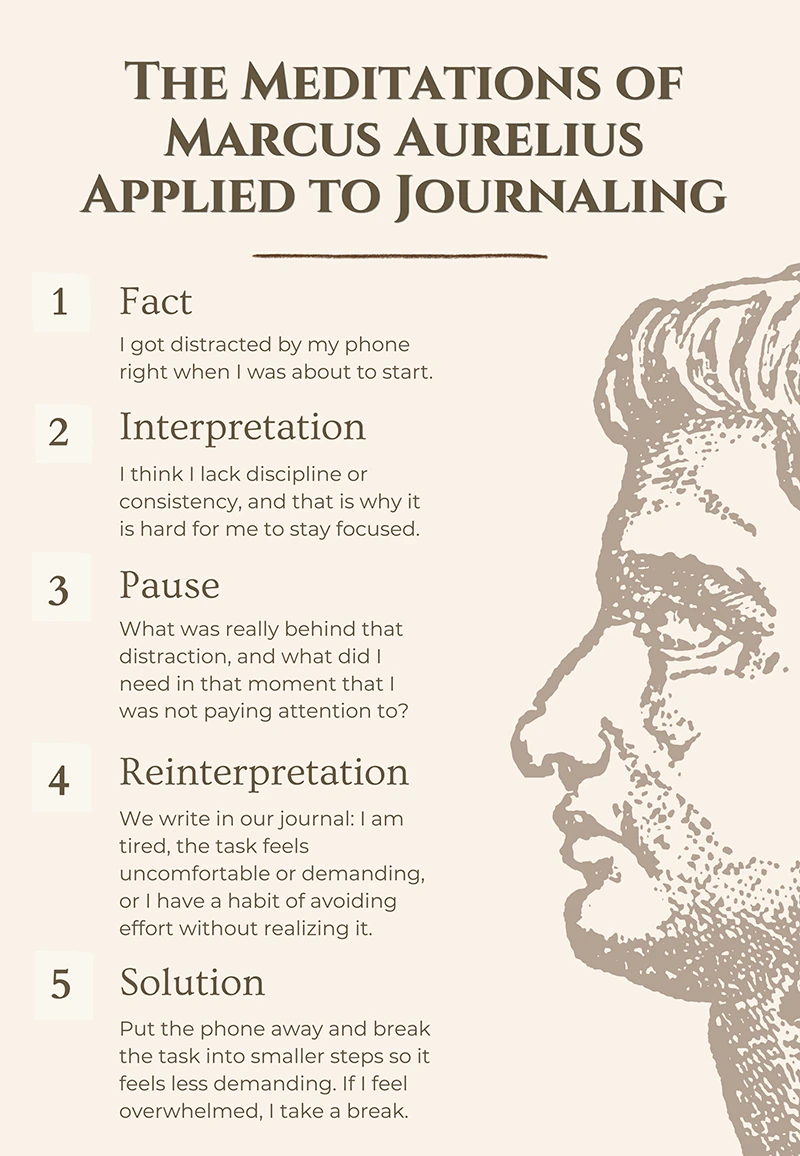
Imagine a very ordinary situation: you are working or studying, you begin an important task, and ten minutes later you find yourself looking at your phone almost without realizing it.
“I cannot focus. This always happens to me. I have no discipline. I am never going to make progress like this.”
Up to this point, you have expressed what was inside you. That alone may bring some relief, but you can still use writing to go a little further.
1
Fact
I got distracted by my phone just as I was about to begin.
2
Interpretation
I think I lack discipline or consistency and that, because of that, I will never be able to maintain my attention.
3
Pause
What was really behind that distraction? Was I tired? Did the task feel uncomfortable? Am I automatically reaching for my phone whenever something requires effort?
4
Reinterpretation
I am tired, the task feels demanding, and I have developed a habit of avoiding that effort by reaching for a quick distraction.
5
Action
I can put my phone away, break the task into a smaller piece, and begin with just that. If I need a break, I can take one deliberately instead of distracting myself automatically.
The revised thought might look like this:
“It is not that I have no discipline. I am falling into an automatic habit of distraction when a task feels demanding. I can start small and do better right now.”
This does not immediately remove the discomfort, but it can reduce the intensity of your interpretation. You stop judging your entire character based on one moment of distraction and return to what you can actually do something about.
05 · PUT IT INTO PRACTICE
Journaling exercises inspired by Marcus Aurelius’ Meditations
The best way to understand this approach is to practice it. You do not need to do all of these exercises at once. Choose the one that best fits what you are going through right now.
01
Raw mental dump
For five minutes, write continuously about everything that is in your head. Do not correct it, organize it, or try to make it sound good.
You are not trying to solve anything yet. The goal is to release some of the pressure and turn that mental noise into something you can observe.
02
Fact vs. interpretation
Choose something that upset you and mentally divide the situation into two parts.
Fact: they did not reply to the message.
Interpretation: they do not care about me.
This distinction helps you notice when you are reacting to something that actually happened and when you are reacting to a conclusion you have not yet verified.
03
Your room to act
Divide a page into two sections. In one, write what you can act on. In the other, write what does not depend on you.
The intention is to stop spending all your energy trying to control what is not in your hands and return to the part of the situation where you can actually do something.
04
Rewrite an automatic thought
Take an absolute statement and make it more precise.
“Everything goes wrong for me” can become “Two things have not gone the way I wanted.”
“I am not good at this” can become “I am struggling with this right now, but I can keep learning.”
05
Review your day
- Where did I respond well today?
- Where did I let myself get carried away?
- What do I want to try to correct tomorrow?
The goal is not to punish yourself, but to review your day so you can enter the next one with a little more awareness.
06
Grounding phrases
Keep two or three short ideas that genuinely help you when you notice your mind beginning to race.
- “Not every thought deserves obedience.”
- “I can distinguish what I know from what I am assuming.”
- “I do not need to turn a feeling into an absolute truth.”
This is not about sugarcoating reality. When you reframe a thought, the goal is not to replace something unpleasant with something pleasant, but to describe the situation more accurately.
06 · AVOID COMMON MISTAKES
Common mistakes when journaling with a Stoic approach
Using your journal this way does not mean everything you write will automatically bring you clarity. Certain habits can still leave you circling the same thoughts.
- Using your journal only to unload distress. It may bring relief, but if you never look at what you wrote, it is easy to remain only at the level of venting.
- Trying to sound interesting. Your journal does not need brilliant writing. The more you perform, the less room there is to observe yourself honestly.
- Expecting an immediate breakthrough. This kind of writing tends to work more like training than a series of dramatic discoveries.
- Never rereading anything. Returning to pages from weeks, months, or years ago can reveal recurring fears, exaggerations, patterns, and progress you may not have noticed.
IN A NUTSHELL
- Write what you actually think first.
- Distinguish the fact from your interpretation.
- Ask yourself which part of the situation depends on you.
- Try to express your thoughts more precisely.
- Review how you respond, not only what happens to you.
- Return occasionally to what you wrote in the past.
The goal is not to write a lot. It is to write in a way that makes you a little less naive about your own thoughts and a little more aware of how you respond.
07 · START TODAY
How to start today without overcomplicating it
Start with five minutes. That is enough to try this approach without turning it into another obligation that is difficult to maintain.
OPEN YOUR JOURNAL AND START HERE
“Right now, my mind is focused on…”
Finish the sentence and keep writing without worrying too much about how it sounds.
When you finish, go back over what you wrote and choose just one sentence. Ask yourself whether it describes a fact, an emotion, or an interpretation.
You do not need to reach a major conclusion. Simply putting into words what you were carrying inside can already be a good beginning.
As the days pass, writing usually begins to feel more natural. Little by little, you can stop using your journal only to describe what happens to you and begin using it to understand how you are thinking about what happens to you.
TO KEEP PRACTICING
Practice Stoic journaling
Keep working with ideas such as distinguishing facts from interpretations, noticing what depends on you, and reviewing your thoughts with a little more distance.