
Is Journaling Good for You? Why Journaling Doesn’t Always Help the Way You Expect
Keeping a journal can be helpful, but not simply because you fill pages. A lot depends on how you use that space and what you expect to get from it.
People often say that writing helps you understand yourself better and, from there, make better decisions. That can happen, but it is not automatic. You can sit down every day, write page after page, and still feel that once you close the notebook, everything remains exactly the same.
Something else can also happen quite easily: you write about what worries you, what happened, or how you feel and, without realizing it, you start repeating the same interpretation over and over again. Your journal becomes a place where you keep circling the same thoughts, but not necessarily a place where you discover anything new.
The difference is not simply whether you write. It also lies in how you write: whether you just put down whatever appears first or, at certain moments, pause to look at what you are saying and why.
IN THIS ARTICLE
01 · BEFORE YOU START
The question is not whether journaling is good for you, but what you are using it for
Sometimes a journal ends up becoming a place where you confirm what you already believe. You write it down, organize it, and give it shape, but you never question it. And the more often you repeat an interpretation, the more solid it can begin to feel.
That is one of the subtleties that can easily go unnoticed: putting an idea into writing does not necessarily mean you understand it better. Sometimes you are simply reinforcing your first version of what happened.
Research on expressive writing has also suggested that the effects of writing depend, among other things, on how that processing takes place. We cannot simply assume that every kind of writing will produce exactly the same result.
Before you start writing, try asking yourself one thing:
What do I need from my journal right now: to vent, organize my thoughts, or better understand what is happening to me?
There is no right answer. Some days you simply need to let out what you have been carrying. On other days, you may need to go a little further and ask yourself what lies behind what you are writing.
02 · THREE WAYS TO USE IT
Three ways to keep a journal
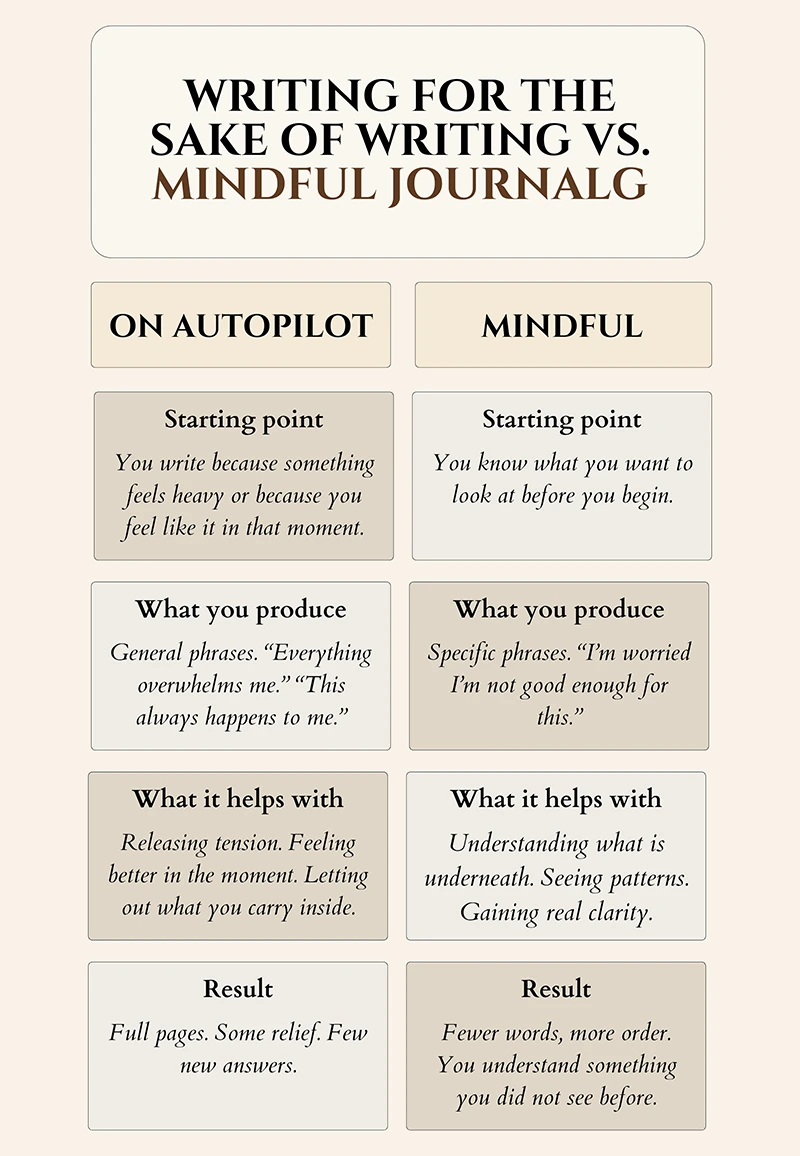
Not every kind of writing serves the same purpose. One approach can help you get started, another can help you release tension, and another can lead you to a deeper understanding of what you are going through.
That does not mean one is right and the others are wrong. It means that each way of writing can take you somewhere different.
The problem begins when you are looking for one thing but using a tool designed for another. If you want clarity but are only unloading whatever comes to mind first, it is easy to end up thinking that journaling is not helping as much as you expected.
Broadly speaking, we can distinguish three simple ways of using a journal.
01
Writing without overthinking
You sit down and start. There is no specific intention, and you do not pause very much. You simply write whatever comes up, almost as if you were talking out loud to someone.
It has one important advantage: it reduces the pressure of getting started. You do not need to know what you are going to write before you begin.
However, if you never pause to look at what you have written, it is easy to remain within what you already know. There is very little distance between the first thought and the words that reach the page.
02
Writing to let things out
Here there is already a clearer intention: you need to get something out of your system. It might be anger, fear, frustration, sadness, or simply an accumulation of thoughts.
That release can create a genuine sense of relief. Expressing something you have been carrying can make it feel lighter for a while.
But feeling better after writing does not necessarily mean you understand what is happening to you any better. Sometimes the benefit ends right there: you expressed it.
03
Writing to understand
You can start in exactly the same way: with an emotion, an idea, a situation, or something that is worrying you.
The difference comes afterward. You read what you have just written, pause, and start asking questions.
Is that exactly what you mean? What lies underneath it? Are you describing a fact or an interpretation? Is there another way of looking at it?
A journal can be a place where you record what you think, or a place where you discover why you think it.
This third way of writing is the closest to reflective journaling. You are not using your journal only to express yourself. You are also using it to think more deeply, question your first interpretations, and understand yourself better.
03 · WRITE WITH MORE INTENTION
How to start journaling more consciously
You do not need to completely change the way you use your journal. In fact, you can begin by writing exactly as you do now.
The difference is simply learning to introduce small pauses whenever a sentence catches your attention.
1
Write naturally
Do not try to make everything you write profound. Start by writing whatever you need to write.
2
Pause when something stands out
If a sentence surprises you, keeps appearing, or seems especially important, read it again before moving on.
3
Ask yourself a question
You do not need a complicated list. One good question may be enough to open a new line of reflection.
4
Continue from the answer
The point is not to answer “correctly,” but to let that new question take you a little further than your first interpretation.
QUESTIONS THAT MAY HELP
- Why is this affecting me so much?
- What do I really want?
- Which part of what I wrote is a fact, and which part is my interpretation?
- Is there something behind this reaction that I am not seeing yet?
- What could I do from here that would help me without harming anyone else?
The difference may seem small, but it can change the depth of what you write considerably. Let us look at two simple situations.
01
After an argument
You might start by writing:
“What they said really upset me.”
And then pause for a moment:
“What upset me was not only what they said, but the feeling that I was not being heard.”
The situation has not changed. What changes is how deeply you begin to understand your own reaction.
02
When facing a decision
You might write:
“I do not know what to do about this job.”
But if you keep exploring, something more precise may emerge:
“I do not know whether I really want to leave or whether I am simply afraid of change.”
Now you are no longer merely describing uncertainty. You have started to identify what may be behind it.
You do not need to analyze every sentence this way. If every journal entry turns into an interrogation, writing can become exhausting. It is enough to pause occasionally when something genuinely seems important.
04 · WITHOUT DEMANDING PERFECTION
Journaling is not about writing well
Once you start thinking about writing more consciously, it is easy to turn that into a new demand. As if every page suddenly had to be deep, clear, and useful.
That is not the point.
Writing consciously does not mean writing better. It simply means being a little more present while you write.
Some days you will arrive at an idea you had not seen before. On other days, you will simply need to let something out. And there will be pages that do not seem particularly important when you read them again.
Your journal does not need to produce a revelation every day. It also has value as a space for expression, memory, or simple companionship. Reflective writing is one possibility, not an obligation.
What matters is knowing what you are doing with that space. If all you need is to release what you are carrying, that is fine. If you are trying to understand something better, then you may need to pause, reread, and start asking questions.
IN A NUTSHELL
- Writing by itself does not guarantee that you will better understand what is happening to you.
- Free writing can help you get started and overcome the initial block.
- Writing to vent can ease some of the emotional pressure.
- Writing to understand means pausing, rereading, and asking yourself questions.
- You do not need to analyze everything you write or always reach a conclusion.
- The best way to use a journal depends on what you need at that moment.
In the end, a journal can be many things. It can be a place to unload after a bad day, preserve a period of your life, or try to understand a decision you have been putting off for weeks.
The difference lies in using it with a little intention and remembering that sometimes the most interesting sentence is not the first one you write, but the one that appears after you ask yourself why you wrote it.
TO KEEP REFLECTING
Write with more intention
You do not always need to find answers. Sometimes it is enough to write what you think, return to it, and ask yourself one more question before treating your first interpretation as final.