
Benefits of Keeping a Personal Journal for Your Well-Being

When people talk about the benefits of keeping a personal journal, they often think of simply writing down what happened during the day. That can be useful, but journaling can go much further than that.
When you practice it with some consistency, writing can also become a way to organize what is going on in your mind, understand what you are feeling, and notice things that were already there but that you had not been able to see clearly.
That is essentially what we mean by journaling today: using writing as a personal space to think, observe yourself, and process what you are going through.
In this article, we will go through the main benefits of journaling one by one, using everyday examples to understand not only what writing can offer, but also how those benefits may show up in your daily life.
IN THIS ARTICLE
01 · A QUICK OVERVIEW
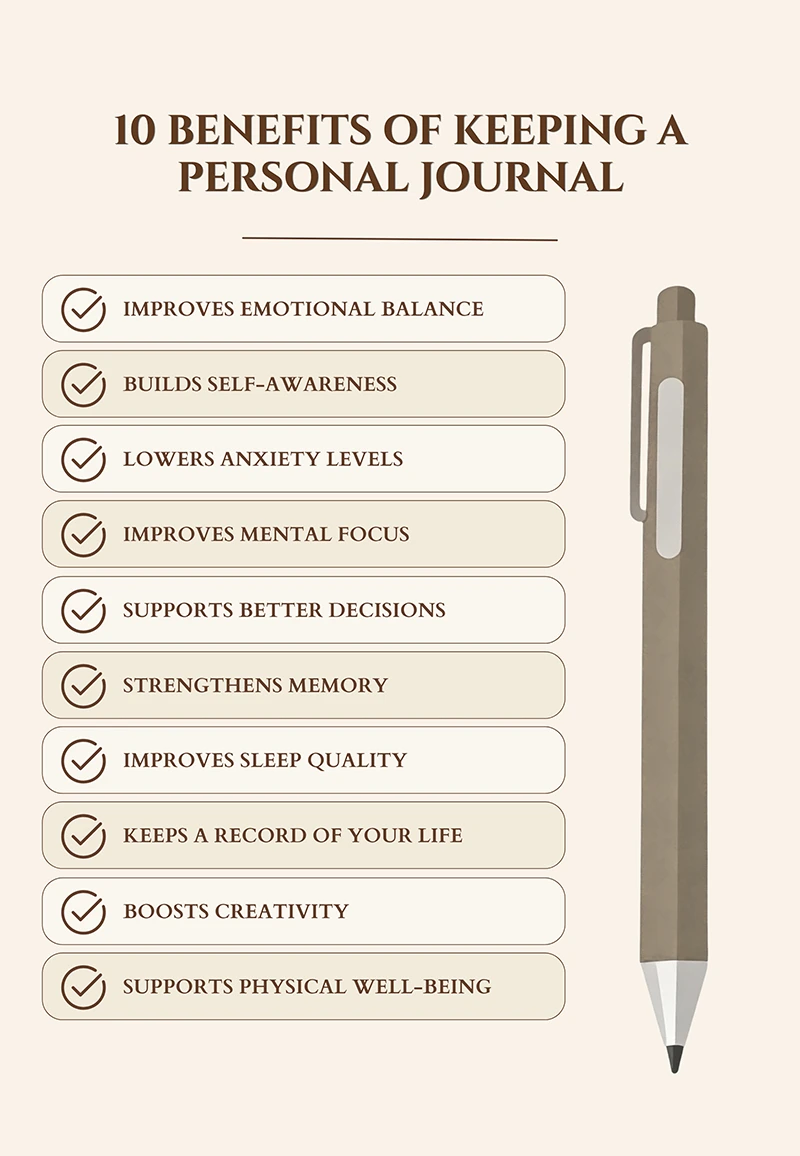
A quick overview of the benefits of journaling
Before going deeper, it helps to look at the bigger picture. Those five or ten minutes you spend writing do not have to be just another task added to your day. They can become a small space to organize your thoughts, release some mental weight, and better understand what you are carrying inside.
| Benefit | What it can offer | How you may notice it |
|---|---|---|
| Emotional regulation | Helps you organize what you are feeling | You begin to understand more clearly why something affects you |
| Self-awareness | Helps you notice personal patterns | You understand your reactions and recurring behaviors better |
| Memory | Encourages you to process what you experienced | You retain details, experiences, and lessons more clearly |
| Mental focus | Can reduce some of the mental noise | It becomes easier to see your priorities |
| Decision-making | Separates options, fears, and arguments | You can examine decisions with greater perspective |
| Reduced anxiety | Can help release repetitive thoughts | You may feel less like everything is tangled together |
| Sleep | Lets you unload unfinished thoughts and tasks | It may help you mentally switch off before bed |
| Personal record | Preserves how you experienced each stage of your life | You can look back and notice how you have changed over time |
| Creativity | Creates a low-pressure space | Ideas and connections can emerge more freely |
| Physical well-being | May accompany lower levels of stress | You may notice less tension or a lighter feeling |
WHAT THEY HAVE IN COMMON
Many of these benefits are connected. When you write, you take something out of your head, put it into words, and give yourself enough distance to look at it more clearly. That process can influence the way you think, feel, and act at the same time.
02 · UNDERSTAND WHAT IT CAN GIVE YOU
What are the benefits of keeping a personal journal regularly?
Now let’s look at each benefit in more detail. You will notice that some of these ideas overlap, because emotional well-being, mental clarity, and self-awareness do not exist in separate compartments.
1. Emotional regulation
When you write about what you are feeling, one of the first things that may happen is that whatever felt mixed together in your mind begins to take shape.
Emotions can feel confusing when they exist only as thoughts. Once you put them into words, you have to name them, distinguish between them, and consider what may have caused them.
It is a little like making a grocery list. When you are trying to remember everything in your head, you have a vague sense that you are forgetting something. Once you write it down, you begin to see what you actually need.
James Pennebaker’s research on expressive writing has examined for years the relationship between writing about emotional experiences and different measures of well-being.
In everyday life, you can see the idea in a much simpler way.
- After an argument: you may spend hours with a general feeling of anger or discomfort.
- When you start writing: that feeling becomes more specific and you begin to see what actually bothered you.
- When the details emerge: you may realize it was not only anger. There may also have been frustration, disappointment, or insecurity.
The problem may still be there, but the way you look at it changes. And when you understand what you are feeling more clearly, you also have more information to decide what to do with it.
2. Self-awareness
Emotional regulation helps you understand what you are feeling in a particular moment. When you keep writing over weeks or months, something deeper can begin to happen: you start to recognize patterns in yourself.
It is no longer only about knowing that you feel frustrated, angry, or more sensitive than usual today. You begin to notice when those feelings appear, what tends to trigger them, and how you usually respond.
Something may bother you today, you write about it, and you understand it. Weeks later, something similar happens and you recognize the pattern. Little by little, you move from thinking “I feel bad” to thinking “this tends to happen to me when something like this occurs.”
In psychology, this ability to observe your own mental processes is related to concepts such as metacognition, studied by researchers including John Flavell.
One journal entry can help you understand a moment.
Many entries over time can help you understand how you tend to respond across different situations.
You may begin to notice this when you react in a way you do not fully understand, when something affects you more strongly than usual, or when you start recognizing emotions that appear again and again in similar circumstances.
3. Stronger memory
Writing can also help you preserve an experience more clearly. Not only because it is recorded, but because telling the story requires you to select, organize, and process what happened.
Thinking “this happened to me” is not the same as trying to explain it in your own words. When you write, you have to decide what mattered, which details you remember, and what the experience meant to you.
In cognitive psychology, this relates to the idea of deeper information processing. Research such as Craik and Lockhart’s work suggested that elaborating on information can improve retention compared with more superficial processing.
01
An experience
Writing about a trip or a particular day preserves details and feelings that might otherwise fade over time.
02
Something you learn
Explaining an idea in your own words forces you to organize it and check what you have actually understood.
03
A conversation
After an intense conversation, writing can help you reconstruct what happened and identify what affected you most.
This is also why many people use journals to preserve different periods of their lives. What we do not record can change considerably in our memory as the years pass.
4. Mental focus
Some days, you do not lack ability or motivation. What you lack is clarity. You have too many things mentally open at once, and even a simple task starts to feel more difficult.
In those moments, writing can work as a kind of mental unload. You take thoughts out of working memory and turn them into something visible.
It is similar to telling someone what is on your mind after thinking about it for hours. The problem has not disappeared, but expressing it may stop it from taking up all of your mental space.
This idea can be connected with John Sweller’s cognitive load theory: when we try to keep too much information active at the same time, thinking and concentrating become more difficult.
A simple experiment: if you notice that you cannot get started on a task, spend five minutes writing down everything that is on your mind without trying to organize it. Then decide what actually needs your attention right now.
You will not have eliminated your tasks, but you may have changed the way you see them. Sometimes that is enough to regain a little focus.
5. Decision-making
Making a decision can be difficult not because you lack judgment, but because too many variables are mixed together at once: what you want, what you fear, what other people expect, the possible consequences, and all the different options.
When you put those things on paper, you begin to separate them. Writing does not make the decision for you, but it can help you look at it from the outside and notice differences between options that felt tangled together in your mind.
- When you have several options: you can write down what you gain and lose with each one.
- When you have been thinking about the same thing for days: putting it into words can help interrupt part of the loop.
- When you keep changing your mind: you can separate facts from fears and assumptions.
Writing does not make decisions for you. It helps you see more clearly what you actually need to decide.
6. Reduced anxiety
There are times when you do not just have a lot on your mind. You also keep returning to the same thoughts over and over again.
Writing can be useful because it changes the way you relate to those thoughts. Instead of thoughts appearing and disappearing in your mind, you have concrete words in front of you that you can observe, organize, and question.
This relates to what psychology calls rumination, studied by researchers such as Susan Nolen-Hoeksema: repetitive patterns of thinking that can maintain or intensify emotional distress.
IF SOMETHING KEEPS GOING AROUND IN YOUR HEAD
What exactly am I worried about?
Try to write it in one clear sentence. Then separate what you know for certain from what you are still imagining or anticipating.
Writing will not make the problem disappear, but it may give you some relief and, more importantly, more mental space to think about what to do next.
7. Better sleep
Another less obvious benefit has to do with bedtime. You may feel tired, but your mind keeps reviewing worries, unfinished tasks, and ideas you do not want to forget.
A 2018 study by researchers at Baylor University compared writing down unfinished tasks before bed with writing about tasks that had already been completed. In that study, participants who wrote a specific to-do list fell asleep more quickly.
The logic is simple: once something has been written down, you no longer have to keep trying to hold it all in your mind.
Try writing for five minutes before bed.
Write down what is worrying you, what you do not want to forget tomorrow, and any thought that is still demanding your attention. You do not need to solve it that night.
8. A record of your own life
A journal preserves something that photographs and calendars do not always capture: how you were actually experiencing what was happening.
Memory changes over time. We forget details, simplify events, and reinterpret earlier stages of our lives from the perspective of who we are now.
In autobiographical psychology, researchers such as Dan McAdams have studied the relationship between the stories we construct about our lives and our sense of identity.
A journal allows you to go back and meet the version of yourself who was actually living through that moment.
Looking back
You discover that something that felt enormous at the time barely matters to you now.
Comparing different stages
You can see changes in the way you think, react, or make decisions.
Recognizing patterns
You begin to notice situations and emotions that have repeated over time.
9. A boost in creativity
Journaling offers something especially valuable for creativity: a space where you do not have to get it right.
No one is judging the result, you do not have to publish what you write, and you do not need to reach a conclusion. That lowers some of your internal filters and allows connections to emerge that you might dismiss too quickly in another setting.
Classic research on creativity by J. P. Guilford helped popularize ideas such as divergent thinking: the ability to generate different possibilities before settling on a single answer.
Do not always look for a brilliant idea. You can start by writing about something completely ordinary. Interesting connections often appear precisely when you stop trying so hard to find them.
10. Physical well-being
Even though writing is a mental activity, what happens in our minds and what we feel physically are not completely separate.
When some of the emotional load or stress decreases, some people also notice physical changes: less tension, a greater sense of relaxation, or simply the feeling of being lighter after expressing what they had been carrying inside.
Research on expressive writing, including work associated with James Pennebaker, has also examined possible effects beyond psychological well-being.
It is worth putting this benefit into context. Writing can be part of a healthy routine, but it is not medical treatment and it does not replace professional care when a physical or psychological problem requires it.
There is nothing magical about finishing a page and feeling some relief. Sometimes you have simply spent a few minutes slowing down, expressing what you had been carrying, and no longer keeping everything inside.
03 · OTHER WAYS TO USE WRITING
Well-known people who have used personal writing
Writing for yourself is nothing new. Throughout history, people have used notebooks, journals, and personal notes for very different purposes: reflection, observation, creativity, or decision-making.
01
Marcus Aurelius
The personal reflections we now know as Meditations were not originally written as a book for publication, but as private notes to himself.
02
Leonardo da Vinci
His many notebooks contained observations, drawings, questions, and ideas. Writing and sketching were part of the way he explored what he saw around him.
03
Tim Ferriss
He has spoken on different occasions about writing exercises he uses to think through decisions, face fears, and put problems into perspective.
04
Emma Watson
She has spoken publicly about using different notebooks and journals to record different areas of her life.
These examples are very different from one another, and that is exactly what makes them interesting. There is no single correct way to use a journal. For some people it is a tool for reflection; for others, observation, creativity, memory, or simply a place to organize their thoughts.
04 · START WITHOUT OVERCOMPLICATING IT
A few final things to know before you start journaling
When you first start, it is normal not to know exactly what to write or to feel as though you should be doing it differently. If you are not used to slowing down and putting your thoughts into words, the first few attempts may feel a little unnatural.
How long do I need to write?
You do not need to spend an hour. Five or ten minutes can be enough if that time helps you slow down and pay attention to what you are writing.
Do I have to write every day?
Not necessarily. You can make it a daily habit if that works for you, but you can also use your journal only when you need to organize something, make a decision, or unload what is on your mind.
What if I do not know what to write?
Start with something very simple: what has taken up the most space in your mind today, how you feel right now, or what situation you would like to understand better.
Do I always need to reach a conclusion?
No. Sometimes writing is useful precisely because it helps you recognize that you do not have an answer yet. The value is not always in solving something, but also in understanding the question more clearly.
TO START TODAY
What is taking up the most space in my mind right now?
Do not try to write something profound. Start by answering that question honestly and let the next sentence grow naturally from the one before it.
Over time, writing usually starts to feel more natural. You worry less about finding the perfect words and begin using your journal simply as a place to pause, think, and listen to yourself with a little more attention.
TO KEEP WRITING
Make space to write
You do not need to write a lot or do it every day. What matters is having a place where you can pause, organize what is on your mind, and return to your own words when you need to better understand a stage of your life, an emotion, or a decision.