The Benefits of Handwriting: Why Paper Still Matters

Paper has a list of shortcomings that would sink almost any digital product pitch: it doesn’t sync files, doesn’t keep previous versions and, when we write something foolish, doesn’t even have the courtesy to offer an undo button. At a technology company, the proposal would never survive its first meeting.
Yet the notebook is still on the table. Not just in the homes of nostalgic people, either: it also belongs to those whose phones hold more writing apps than they will probably ever open. Sometimes they want to sort out an idea; sometimes to write a letter. Often, they simply appreciate being able to do one thing without twenty others demanding attention.
The return to analogue things does not mean the future has failed. Having learnt to do almost everything through a screen, we are beginning to distinguish what we can do faster from what we would rather experience differently. Handwriting offers a particularly revealing example.
IN THIS ARTICLE
01 · THE RETURN OF PAPER
Paper has not handed in its resignation
First the road atlas disappeared from the glove compartment. Then address books lost their purpose, and compact cameras gradually gave way to smartphones. The notebook seemed destined to follow: few tools make it as easy to search, edit and share a note as an app does.
But the replacement was never complete. A pocket diary can live alongside a synced calendar; a photograph can sit in the cloud before finding its way into a physical album months later. Nor should we call every notebook sold a cultural revolution. It is enough to notice that usefulness alone no longer explains every choice we make.
A trend announced on the internet
The very networks that once promised to make paper obsolete are full of communities devoted to handwritten journals, letters and film cameras. There is often an obvious pleasure in beautiful objects. Denying that would be naive. But a photograph of a spotless desk hardly explains why someone goes back to writing after the camera is turned off.
Writing a letter means deciding what deserves to stay on the page, finishing it and sending it knowing the answer will not come within seconds. Instant messaging has solved the problem of distance remarkably well; a letter, in exchange, preserves a delay that changes both what we say and what we expect. Neither format needs to declare victory.
01
Choosing a single object
A notebook does one thing rather well: it is ready when you want to write. There is no app store waiting behind the last page.
02
Giving words a physical form
A letter can be folded and kept; a sheet can acquire stains, notes in the margins or a date that takes on meaning months later.
Nostalgia, yes. But not just nostalgia
Someone may pick up a grandfather’s fountain pen because of the memories it holds; another person buys a first notebook for the simple pleasure of opening it. Both experiences belong to the same trend, although only one is rooted in nostalgia. Someone who grew up exchanging messages may not see a letter as a return to childhood. They may discover something genuinely new.
It would be a shame to turn that preference into another shopping obligation. Thirty markers and a brand-new planner may be fun, but no idea has ever refused to arrive for lack of stationery. A sheet of paper folded in half usually does the job. It may be less photogenic; as a place to write, it is surprisingly capable.
Not everyone is abandoning screens. You can enjoy a notebook and still be grateful that GPS gets you somewhere without unfolding a map across the steering wheel.
We do not need to choose between living in the present and keeping a notebook. What deserves attention is the change in experience: what happens to an idea when, instead of typing it, we have to shape it letter by letter?
02 · ONE IDEA, TWO APPROACHES
The keyboard gets there first; the hand takes another route
A keyboard lets us write almost as quickly as people speak. A pen imposes another pace: every word has to travel across the page. The difference seems slight until someone begins talking quickly and we discover that our hand has no intention of keeping up.
It isn’t only about speed
Typing lets us capture far more words. By hand, we often have to choose. That selection may force us to understand something before noting it down, but it may also cost us a sentence we needed to keep. Slowness is not a virtue simply because it is slow.
The surface also changes the way we organise our thoughts. A digital document provides tools for arranging information; a sheet of paper accepts, without complaint, a crossed-out word, a circled figure or two ideas connected from opposite corners.
The freedom of a page without menus
In a meeting, someone mentions a deadline that depends on a budget decision. One person opens a spreadsheet and puts each detail in its column; another writes the date in the centre of a page, circles the figure and draws an arrow between them. Both sets of notes can be rigorous. What differs is the way the relationship becomes visible.
We needn’t turn every doodle into an intellectual achievement, either. For transcribing an interview, working with others remotely or revising a document twenty times, a keyboard has advantages that are hard to dispute. But some tasks remind us that speed and convenience are not the only things that matter.
Sometimes we write to reach the finished text as quickly as possible. At other times, we write to discover what we wanted to say.
03 · BETWEEN SCIENCE AND EXPERIENCE
Six benefits of handwriting, without supernatural powers
If every headline about handwriting were true, buying a notebook would be enough to improve our memory, sharpen our concentration, generate brilliant ideas and sleep soundly. An extraordinary investment. The research is less emphatic: some benefits emerge in specific situations, while others depend on the task and the way we write.
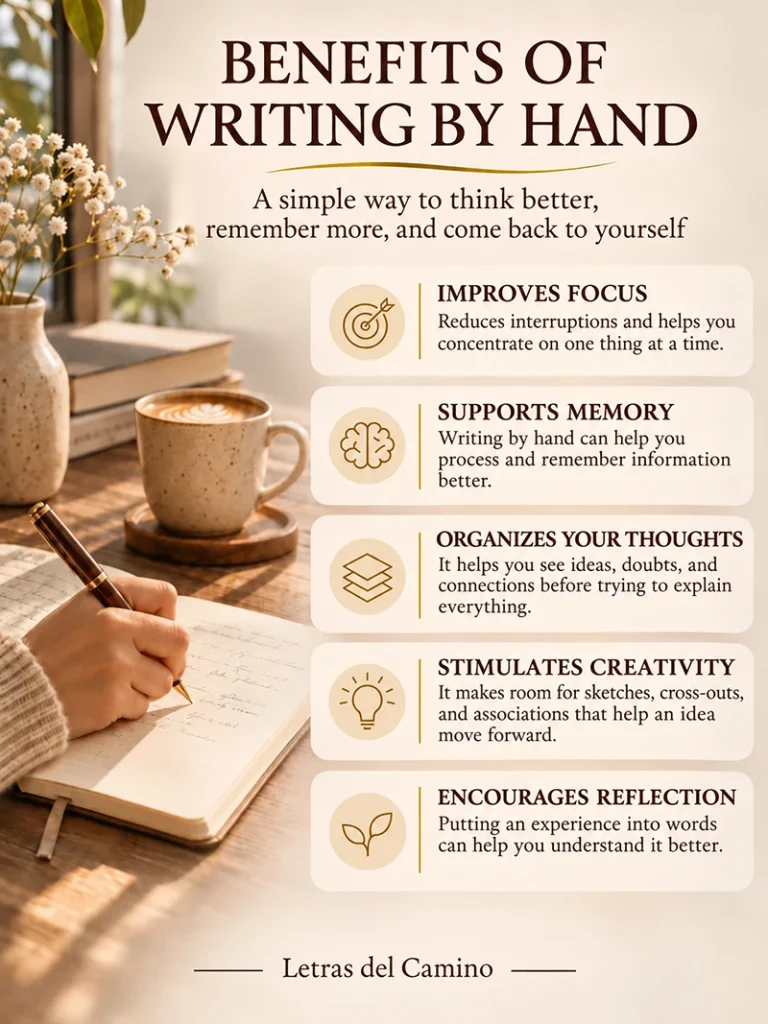
1. Learning: fewer words can sometimes go further
In 2024, a meta-analysis in Educational Psychology Review brought together 24 studies on university note-taking. It found an average academic-performance advantage among students who took and reviewed handwritten notes. Those who typed, however, recorded more information. The findings are not contradictory: writing down more and learning better are not necessarily the same thing.
That does not mean paper wins every comparison. Another review, published in 2022 in Contemporary Educational Psychology, found no overall advantage for either medium when distractions were controlled. Study methods, the task and the surrounding environment also matter.
What the research actually tells us
The evidence on note-taking does not mean that anything written by hand will be remembered better. These results come from specific learning situations, not from some magical property of a pen.
2. Attention: one less screen, a few fewer interruptions
A notebook never interrupts a sentence to tell us someone has reacted to a photograph. Without notifications, one particular source of disruption disappears, and we may find it easier to stay with a task.
It does not make us immune to distraction: the human mind was finding ways to wander centuries before Wi-Fi. A computer configured for uninterrupted work can also provide peace. Paper merely removes a few obstacles. Sometimes that is enough.
3. Thinking: letting ideas remain untidy
Some problems refuse to line up neatly. A decision about changing jobs may involve money, working hours, ambition and the fear of making a mistake. On paper, words can sit apart, connect through arrows or gather in clusters without any plan in advance.
Drawing three arrows does not solve the problem, but at least the disorder becomes visible. We can examine it before pretending everything fits into a flawless explanation.
4. Creativity: working with drafts we can see
On a sheet of paper, the discarded title remains. Beside it lies an unsuccessful sketch, an underlined word and a circle whose purpose we are still trying to work out. The page does not look finished; that is precisely why it reveals the tentative result and the route we took to reach it.
Ideas arrive at keyboards too. There is no solid proof that paper makes someone creative by itself. It does, however, offer a flexible surface to anyone who likes mixing words, scribbles and associations without choosing a format first.
A
To understand
A sketch of figures, arrows and questions lets us examine relationships before putting the explanation into sentences.
B
To invent
A page full of abandoned possibilities may be where the one you had not yet imagined finally appears.
5. Personal expression: finding words for something confusing
Writing about an experience requires us to look at it carefully. A conversation that seemed insignificant can acquire weight when we recall the precise words, a moment of silence or what we chose not to answer. The page does not know our reasons. In trying to explain them, we sometimes begin to understand them ourselves.
Research on expressive writing has found small positive effects on certain measures of emotional distress. A 2023 meta-analysis examined 31 studies and found small overall reductions in symptoms of stress, anxiety and depression in the samples studied. That does not make writing a universal therapy, nor does it show that these effects depend on handwriting.
6. Memories: capturing what later changes
Years later, we might remember a move as one chaotic month. A note written during those days could bring back a detail missing from that summary: the neighbour who lent a ladder, the cat hiding under a box, the first coffee drunk sitting on the floor.
A digital journal can preserve those scenes too. Handwriting adds a material dimension: letters that rush towards the bottom of a page, a crooked line, a word that would not fit and ended up in the margin. None of this proves we remember better. What survives, alongside the words, is something of the gesture that made them.
IN SHORT
- In some educational settings, studies suggest benefits from handwritten notes, but results depend on the context.
- A notebook can reduce digital interruptions and allow room for drawing, connecting and crossing things out.
- Writing about experiences may help because of the process of putting them into words, even when done digitally.
- There is no scientific obligation to write by hand: what matters is why and how we use each medium.
04 · THE TRACES WE LEAVE
The small biography of a crossed-out word
The signature we scribble when accepting a parcel may be illegible. The same handwriting at the end of a dedication becomes an unmistakable reminder of who wrote it. Sometimes we keep a card for years even though its message would fit easily on a phone. Asked why, we would probably begin by talking about the person, not the words.
The words could be copied without losing a comma. But the card keeps a fold, a date and the trace of the time someone gave to it. We needn’t set it against a voice message: both can move us. Some objects simply preserve more than the information they contain.
Imperfection needs no defence
When preparing for an exam or submitting a report, a crossing-out may be exactly what we want to avoid. Digital editing has the advantage of erasing without leaving a trace. On a personal page, though, a visible correction need not be a flaw. We can leave it there and carry on, without spending ten minutes pretending we got it right the first time.
A page does not have to turn out well to have been worthwhile.
The page lets us see part of the journey. What we said first. What we replaced later. Even the thought that came too late and ended up beside an asterisk in the margin. Some pages deserve to be kept; others can go straight into the recycling. Both have served their purpose.
05 · NO NEED TO TAKE SIDES
Paper is not a hero, and the screen is not the enemy
A poem can begin on a napkin and pass through twelve digital versions. An invitation designed on a computer may end with a handwritten dedication. In ordinary life, the two formats coexist without much conflict; we are usually the ones insisting that they must be enemies.
A comparison is useful when it concerns actual tasks, not when we demand loyalty to a tool.
| What you need | Paper | Digital |
|---|---|---|
| Sketching an idea | Draw or jot things down without setting anything up | Rearrange and expand with ease |
| Sharing a text | Give someone a physical note | Send it and edit it together |
| Finding something old | Browse pages and their marks | Search words or dates in seconds |
| Keeping a journal | Keep a physical notebook | Access your writing and back it up |
Accessibility also matters. An adapted keyboard or speech-to-text can make writing possible for someone who finds holding a pen difficult. At the other end of the spectrum, someone who spends hours at a screen may prefer to end the day with a notebook. Choice means very little if we turn it into another obligation.
One possible combination: sketch a project by hand, draft it on a computer and return to paper when you need to see the whole picture. Or do the reverse. The tools will not take offence.
06 · RETURNING WITHOUT CEREMONY
Five perfectly good excuses to pick up a pen
We have a remarkable talent for turning a simple gesture into an organisational project. Before writing a single sentence, we may have selected a notebook, compared pens and designed a routine for the next six months. By the end, the preparation has filled more pages than the journal.
No ceremony is required to begin. These five suggestions let you try paper without adding another duty to your calendar.
1
The disappearing list
Write down what you need to make a meal. Cross things out, change the order and throw the sheet away when its work is done. Not everything we write needs to be kept.
2
A recommendation in your pocket
Jot down the name of a film or place someone mentioned. Add who recommended it: that detail often disappears from memory before the title does.
3
A letter you don’t have to send
Write to someone you have not seen for a while. Tell them what made you think of them. An envelope and stamp are optional.
4
A map of an idea
Put something you are thinking about in the centre of a page. Around it, write what you know, what you doubt and what you still need to ask.
5
Three lines about an ordinary day
Don’t try to summarise the entire day. Choose something specific: a conversation, a small surprise, a remark that made you smile. If you feel like writing more, the page is there.
Perhaps you will never repeat any of these activities. We do not have to turn every enjoyable experience into a measurable habit; it is one of the more exhausting fashions of modern life. Handwriting can occupy one Tuesday and disappear until next month. Paper won’t be counting.
07 · WRITING WITHOUT AN AUDIENCE
A personal journal does not require a life worthy of a novel
Personal journals carry a rather unfair expectation: they seem reserved for people who experience momentous events and have a profound conclusion ready every evening. Fortunately, most lives contain a considerable number of perfectly ordinary Tuesdays.
One such Tuesday might include a conversation we replay on our way home because we did not say what we meant to. It may not deserve a novel, but putting it into words might reveal that it has been on our mind for days. An experience’s value is not always reflected in how dramatic it appears.
A page is not an official statement
When we send a message, we anticipate how another person will read it. A journal allows us to write without that negotiation. We can leave an opinion half-formed, acknowledge that we think differently today or stop before reaching a conclusion. Nobody is asking us to defend our draft in public.
Of course, a blank page can sometimes look excessively blank. Instead of asking yourself what happened today, it may help to begin with a narrower question. Not “How is my life going?”, but something like this:
A QUESTION TO WRITE ABOUT
Which moment this week would you describe differently if it happened again?
Choose one specific situation. Describe what happened and what you would change in the way you tell the story now. You do not have to reach a conclusion.
Letras del Camino guided journals begin with that possibility: offering a question or a concrete situation when the blank page feels too large. The prompt guides the beginning, but it does not decide what we should think or predict what we will discover.
You can write in a notebook, use an app or alternate between the two. What matters is having a space you can return to without explaining the empty pages. Three weeks without writing do not require an apology.
An unpoetic but useful precaution: if you are keeping intimate thoughts, consider where you leave your notebook or how you protect a digital file. Privacy is part of the writing experience too.
08 · REASONABLE QUESTIONS
Frequently asked questions about handwriting
Paper needs no instructions to work, yet some of the claims made about its virtues are remarkably categorical. These answers separate what research suggests from what depends on individual experience.
Does writing by hand help you remember things better?
Some educational studies have found benefits from taking and reviewing notes by hand. It is not a guarantee for every task or person: how you summarise and study matters too.
Is it better to take notes on paper than on a computer?
It depends on the goal. In some studies, handwritten notes are associated with better learning outcomes, while typing captures more information. Other research finds no difference when distractions are controlled.
Can keeping a journal reduce stress?
Some studies on expressive writing find small average benefits in the groups examined. It does not happen for everyone, it does not replace professional care, and those results do not show that paper is superior to digital writing.
Do I need to write every day?
No. An occasional letter, a notebook for ideas or an irregular journal are all ways of writing by hand. The frequency can fit around your life.
Can I combine a paper journal with a digital one?
Of course. You may enjoy writing by hand when you have time and use your phone to capture a fleeting idea. The important thing is that both methods work for you.
09 · TO FINISH
A technology that needs no updates
Paper will continue to lose plenty of contests against a screen. It cannot find a word among a thousand pages in a second or send a letter across the world without an envelope. Unfortunately for its development department, the next notebook release is unlikely to fix those shortcomings.
There is no reason to give up those advantages. Precisely because technology allows us to do so much efficiently, we can choose to reserve a few things for a different experience, even if it takes longer.
The freedom to choose also means being able to write slowly when nobody is making us hurry.
Next time you need to jot something down, you will probably reach for your phone. Perhaps you will pick up the pen left on the table. Neither choice deserves a medal. It is simply worth remembering that the choice is still ours.
KEEP WRITING
From thought to page
If you feel like moving from reading to practice, here you will find products from the Writing category. Of course, a blank sheet is still enough to get started.