50 Questions to Get to Know Yourself Better

When someone asks, “How are you?”, you probably don’t need long to think of an answer. “Fine”, “Getting by” or “Busy as ever” usually does the job. But if they ask, “What have you been missing lately?”, you may need a moment to work that out.
We can remember everyone’s schedules, the week’s obligations and even our colleagues’ habits, yet we don’t always know how to explain what we want, what bothers us or why we keep making certain choices. It’s not that we aren’t interested in ourselves. Very few conversations take us that far.
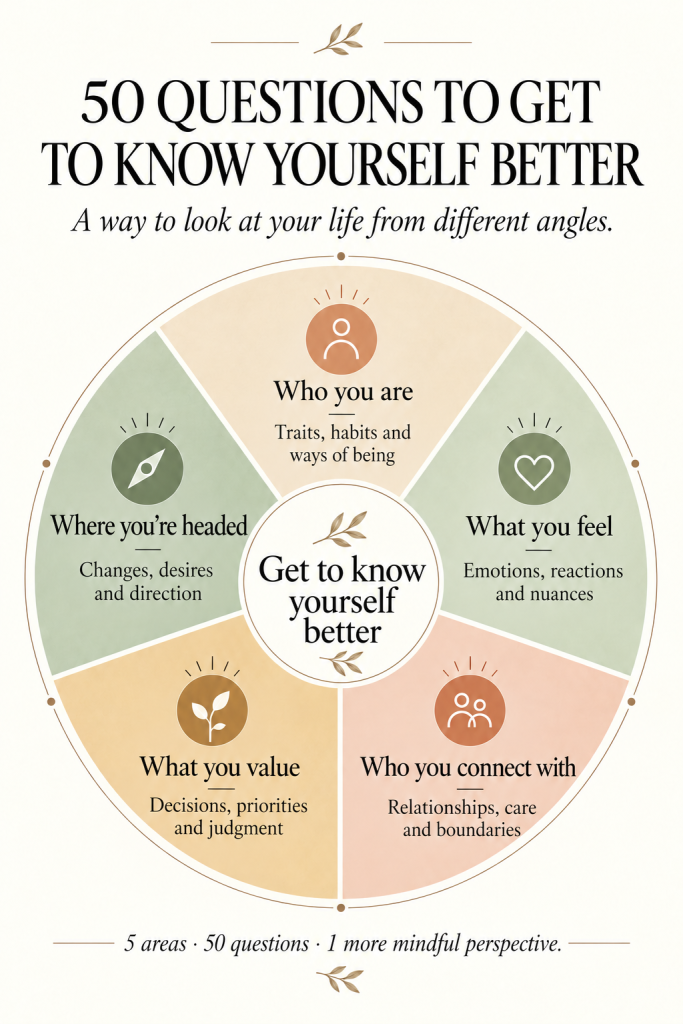
These 50 questions to get to know yourself better explore five areas: your personality, emotions, relationships, decisions and hopes for the years ahead. Some will be easy to answer. Others may bring back moments you hadn’t thought about in years.
This isn’t a test, and no answer makes you a better person than another. You can think about the questions, discuss them with someone or write in your journal. There’s no deadline for finishing the list.
IN THIS ARTICLE
01 · BEFORE YOU ANSWER
What a description can’t tell you about yourself
Someone might describe themselves as easy-going while spending a whole month snapping at people. Someone else claims to hate spontaneity but still fondly remembers a holiday they took without booking anything. Labels help us introduce ourselves, but they rarely tell the whole story.
That doesn’t mean a description is wrong. We behave differently depending on the moment, the people around us and our circumstances. Asking about specific experiences reveals things that won’t fit into a word like “shy”, “responsible” or “independent”.
We’ve arranged the questions in five sections so you can go straight to the one that interests you most.
| Section | Questions | What to look for |
|---|---|---|
| Personality | 1–10 | Your habits and the things you do naturally |
| Emotions | 11–20 | What you feel and how you respond |
| Relationships | 21–30 | How you connect with other people |
| Decisions and values | 31–40 | What you choose and put first |
| Change and the future | 41–50 | What you want to keep, try or change |
A WAY TO APPROACH THEM
Your answer doesn’t have to sound clever or final. “I don’t know” is a perfectly reasonable place to begin, as is remembering a conversation without being sure what it meant. You might answer differently in a few years, and both answers would tell you something about yourself.
02 · THE 50 QUESTIONS
50 questions to get to know yourself better, grouped by topic
You don’t have to answer them in order. Each question comes with a short reflection to help you recall an experience, picture a scene or find a starting point. If you’re writing, describe something that actually happened: what you said, where you were, how the other person reacted. That often tells you more than an impressive-sounding description of yourself.
1. Your personality and the way you are
If someone asked you to describe yourself in three words, you’d probably reach for familiar ones. But your personality also shows up in how you spend an unplanned Sunday, which moments from a trip stay with you, and what you could happily talk about for hours.
These first ten questions begin with ordinary situations. The aim isn’t to uncover a secret personality trait, but to notice habits and reactions you rarely mention when talking about yourself.
1. When is it easiest to be yourself without worrying how you come across?
With some people, you don’t worry about sounding interesting. With others, you rehearse every sentence before saying it. Notice when that self-consciousness fades. It might be around a particular person, in a familiar place or while doing something you’re good at. The difference says a lot about where you feel comfortable.
2. Which of your habits describes you better than any adjective?
Think of the things you do without being reminded: opening the windows first thing, always arriving early, saving concert tickets or cooking for other people. We hardly ever mention these habits when describing ourselves, but the people we live with would recognise them immediately. Choose one that stays with you even when your routine changes.
3. What everyday thing almost always puts you in a good mood?
The smell of bread as you pass a bakery, finding a seat on the train, hearing a song you haven’t played in years. A good mood doesn’t always follow wonderful news. Remembering what lifts yours can show you what you genuinely enjoy, beyond the things you usually say you like.
4. What do you usually do with a completely free afternoon?
An afternoon without plans can fill up with errands or turn into three hours of reading, walking or watching videos. What’s interesting is what you choose when nobody is setting the timetable. There’s no need to judge whether you used the time well: how you spend it says something about both your preferences and how tired you might be.
5. What about you surprises people who don’t know you well?
Perhaps you seem quiet at first but end up talking more than anyone at the table. Or you appear confident even though you second-guess every decision. Think of a time someone said, “I didn’t expect you to be like that.” Their surprise may reveal the gap between a first impression and the side of you that appears with trust.
6. What do you do differently around someone you trust?
With certain people, we ask for things without rehearsing, allow ourselves a bad mood or share an idea before it’s fully formed. With others, we carefully choose what to reveal. Neither version has to be fake. Notice what changes in your voice, jokes or silences when you know you don’t have to explain yourself.
7. What opinion have you changed significantly in recent years?
You may once have thought city living was essential and now prefer being close to home. Or perhaps you’ve changed your mind about work, friendship or money. Try to remember what shifted that opinion. A change of heart doesn’t always come from one dramatic revelation; it can be the result of many perfectly ordinary Tuesdays.
8. What plans do you agree to out of obligation, even when you don’t want to go?
A crowded birthday party, yet another work dinner, a hike everyone else has signed up for. It’s easy to agree before asking yourself whether you want to. Recall the last time you said yes to avoid disappointing someone and how you felt when you arrived. Perhaps the problem wasn’t the plan, but not giving yourself a choice.
9. What part of your everyday life would you like to keep exactly as it is?
When we think about change, we tend to focus on what’s missing. But some routines deserve to stay: leisurely Sunday breakfasts, a weekly call, the walk you take to work. Naming something that works helps you avoid overlooking it when you rearrange everything else. When in your day do you feel that nothing needs fixing?
10. What skill do you use so often that you barely notice it?
Some people smooth over disagreements, find shortcuts through bureaucratic tasks or explain difficult ideas without making anyone feel foolish. When something comes easily, we stop recognising it as a skill. Remember a time someone thanked you for something you’d done almost without thinking.
To make it more concrete: use last week as your starting point. It’s easier to describe what you did on Saturday than explain what you’re like “in general”.
2. Your emotions and how you respond
We don’t always recognise what’s happening inside us while it’s happening. You might be irritable all morning and only later realise you’ve been worried for days. Even moments of happiness can slip by between one errand and the next. These questions look at both what you feel and what you do with those feelings.
11. Which emotion is hardest for you to recognise when it appears?
Sadness can feel like exhaustion, nerves like anger, disappointment like an urge to leave. We don’t always identify a feeling in the moment. Think of a situation where you understood your reaction only hours later. What you said at the time and what you realised afterwards may be two different things.
12. What signs tell you that you need a rest?
Some signs appear before you admit you’re worn out: reading the same email three times, snapping at someone or no longer enjoying a familiar activity. Everyone has their own. Think back to your last particularly demanding stretch and look for the first warning you remember, not the moment you finally ran out of energy.
13. What recent situation made you react more strongly than you expected?
An innocent remark might have left you angry all afternoon, or a ten-minute delay might have pushed you over the edge. There’s usually a story behind a reaction: you were in a hurry, hadn’t slept well for days or were already bothered by the issue. Reconstructing that context can change how you remember the incident.
14. How do you usually hide the fact that something has upset you?
Smiling when you’re uncomfortable, saying “it doesn’t matter” too quickly or changing the subject are familiar tactics. They may prevent an argument at the time but leave things unresolved. Recall when you last did this. Were you protecting a relationship, avoiding a scene or simply giving yourself time to work out what you thought?
15. Which conversation do you keep replaying even though it’s over?
A conversation can last fifteen minutes and stay with you for days. You return to a sentence, imagine a different reply or try to interpret a gesture. Rather than replay the whole exchange, find the part you keep returning to. Perhaps there was something you didn’t say, or it touched an older worry.
16. When do you tend to compare yourself with other people?
Comparisons sometimes arrive uninvited: a holiday photo, hearing what an acquaintance earns, learning about the plans of someone your age. What catches your attention may point to something already on your mind. It’s also worth considering how much you don’t know about that other person’s life.
17. What helps you regain your calm when a day goes wrong?
One person goes for a walk without their phone, another calls their sister, someone else needs to make dinner in silence. The same way of unwinding won’t work every time. Remember what you did after a difficult day and whether it helped. You may also recall one of your usual solutions that didn’t work that time.
18. What kind of comment affects you more than you’d like?
Not all opinions affect us equally. A joke about our appearance might roll off us, while a remark about our work stays with us for days. The words matter, but so do the person who says them and the timing. Recall a comment that remains vivid and place it back in the relationship where it was said.
19. What recent moment of happiness passed so quickly you barely noticed it?
Some happy moments fit inside a voice message, a pleasant walk or news you shared while putting away groceries. Because they don’t feel like major events, we quickly forget them. Think back over the past few weeks and retrieve something lovely that you didn’t photograph or particularly celebrate.
20. When did you last admit you’d reached your limit?
We often know we’re taking on too much before we say so. We accept another task, answer messages at night or postpone rest until everything is finished. Recall when you finally had to say “enough”, even if that meant cancelling an appointment. What happened before you could acknowledge that limit?
When an answer is hard to find: choose something that happened in the past few days. You don’t need to go back to childhood to talk about how you feel today.
3. Your relationships and the people around you
With some people we speak freely; around others we change our tone almost without noticing. That doesn’t automatically make one relationship good and another bad. These questions focus on how you behave with others, what you appreciate about their company and what you find difficult to say.
21. Who can you be silent with without feeling you need to fill the gap?
Shared silence can be awkward, or as comfortable as a familiar room. Think of someone you don’t have to talk to in order to show you’re there. Perhaps it’s during a car journey, while cooking together or waiting for the bus. That ease says a lot about the way you keep each other company.
22. What gesture makes you feel cared for?
Sometimes it’s enough for someone to remember how you take your coffee, message to check you’ve arrived safely or sit beside you when you don’t feel like talking. We don’t all recognise affection in the same way. Recall a recent gesture that made you feel considered, even if the person doing it thought nothing of it.
23. What do you find difficult to ask of the people closest to you?
Asking someone to accompany you to a medical appointment, admitting you need help with paperwork or saying you’d like an afternoon alone. We often assume others should notice without being told. Think of something you’ve been silently hoping for and how you might ask for it in your own words, without overexplaining.
24. What role do you usually take in your groups of friends?
In one group you may always organise plans; in another you’re the listener, the joker or the person who calms an argument. These roles can develop without anyone assigning them. Think of your last get-together and notice what you did instinctively. You can also ask whether you still enjoy that role.
25. Which conversation are you putting off because you don’t know how to begin?
Some conversations are hard not because of what we need to say but because of the reaction we imagine. Saying something hurt, asking for a change or admitting a mistake can be postponed for weeks. Write down the first sentence you’d say if the person were in front of you. You don’t have to script the rest.
26. What have you stopped doing at some point in order to fit in with someone?
Perhaps you started listening to music you didn’t enjoy, changed how you dressed or kept an opinion to yourself to avoid standing out. Adapting to others is part of getting along; always giving up what’s yours is another matter. Remember one specific occasion and how it feels to look back on it now.
27. What tells you that you feel at ease in a relationship?
Feeling comfortable doesn’t mean never arguing. It might mean being able to make a mistake without fearing ridicule, suggest plans without justifying them or disagree without it becoming a drama. Think of a relationship that’s good for you and describe an ordinary moment when that ease was apparent.
28. Who would you like to spend more time with this month?
We say “we must catch up” and months disappear between work, travel and chores. Choose someone whose company you miss and think about when you last saw them. Perhaps you’d like to revive an old routine or simply set a date. Caring about someone doesn’t always show in how often you meet.
29. What boundary would you like to express more clearly?
A boundary doesn’t have to be stated angrily. It might be saying you don’t answer work messages after a certain hour or would rather people called before dropping by. Notice a recurring situation where you tend to give in. Being clear about what you need doesn’t mean justifying every detail.
30. Who has taught you something about yourself without meaning to?
Some friendships reveal how patient we can be; others bring out a sense of humour we rarely use. Even a difficult relationship can show how we respond to criticism. Think of someone who has changed how you see yourself and remember a particular occasion. They don’t have to be part of your life today.
Relationships can reveal sides of us that are harder to notice when we’re alone.
4. Your decisions, values and priorities
It’s easy to say we value friendship, rest or freedom of choice. Then comes a busy week, an unexpected invitation and three problems to sort out. Our decisions happen in the middle of all that. These questions look at what our priorities become in practice, without demanding perfect consistency.
31. What recent decision did you make with other people’s needs more in mind than your own?
Agreeing to a family obligation, changing your holiday plans or staying late to help a colleague can be generous. It can also leave you feeling your needs were overlooked. Look at a recent choice without deciding beforehand whether it was right or wrong. Whose voice did you listen to most as you made it?
32. What matters to you enough that you wouldn’t trade it for more money?
Money makes many things easier, but some things come at a cost beyond the price tag. Perhaps you wouldn’t trade family dinners, time to care for someone or living near your friends. Choosing one of these helps you define what a satisfying life means to you, beyond how much you’d like to earn.
33. What commitment do you keep because it still matters to you?
Sticking with a project takes effort, but not every commitment becomes a burden. Some remain meaningful for years: playing on a team, tending a garden or volunteering. Think of something you continue because you want to, not because you’d feel guilty stopping. What still makes it worth your time?
34. What do you do when your plans clash with what you need?
You fill a week with plans, then on Wednesday you need sleep, solitude or to postpone a meeting. Some people change course easily; others feel they’ve failed by doing so. Recall the last time your body or mood asked for a different plan. What’s interesting is how you negotiated that change with yourself.
35. What do you keep doing simply because you’ve always done it that way?
A habit can have good reasons behind it or simply be something no one has questioned: shopping in the same place, attending every gathering or keeping up a task that used to be necessary. Choose something you do on autopilot and try to remember how it began. Perhaps it still suits you; perhaps you’ve stopped asking.
36. Which part of your calendar best reflects your real priorities?
A calendar tells a story, although it also contains obligations we haven’t chosen. If you say friendship matters but rarely make time to see your friends, that tension is worth noticing. Compare one priority you talk about with what happened this week. This isn’t an exercise in keeping moral accounts of your time.
37. What mistake changed the way you make decisions?
After losing money, trusting the wrong person or taking on too much work, you may have learned to ask questions, read carefully or seek advice before deciding. Mistakes don’t always teach clear lessons, but some really do change our habits. Find one that made a visible difference to how you act.
38. What helps you choose when you like two options equally?
Two appealing jobs, holiday destinations or evening plans can leave you stuck. When neither is an obvious winner, we often rely on criteria we rarely explain: proximity, peace, novelty or company. Think of a recent choice and what tipped the balance, even if it was something as simple as the timing.
39. When did you recently say “yes” even though you wanted to say “no”?
Sometimes “yes” comes out before we’ve checked whether we have time. Then we try to squeeze in another favour, visit or responsibility. Recall one of those moments and what you feared might happen if you refused. Perhaps next time you’ll still say yes, but you’ll understand better what’s shaping the answer.
40. What do you take care to do well even when no one will notice?
Plenty of thoughtful work goes unpraised: tidying a shared room, preparing properly for a meeting or returning something borrowed in perfect condition. What you do without recognition reveals something about your standards, enjoyment or respect for others. Remember a task you chose to do carefully for its own sake.
5. Your wishes, changes and future
Imagining the future doesn’t have to mean becoming someone else. It can also mean recognising what deserves to continue, the interests you’ve left unexplored or the routines that no longer suit you. These final questions make room for big plans and the things that happen on an ordinary Tuesday.
41. What would you like to learn even if it had no practical use?
Recognising trees, playing an instrument, baking bread or understanding a telescope won’t necessarily advance your career. Some interests are worth pursuing simply because you’re curious. Think of something that fascinated you as a child or a subject you often look up online with no particular purpose.
42. What specific change have you been putting off for months?
Perhaps you’ve been meaning to take a different route to work, go back to swimming lessons or eat breakfast before checking your phone. You don’t need to choose a life-changing transformation. Look for something specific that keeps coming to mind and remember what got in the way each time you meant to start.
43. What part of your life would you like to stay the same five years from now?
When we picture the next five years, we usually list what we’d like to achieve. Try the opposite: look at what you already have. It could be a friendship, a shared ritual, living in a certain city or having time to read. Knowing what you want to preserve affects the choices you make now.
44. What would you do with one free morning every week?
A free morning every week isn’t the same as a Saturday on holiday. You might visit a market, study something you’ve been meaning to learn, go swimming or do absolutely nothing. Your first answer may point to an activity you never make space for, or simply how much you need to rest.
45. What old dream still comes back to you now and then?
Some wishes change shape without disappearing: playing in a band, learning another language or taking a trip you keep postponing. You may no longer want the exact version you imagined at sixteen. Bring one of those wishes back and see which part still appeals, without expecting it to look the same as it did then.
46. What would you like to try even if you couldn’t predict the outcome?
Starting to paint, signing up for a workshop or pitching an idea at work can be uncomfortable: for a while, you won’t know whether you’re any good at it. We often avoid experiences because we don’t want to be beginners. Think of something you’d try if the result didn’t have to impress anyone.
47. What interests you about the stage of life you’re in now?
Every stage brings its own questions. Perhaps you’re surprised by how much you enjoy routine, find conversations interesting that once bored you or wonder what another way of living might feel like. Rather than comparing your current age with ten years ago, notice the new questions that this time of life is bringing you.
48. What would you like to stop doing purely out of habit?
It might be checking your phone the moment you wake up, buying the same things at the supermarket or agreeing to meetings where you barely participate. A habit doesn’t need changing just because it’s old. Pick one you keep without actively choosing it and imagine doing something different for a week.
49. What would make you say, a year from now, that it had been a good year?
At the end of a year we tend to recall trips, achievements and setbacks. But in twelve months you may be pleased that you’ve brought back long meals together, slept more regularly or visited someone more often. Choose something you could recognise in a real story. That detail helps you imagine a good year without making a list of achievements.
50. What question about yourself would you like to answer better in the future?
Perhaps you don’t yet know what work you want to do, where you’d like to live or how you want to shape your relationships. Some answers depend on experiences you haven’t had yet. Choose a question that’s still open and write why it matters to you. Keeping it may be more useful than inventing an answer just to close it.
AFTER QUESTION 50
You may have skimmed some questions and got stuck on one that looked simple. You can return to the others another day. A list of fifty questions doesn’t require fifty immediate answers.
03 · FROM THINKING TO WRITING
How to answer these questions without turning them into a chore
Some questions linger during a walk. Others feel worth writing about, even if the answer fills only a few lines. Writing has one practical advantage: it keeps a record of what you thought that day, in the words you found at the time.
If asked “which part of your calendar best reflects your priorities?”, you might reply, “Family comes first.” Another answer might be: “This week I cancelled two walks to finish work that wasn’t urgent.” The second describes a real choice, with its circumstances, and gives you something more to think about.
01
Choose just one
You don’t have to start with number one. Pick the question that brought back a memory or feels particularly relevant today.
02
Describe a scene
Write about something that really happened, including people, places and what was said. Those details keep the answer from becoming too general.
03
Come back whenever you like
Date and save your answer. Reading it later may show you which concerns remained and which no longer take up so much space.
These questions work just as well in a notebook as in the Letras del Camino app. If you prefer writing digitally, you can save your answers in your journal and return to them whenever you like. The point is to have somewhere to record your thoughts, not to turn every entry into an essay.
A QUESTION TO TRY RIGHT NOW
What happened this week that says more about me than the way I usually describe myself?
Remember something you did this week without thinking much of it: a phone call, a choice at the supermarket, a particular reaction. Write down what happened as it happened. You can decide what it means later.
04 · BEFORE YOU FINISH
Frequently asked questions about getting to know yourself
Some doubts arise before you even choose your first question. These are among the most common when someone decides to write down their answers.
Do I need to answer all 50 questions?
Not at all. You could read them all and write about three, or spend several days on just one. The numbering helps you find your way around; it doesn’t mean there’s a test to finish.
What if I don’t know the answer?
Write “I don’t know” if that’s what you think. Then try remembering a moment related to the question. You may find a clue in describing what happened, or decide to leave it open.
Is there any point in answering them again later?
Yes, especially if you date your answers. Something you wrote six months ago may surprise you, while another answer will still feel true. You don’t need to decide which is the “real” one.
Is it better to write by hand or in an app?
Either works. Some people prefer paper; others like having their journal on their phone. Choose whatever suits the times and places when you feel like writing.
Do I have to share my answers with anyone?
No. You can also share a response if you’d like to talk to someone about that subject. They’re your words, and it’s up to you what you do with them.
When you return to your answers, you may remember a conversation, a habit you took for granted or a decision whose reasons now look different. That’s already plenty to keep writing about.
TO KEEP EXPLORING
1,000 Questions to Ask Yourself
If these fifty questions have helped you begin, 1,000 Questions to Ask Yourself offers more to explore, from relationships and emotions to habits and choices. You can use it as a printable PDF or within the Letras del Camino app as an addition to your personal journal. There’s no fixed order: open the section that appeals to you when you feel like writing.