Couples Questions to Get to Know Each Other Better

There is a comfortable assumption in many relationships: that simply spending enough time together will eventually do the work of getting to know the other person.
And to some extent, that is true. Over time, you see how they react, what bothers them, what they usually order when you go out to eat, or the expression they make when something does not sit right with them. But there is a small trap here: the more you think you know someone, the easier it becomes to stop asking them questions.
Little by little, you can start relating to a version of your partner that you have already built in your head. Often that image is still accurate, but sometimes it has become a little outdated.
That is why questions between partners are not only useful for having interesting conversations. They can also help you look again, check whether what you take for granted is still true, and create small spaces where everyday routines usually move too quickly.
IN THIS ARTICLE
01 · WHEN YOU THINK YOU ALREADY KNOW
What happens when you stop asking questions in a relationship
At the beginning, you ask about almost everything. Not because you are following any special technique, but because you are curious. You want to know what the other person thinks, what worries them, how they remember certain experiences, or what they hope for in the future.
Even questions that seem small have value because, little by little, they help you build a better understanding of the person in front of you.
Over time, that curiosity does not usually disappear overnight, but it can become less noticeable. You stop asking because you think you already know the answer.
And often you will be right. The problem begins when what you are taking for granted belongs to a version of your partner from months or even years ago.
When you do not ask, the gap does not stay empty.
You fill it yourself: with memories, intuition, tiredness, past experiences, or whatever interpretation seems to fit best in that moment.
You notice this especially in small things: a reaction you do not understand, a comment that bothers you more than expected, or a conversation that leaves you with a strange feeling even though nothing particularly serious seems to have happened.
Because it does not seem important, you let it go. But when this happens repeatedly, the relationship can begin to lose some accuracy. Not necessarily affection or commitment, but clarity about what the other person is actually experiencing.
You still love the person, but you begin interacting with a slightly blurred version of them.
02 · CHANGE THE CONVERSATION
Why asking questions changes the way you understand your partner
A good question does something very useful: it interrupts the automatic interpretation.
Instead of settling for the first explanation you have built around what is happening, you make room for the possibility that there is something you still do not know.
This matters a great deal in relationships because many arguments do not arise only from what happened, but from what each person believes happened or from the intention they attribute to the other person.
✕
A conclusion
“You have been acting strange lately.”
The sentence already contains an interpretation and may put the other person on the defensive from the start.
?
A question
“Is there something worrying you that you have not told me about?”
Here, there is still room for the other person to explain what is happening from their own point of view.
Asking questions does not mean being suspicious. It means avoiding the mistake of turning what you know about your partner into something fixed.
Your partner does not think exactly the same way at every stage of life, and they do not always want the same things. Neither do you. That is why some conversations are worth revisiting even if they once seemed settled.
Knowing someone does not mean finishing the process of discovering them. It means staying curious even when you think you already know the answer.
03 · START PAYING ATTENTION AGAIN
Benefits of asking questions in a relationship
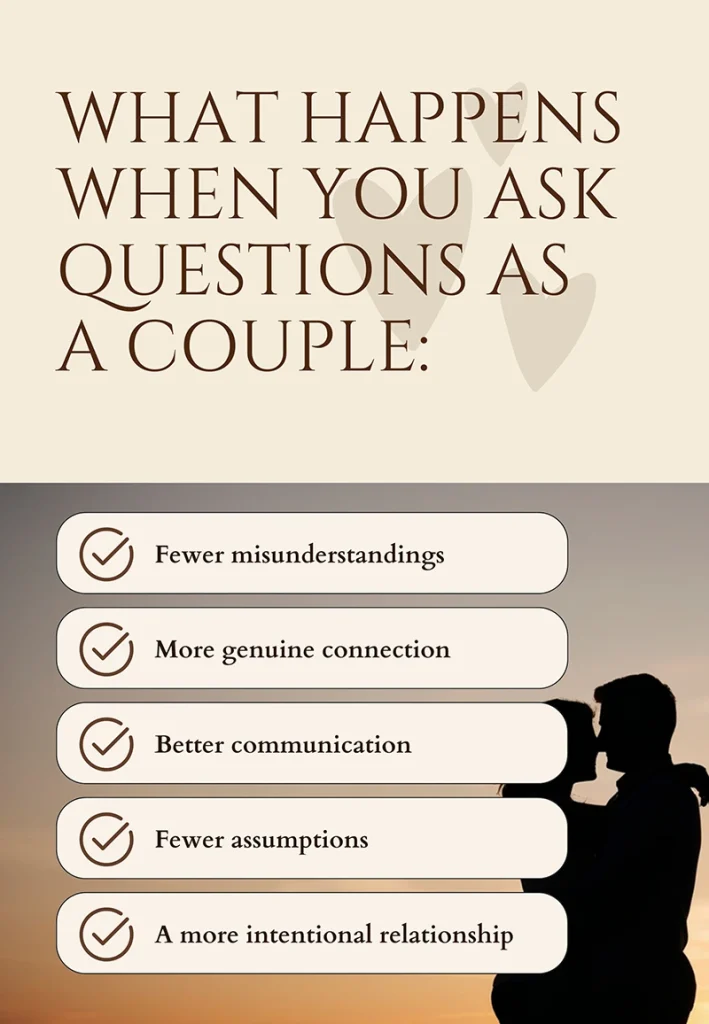
The clearest benefit is that you begin to understand what lies behind each answer. Not only what your partner says, but the experience, concern, or need they are speaking from.
That can reduce many of the small misunderstandings that seem unimportant but keep happening. Hearing a sentence is not the same as understanding the context behind it.
You also recover something that often fades over time: attention to detail.
You begin to discover that certain habits have a history, that some reactions come from somewhere different than you imagined, or that opinions you thought were settled have changed.
You do not need to turn every dinner or walk into a deep conversation. Doing that constantly can become exhausting. The value lies in introducing questions during moments when you would normally be operating on autopilot.
After an argument, a question may help you discover what actually hurt. During a period of change, it can help you see whether you are still moving in a similar direction. And on a completely ordinary day, it can open a conversation that otherwise might never have happened.
Another important effect is that questions can improve the way you argue. They do not eliminate conflict, but they can help you pause before assigning intentions that may not actually be there.
And there is something even more important: asking questions keeps alive the idea that the person in front of you is still changing.
It will not make the relationship perfect. It may simply make it a little more conscious.
WHAT QUESTIONS CAN OFFER
- They reduce some of the assumptions you make.
- They help you understand the context behind an answer.
- They can reveal changes you had not noticed.
- They can open conversations that are difficult to start in other ways.
- They help you revisit expectations and unspoken agreements.
- They keep your curiosity about the other person alive.
04 · QUESTIONS THAT CREATE SPACE
Questions for couples to get to know each other better: 5 examples explained
This is not about firing off one question after another or turning every conversation into an interview. What matters is how you ask them, when they come up, and above all, what you do with the answer afterward.
A good question does not necessarily look for a quick answer. It leaves room to think, add nuance, and even change your mind while talking.
01
When have you felt most understood in this relationship?
The answer may give you clues about what the other person needs in order to feel genuinely heard.
Sometimes it will bring up an important conversation. Other times, it may be a small gesture that barely registered with you at the time.
02
Is there anything you wish I understood better about you?
This creates space for something that may never have been explained very clearly.
The answer may come immediately or take some time. Both are perfectly valid.
03
What have you changed your mind about recently?
This breaks the feeling that you already know exactly how your partner thinks.
It can also reveal changes, nuances, and new ways of seeing things that once seemed completely settled.
04
What has been making you feel closer to me lately?
This can help you understand what is strengthening your connection right now.
And the answer will not always match what you had imagined.
05
Is there anything we are taking for granted that we should revisit?
This may feel like a slightly more uncomfortable question, but that is exactly why it can be useful.
It can uncover expectations, unspoken agreements, or situations you both stopped discussing because they seemed resolved.
You do not have to ask all of them. One question at the right moment can create a much more meaningful conversation than trying to work through an entire list.
05 · WITHOUT TURNING IT INTO AN INTERVIEW
How to use these questions without making the conversation feel forced
The problem is rarely the question alone. Often, it is the moment when you ask it.
If it comes completely out of nowhere, even a good question can feel strange. It usually works better when a conversation is already happening and you simply decide to explore something that has naturally come up.
1
Choose the right moment
You do not need to stage a serious conversation. Simply look for a moment when both of you have enough time and space to talk without rushing.
2
Do not expect a perfect answer
Some questions need time. Pushing for an immediate answer often gives you exactly that: a quick answer, not necessarily a thoughtful one.
3
Listen before you respond
If the other person feels that every answer will immediately turn into a debate, they will start filtering what they say.
Listening does not mean agreeing with everything. It means first trying to understand what the other person is actually saying before defending your own position.
4
Do not turn it into an obligation
You do not need to introduce a deep question every day. The idea is to open small spaces within everyday life, not turn the relationship into a permanent interview.
A QUESTION FOR TODAY
Is there something about you that you think I take for granted that is no longer quite true?
Do not immediately look for a complicated answer. Simply let the conversation go wherever it naturally needs to go.
06 · KEEP DISCOVERING EACH OTHER
Keep getting to know each other over time
There are relationships where people talk a great deal and still leave many things misunderstood. Not necessarily because of a lack of interest, but because everyday conversations often revolve around practical matters: schedules, work, shopping, children, plans, and problems that need solving.
Questions cannot fix a relationship by themselves, but they can change the position from which you look at what is happening.
And you can notice that in very concrete ways: in how you interpret an answer, how quickly you assign an intention to someone, and how willing you are to correct what you thought you knew when new information appears.
IN A NUTSHELL
- Do not assume you already know every answer.
- Ask before filling in the gaps yourself.
- Listen to the answer before turning it into a debate.
- Leave room for your partner to change their mind.
- You do not need to have deep conversations all the time.
- Curiosity is also a way of continuing to care for the relationship.
In the end, perhaps it is not so much about knowing more and more facts about the other person, but about continuing to get to know them.
Because when that curiosity disappears, the relationship does not necessarily fall apart, but it can become more automatic and lose some of its nuance.
Asking again from time to time is a simple way to help prevent that.
TO KEEP THE CONVERSATION GOING
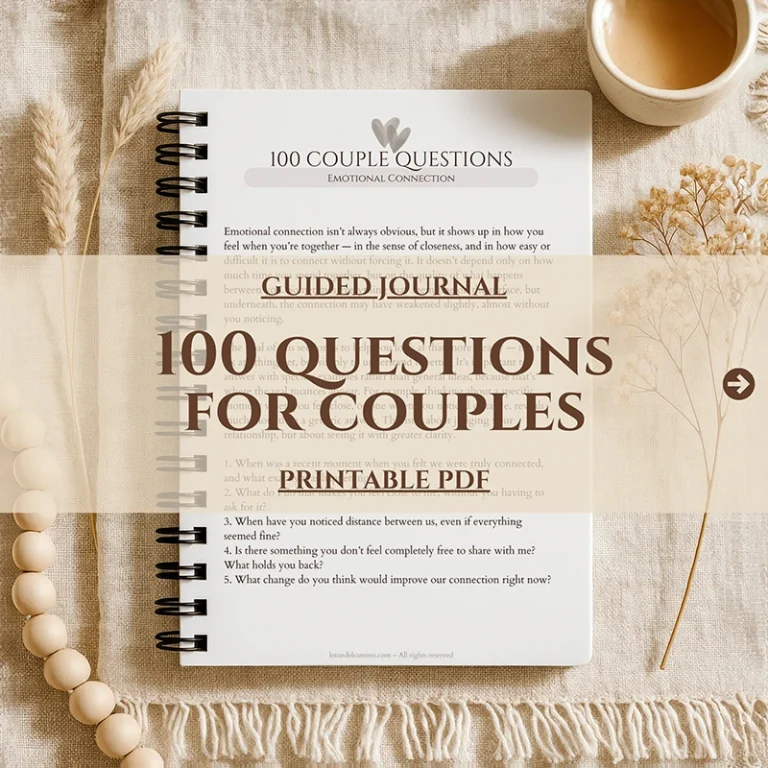
100 questions for couples
If you want to go beyond individual questions, you can use a guide organized around topics such as communication, trust, personal history, conflict, the future, and recurring patterns.