🧩 What This Stoic Journal Is
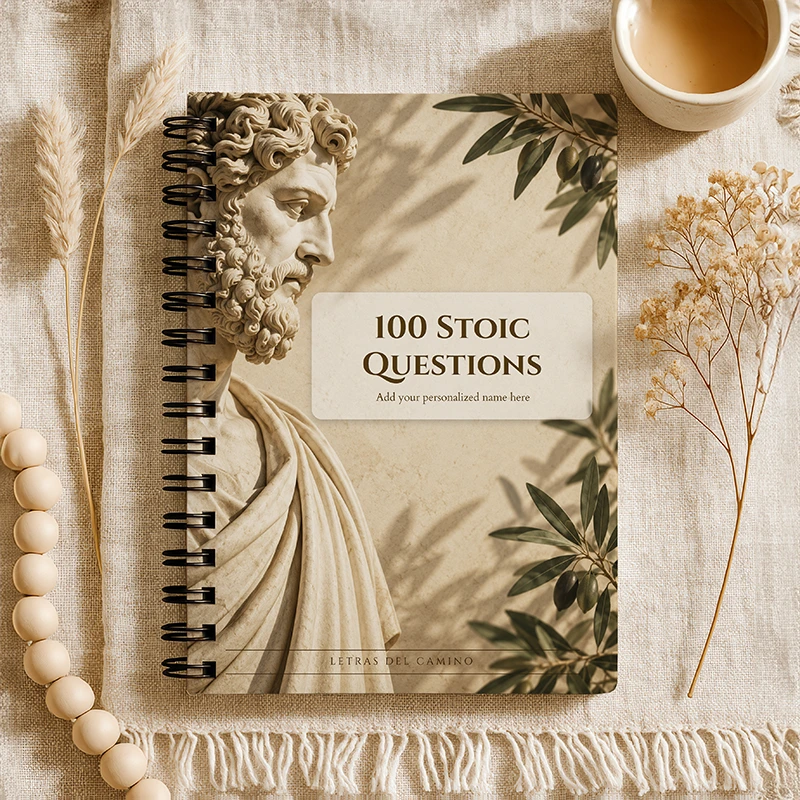
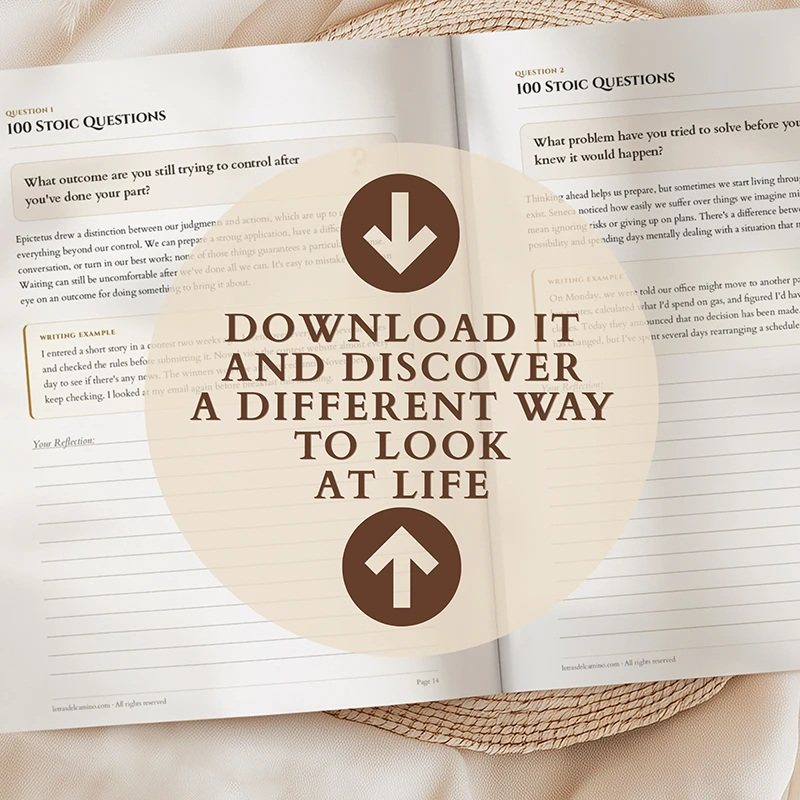
100 Stoic Questions to Focus on What Matters is a guided journal that brings together 100 personal reflection questions inspired by the ideas of Seneca, Epictetus, Marcus Aurelius, and the Stoic tradition.
It isn’t a philosophy textbook or a collection of motivational quotes. It’s an invitation to examine familiar situations: a decision you keep defending, a worry you can’t seem to put aside, an argument you remember all too well, or a habit you’ve never really questioned.
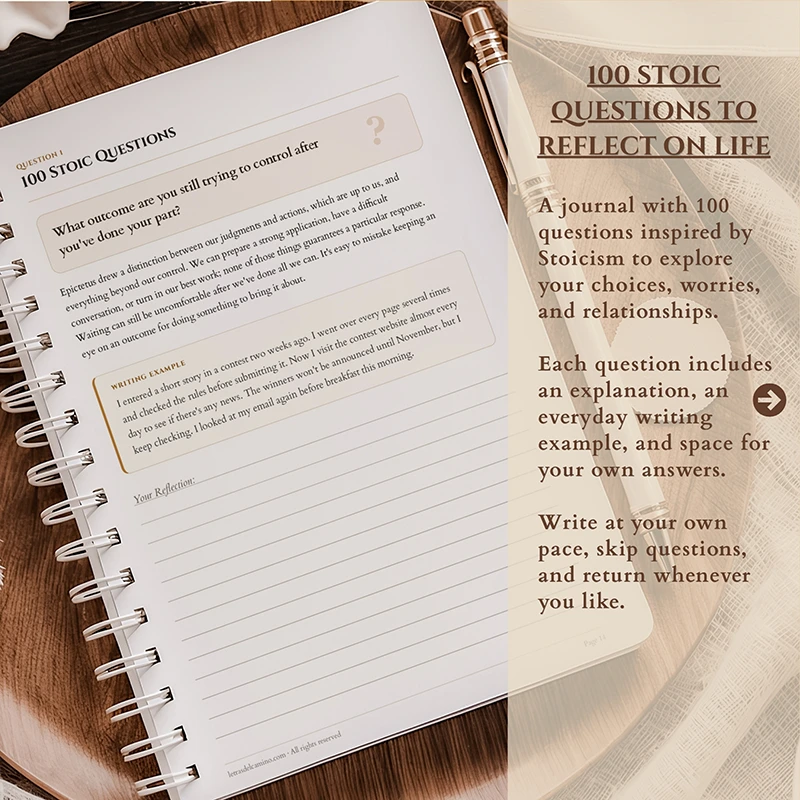
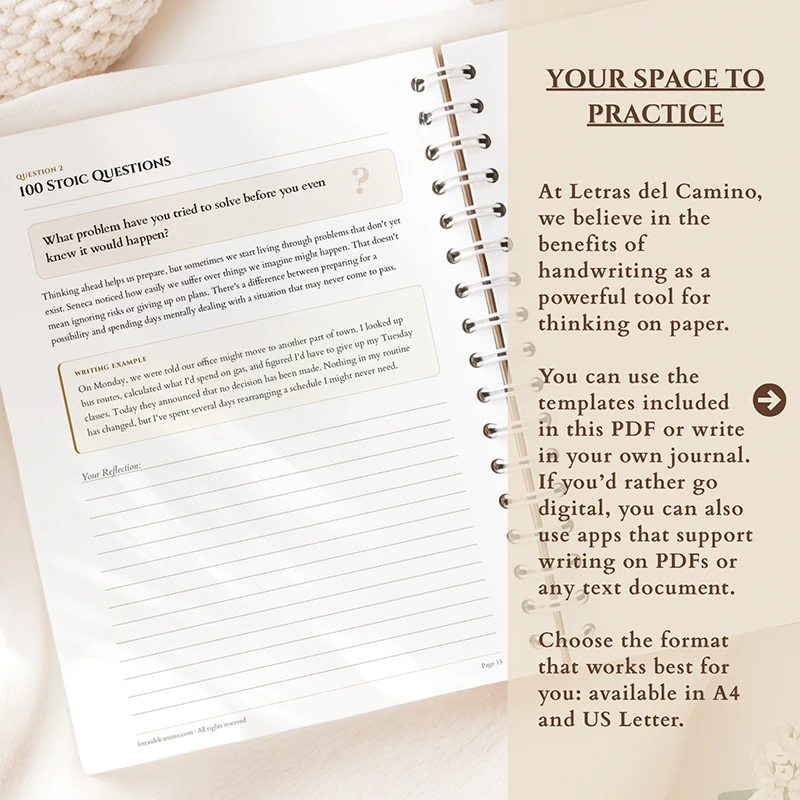
Each question comes with an explanation that explores the idea and connects it to Stoic thought, along with a first-person writing example based on an everyday experience.
You’ll then find space to write your own response. You might describe something that happened, remember a conversation, share an opinion, or admit that you’re still not sure what you think.
The idea isn’t to learn how a Stoic philosopher would answer each question. It’s to use some of their ideas to look at your own life from different perspectives.
💬 What This Journal Can Help You Explore
This journal offers 100 opportunities to examine your choices, worries, relationships, and ways of responding to everyday situations.
Through its questions, you can:
- distinguish between what is within your control and what isn’t
- notice how your interpretations influence the way you experience certain situations
- reflect on anger, impatience, and worries about the future
- examine how much importance you give to other people’s opinions
- recognize contradictions between what you believe and what you do
- reconsider how you spend your time and what you prioritize
- question how much you really need some of the things you want
- explore how you behave in everyday relationships and conversations
- remember decisions, mistakes, and experiences that still mean something to you
- pay attention to small parts of your life that usually go unnoticed
Not every question is about identifying a problem. Some will invite you to recall a pleasant memory, recognize a decision you’re still happy with, or appreciate a familiar part of your daily routine.
The journal doesn’t try to give you 100 correct answers. It offers 100 starting points for writing your own.
🧠 What You’ll Find in the 100 Questions
The 100 questions explore different aspects of human experience through ideas connected to Stoic philosophy.
Among the topics you’ll find are:
- What we can control: distinguishing our own decisions and actions from outcomes that also depend on other people and circumstances.
- Worrying about the future: noticing how much time we spend imagining situations that haven’t happened yet.
- Emotions and reactions: examining how we respond to anger, frustration, impatience, and everyday setbacks.
- Time: reflecting on how we spend our days and the things that matter to us but keep getting postponed.
- Desires and comforts: asking ourselves what we truly need and what we’ve gradually come to consider essential.
- Other people’s opinions: recognizing the influence of approval, criticism, and other people’s expectations.
- Relationships: exploring patience, listening, disagreements, living alongside others, and treating people with consideration.
- Justice and responsibility: looking at the way we act when our decisions affect other people.
- Change and loss: reflecting on how we deal with situations we cannot keep exactly as they were.
- Character and choices: examining our habits, contradictions, and behavior in specific situations.
- The value of everyday life: paying attention to people, places, and small moments that have become part of our routines.
The questions aren’t organized as a course you have to complete step by step. Each explores a different situation and can be answered independently.
📝 How Each Question Works
All 100 entries follow a simple structure that combines philosophical reflection with personal writing.
Each one includes:
- An open-ended question: an invitation to remember an experience, examine a decision, or think about a situation from your own life.
- An explanation: a short text that develops the idea and connects it to Stoic thought and everyday experiences.
- A writing example: a first-person response showing one possible way to approach the question, with realistic situations and recognizable details.
- Space to write: a place to develop your own answer, express your doubts, or preserve a memory.
The examples aren’t correct answers you’re expected to copy. The people in them make mistakes, change their minds, feel embarrassed, or leave conversations unfinished.
That means you don’t have to present the best version of yourself or turn every experience into a lesson.
✍️ How to Use This Journal
- Choose a question that interests you, or open the journal to any page.
- Read the question and its explanation to explore the idea behind it.
- Look at the writing example and notice how it connects the question to an everyday experience.
- Think about whether you remember a similar situation or whether the question brings something else to mind.
- Write your own response without worrying about reaching a perfect conclusion.
- Return to the question whenever you like, especially if your perspective changes over time.
You don’t need to answer the 100 questions in order or write every day.
You can skip questions that don’t interest you, spend several sessions on the same reflection, or put the journal aside for a while and come back to it later.
Some questions will give you plenty to write about. Others may not mean much to you right now. It’s fine to leave pages unanswered.
You don’t have to write long entries, either. A conversation, a brief memory, or a few sentences may be enough.
The journal is designed to fit your own pace, rather than become another task you feel obliged to finish.
👤 Who This Journal Is For
This journal may be a good fit if you:
- are interested in Stoicism and want to explore it through everyday situations
- enjoy asking questions and reflecting on your experiences
- want to better understand your choices and reactions
- would like to examine how much other people’s opinions influence your life
- often find yourself worrying about things that haven’t happened yet
- want to reconsider how you spend your time and what matters most to you
- are interested in reflecting on justice, responsibility, and human relationships
- enjoy preserving memories and experiences through writing
- prefer specific questions and realistic examples to motivational messages
- are looking for a journal you can use freely, without dates or daily obligations
You don’t need to have read Seneca, Epictetus, or Marcus Aurelius. The philosophical ideas are introduced through accessible explanations and recognizable experiences.
It may also interest you if you’re already familiar with Stoicism and want another way to connect some of its teachings with your own life.
📥 Product Details
- Product: 100 Stoic Questions to Focus on What Matters.
- Contents: introduction, 100 reflection questions with explanations and writing examples, and a closing section.
- Philosophy: reflections inspired by Seneca, Epictetus, Marcus Aurelius, and the Stoic tradition.
- Includes: 100 original questions, accessible explanations, everyday writing examples, and space for personal responses.
- Language: English.
- Printable format: PDF files in A4 and US Letter sizes.
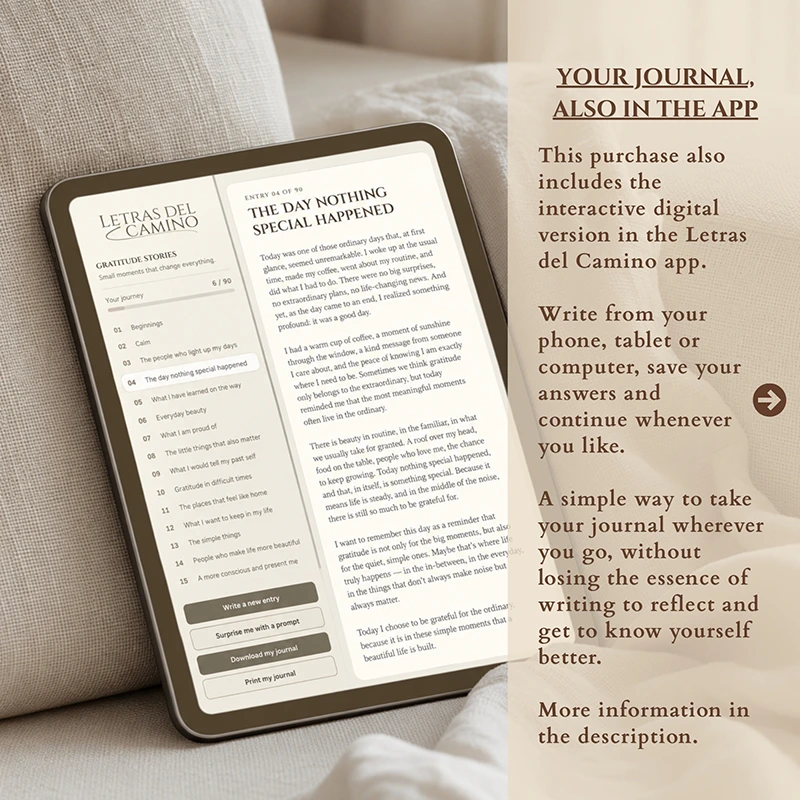
- Digital version: access to the interactive journal through Letras del Camino.
- Delivery: digital product. No physical item will be shipped.
You can use the printable PDF independently, print the entire journal, or select only the pages you’d like to answer.
The Letras del Camino version also allows you to read the questions and write your reflections from your phone, tablet, or computer.
🔎 What Makes This Journal Different
There are many ways to explore Stoicism. Some focus on quotations from ancient philosophers. Others explain their teachings or offer exercises for applying them to specific situations.
This journal takes a different approach: it uses questions to invite readers to explore their own experiences.
We can understand that not everything is within our control and still spend an afternoon waiting for a reply that never arrives.
We might believe patience is important and then lose ours over something insignificant. Or we might discover that a perfectly ordinary habit takes up much more space in our life than we realized.
The 100 questions explore situations like these. They aren’t intended to prove that we’re always doing something wrong or that there’s only one correct way to live.
The explanations offer a philosophical perspective, while the examples show how an idea might appear in a conversation, a decision, or a memory.
Philosophy offers a way of looking at things. What you write in response is entirely your own.
You might agree with a Stoic idea, question it, or discover that your experience leads you to a different conclusion.
The result isn’t a manual containing 100 instructions. It’s a journal offering 100 opportunities to think, remember, and write.
❓ Frequently Asked Questions
Do I need to know anything about Stoicism to use this journal?
No. The explanations connect philosophical ideas with everyday situations. You can use the journal without having read any Stoic philosophers before.
Is this a philosophy book or a writing journal?
It’s a personal reflection journal inspired by Stoicism. Each question includes a short philosophical explanation and a writing example to help you develop your own response.
Do I have to answer the 100 questions in order?
No. Every question works independently. You can follow the order of the journal, choose a page at random, skip questions, or return to an earlier one whenever you like.
Do I need to write every day?
No. There are no dates or required schedules. You can answer several questions in one sitting, spend more time on a single reflection, or leave weeks between writing sessions.
Does the journal include sample answers?
Yes. All 100 questions come with first-person writing examples. They describe everyday situations and show one possible way to respond, rather than giving you answers to copy.
Are there correct answers to the questions?
No. The journal invites you to reflect on personal experiences and opinions. You can agree with the perspective offered, disagree with it, or recognize that you’re still unsure what you think.
Is this the same as the 30-chapter Stoic journal?
No. They’re two different products. The 30-chapter journal develops longer reflections and writing exercises about everyday situations. This journal contains 100 independent questions, each with an explanation, a writing example, and space for your response.
Is this a collection of quotes from Stoic philosophers?
No. The content consists of original questions inspired by Stoic thought, rather than a collection of quotations. The philosophical references help explain the ideas behind each reflection.
Can I use the journal without the Letras del Camino app?
Yes. The printable PDF files can be used independently. The app offers an additional way to read the content and write digitally.
Is this a digital or physical product?
It’s a digital product available as a printable PDF, with access to an interactive version. No physical book or notebook will be shipped.
What language is the journal written in?
The entire journal, including the questions, explanations, writing examples, introduction, and closing section, is written in English.