
I never thought writing was something special. For many years, writing wasn’t part of my life. Beyond emails and scattered notes, I didn’t have a real connection with words. Until, not long ago, something changed: I started by trying a simple gratitude journal—three things each night—and that’s when a door opened.
As I kept writing, I understood one thing: in those clumsy sentences there was more of me than I realized. Writing wasn’t for others—it was to understand myself and keep myself company. To not stay silent about what I didn’t dare to say out loud.
Now I already have hundreds of pages written, which I like to reread from time to time.
A refuge every day
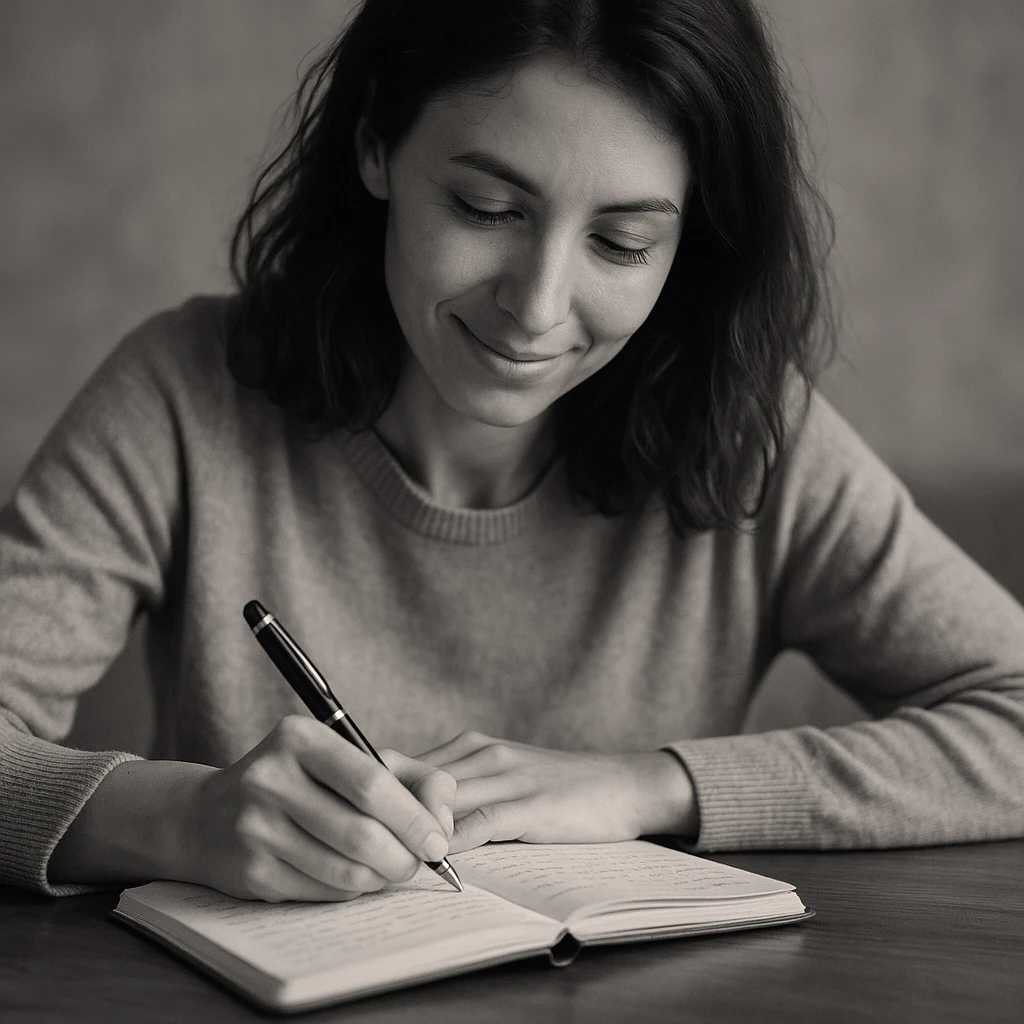
For the past few months, when I shut down my computer I sit at my desk with a notebook. Almost always it’s before dinner. A few minutes are enough to open that space where I can be with myself without anything rushing me. I don’t always write much—sometimes just three lines. But there I find refuge.
Everyone has their moment. And every moment finds its refuge.
Writing, in those moments, is like closing a door and staying inside. Outside, everything goes on the same: pending notifications, quick conversations. But on the page there is silence. And in that silence, something in me appears that can’t be heard in the noise.
It calms me especially on the most stressful days, when my mind won’t stop even after I’ve shut down the computer. Then I let loose phrases fall onto the page. Sometimes they don’t even make sense, but that’s enough—the pace slows down and the body loosens a little.
I don’t write to make it look pretty. I write so I can breathe and let it out.
A life story
A journal is never just a notebook—it’s memory. Fragments of days that seemed ordinary and that, when reread, are perceived differently.
I notice it every time I open an old one. I find pages full of complaints, doubts, things that at the time felt unbearable. And I’m surprised that now they barely hurt. What once stole my sleep now fits into a few lines that don’t weigh the same—even if only months, or even days, have passed since then—and that makes you think.
Sometimes I open to a random page, read a sentence, a paragraph, and I find myself different. Reactions that used to overwhelm me, today I look at them calmly. It’s as if the paper reminded me: you survived, and you will do it again.
I don’t write to leave an inheritance. But I know what I write down are traces—my traces—and rereading them, even if no one else ever does, helps me know myself better.
Confidence and resilience
A journal is also proof that we’ve endured, that we’re still here. Each page says it in its own way: the exhaustion, the anger, the fear. And also that, despite everything, we didn’t stand still.
When I read myself again, I discover things I couldn’t see at the time. It strikes me to realize that I was there, in complicated places, with the feeling that I wouldn’t be able to… and yet I made it through.
It happens to me especially when I write about past events. It’s one of my favorite practices: returning to what already happened and putting it into words. That helps me see what a person can endure, the effort they make to improve, even if they don’t notice it in the moment. Looking back—whether or not anyone applauds it—plants confidence in me.
It wasn’t sudden, not at all. I can’t say writing gave me confidence overnight, but it did help me look at my stumbles. There were patterns that repeated, ways of reacting that led me to the same place. Once I saw them on paper, I couldn’t ignore them anymore. Little by little I began to name them, understand them, and change them—even if only a little. That clarity felt like a breath, and in that breath, strength appeared.
I also tend to write down small achievements—very small ones: finishing something pending, daring to say what I think without dressing it up, even having a day when everything weighs less. They’re not big milestones, but rereading them I realize they count too. In moments of doubt, those notes help me a lot.
Writing reminds me that fragility doesn’t erase strength. That enduring, sometimes, isn’t about triumphing or winning anything—it’s simply continuing. And that, even if it seems small, is already a lot.
Going to sleep with a lighter mind
Night has something strange about it. Outside everything shuts down, but inside, the mind turns on lights we didn’t ask for. Unfinished tasks appear, what’s pending, what hurts a little more when we rest our face on the pillow.
For many people, writing before bed is a way to release that noise—to leave it on the page so it won’t keep spinning while we try to rest.
I haven’t had serious sleep problems. I’ve always slept well, almost without thinking about it. But I know people close to me who haven’t. And for them, writing down three sentences before closing their eyes makes a difference. It’s like closing the day—what’s written down doesn’t bother the mind as much.
It can be simple: three sentences, nothing more. Something that worries you, something to be grateful for, or a minimal list of what you’d rather leave for tomorrow. It’s not about writing a chapter—just opening a small crack so rest can enter more cleanly.
Science also talks about this, even though I lean more on what I’ve lived. Studies say that writing down tasks before bed shortens the time it takes to fall asleep. But beyond that, the gesture is what matters: letting go of what’s extra, even a little, to sleep lighter.
Caring for memory and attention
Writing doesn’t only leave a record—it also reinforces what we’ve lived. When we write something down, that memory settles differently, as if it had a second layer. What passes through words is stored in another way. Because writing forces us to pause for a moment, to organize what would otherwise get lost among so many things.
I’ve always thought that what is written is lived twice. And I notice it. Memory has never been my strong point, but thanks to my notebooks I keep moments that otherwise would have faded. I don’t know if it’s journaling, the breathing exercises I do from time to time, or the mix of both. The truth is that when I write, my attention sharpens, as if my gaze became clearer.
A simple exercise is to choose, at the end of the day, one moment you want to keep. A conversation, a walk, a small gesture. Writing it down doesn’t only help you remember it—you relive it. And that repetition makes it even more alive.
Science has its explanation: studies say that writing regularly improves working memory, even reading and math comprehension. Still, what matters most to me isn’t the theory—it’s how it feels. Writing isn’t only emotion. It’s also an exercise in memory, in attention, in life.
Creativity in motion
Creativity rarely appears when we call for it; it almost always arrives when we least expect it. And writing without a filter is a way to open the door for it. When we do it without editing, without judging, the page becomes a spark—a spark that ignites connections that were sleeping before.
It happens to me a lot. I’ve had important ideas while writing, both personal and professional, although, if I’m honest, most clear intuitions come to me while walking—when the body moves and the mind clears. But writing them down in the notebook has saved me from losing them. And not only that: when I write them, often new ones appear, or the vague ones take shape. The notebook becomes a space for exploration. What was smoke begins to have a body.
An exercise that’s often recommended, although I don’t practice it much, is morning pages: writing three pages straight right after waking up. They don’t have to make sense—the important thing is to let whatever is inside come out. And many times, among aimless sentences, something clear appears: an image, an idea, even a solution.
The relationship between writing and creativity has also been studied. It’s said that constant practice helps you enter a flow state—that moment when ideas link themselves together, as if they were only waiting for you to give them a channel.
Mindfulness on every page
In a world that pushes us to run, writing feels almost like an act of rebellion. It’s not just recording what happens—it’s being there while we do it. Sitting with a notebook can be a simple form of mindfulness: a pause in which we stop reacting to the outside and stay for a moment with what we feel here and now.
When I write, I notice things that would otherwise pass by. A gesture, a sound, a small emotion. During those minutes my attention doesn’t jump from one place to another. I don’t check notifications, I don’t think about what comes next—I’m simply there, pen in hand, listening to what moves inside. That kind of presence rarely appears elsewhere in my day.
A simple exercise is a gratitude journal. At the end of the day, write down three things you feel grateful for. They can be tiny: a simple meal, the calm of a walk, a kind word. I usually do it—when I finish writing, I always try to give thanks for something. Naming them changes the way I look at the day. It gives it a different color.
The similarities with meditation are obvious. Both practices invite us to observe without judging, to accept what appears, and to hold attention in the present moment. Writing, in a way, is a form of meditation without calling it meditation.
Improving communication
Writing also trains the word. Many times it has helped me to outline a conversation before having it—to write what I want to say to someone, or how I would explain an idea that’s been circling in my mind. As I do it, I notice that sentences organize themselves, detours disappear, and what I want to express becomes clearer.
Reflection comes from there. When we write, we learn to speak more precisely. Because when we put words on paper, we face them—we see whether they say what we feel or whether they fall short. The distance writing gives allows us to soften, adjust, and find the most honest way to say something without losing its strength.
A simple example: before a difficult conversation, write it out completely in the notebook. It doesn’t matter whether I end up saying the same thing or not. What matters is that in that rehearsal I discover what I want to communicate and how to do it without getting trapped in the tension of the moment.
It has been studied too. Practicing with written words improves verbal fluency and helps organize ideas in the mind. In the end, every time we write it’s as if we were speaking to ourselves. And from there, clearer words toward others are born.
Oh—and as an extra, writing what you want to say often helps you realize things you didn’t understand, whether about others or about yourself.
Managing stress and emotions
A journal can be a place to release what weighs on you. Not to solve everything in the moment, but to open an exit before it builds up too much. The page receives what we don’t know who to tell, what we prefer not to say out loud. And just by naming it, a little relief appears.
It happens to me a lot. When I write about what I feel, I organize myself inside. The problem is still there, but stress goes down. What was a confused mass becomes concrete sentences. And by putting words to it, it doesn’t squeeze the same way. Naming fears and sadness, without decoration, is a way to take away part of their force.
An exercise that works for me is writing right when something affects me. Instead of staying quiet or letting it spin in my head, I open the notebook and drop it there, even in short sentences. Writing “today I feel…” and continuing without overthinking it. Many times, after a few lines, I notice the emotion doesn’t weigh as much.
Studies say it too, although I believe it from experience. Those who write about what hurts them tend to reduce anxiety and even improve physically. A journal doesn’t erase pain. But it offers a safe place to hold it.
Greater self-awareness
A journal doesn’t only store memories—it also reveals patterns. When we write with some consistency, words, emotions, and themes begin to repeat—things we may not have noticed. The notebook becomes a mirror, and in it appears what was hidden before.
It happens to me both when writing and rereading. Suddenly I discover I’ve spent weeks circling the same idea, the same worry. That makes me more aware of what truly occupies me inside, even if I hide it in daily life. And sometimes, from those repetitions, a question arises that I can’t avoid: do I want to keep enduring this?
A clear example is seeing how I return again and again to the same thing: a job that doesn’t fulfill me, a relationship that drains me, a fear that won’t go away. Finding it written across several pages no longer feels like a passing thought—it’s something asking for attention.
In that sense, the journal works like a mirror that reflects what we are and also what we avoid looking at. And even if it’s uncomfortable, that self-awareness opens the door to more honest change.
Shared emotions, deeper bonds
Writing doesn’t always stay personal—it can also build bridges to others. By putting what we feel into words, we learn to recognize nuances that we later identify in the people around us. The notebook becomes a kind of school of empathy, a place where we practice with ourselves first what we later bring into our relationships.
It happened to me with people who hurt me or who simply weren’t well. By writing about them, I managed to look at them with more distance. To understand a bit better what might have been behind their gestures, their silences. That doesn’t erase what happened, but it opens a space where anger makes room for something else—closer to compassion.
To understand is power.
An exercise that helps me is writing letters I will never send. Letters to people I still have unfinished business with, to those who are no longer here, or to those I will never be able to speak to in person. In those letters, everything fits: complaint, anger, but also gratitude. And as I write them, I feel something loosen. At the same time, I train my gaze to recognize what is human in the other.
Sometimes I do it as if it were the last chance to communicate with that person. I recommend it—but do it consciously, as if it truly were, and you’ll see what happens.
Studies have observed it too. People who write about their emotions develop more empathy and healthier bonds. But beyond theory, what matters is the experience: understanding ourselves on the page prepares us to understand outside of it, too.
A map of personal growth
A journal can also be read as a map. Each page is a mark on the path, and together they draw the processes we’ve lived through. They don’t only record what happened—they also show how we faced it, what we thought at the time, how we felt it. Returning to those pages reveals a wider route, almost as if we could look at life from above.
For me, as I said before, rereading is what gives me the most. Going back to what I wrote some time ago gives me another perspective. What one day was a huge problem, today I understand as a stage—sometimes as a lesson. That distance helps me value how far I’ve come and also think about where I want to go. If I solved something one way before and today I’d do it differently, it means something changed in me.
A simple exercise is to compare similar situations written at different times. Seeing how I handled a conflict a few months ago and how I handle it today lets me see changes I don’t notice day to day. That comparison is concrete proof of growth.
Journaling is being talked about more and more as a personal development tool. Not because it gives magical answers, but because it offers perspective. It shows the thread of who we are and helps us make decisions with more awareness.
Closing
Writing isn’t a productivity exercise or a technique to perform more. It’s a deeply human gesture. Each word in a notebook is a way of listening to ourselves, understanding ourselves, opening a space in the middle of a life that rarely leaves gaps. Journaling isn’t a method to master, but a place to return to whenever we need it.
You don’t have to wait for the perfect moment. You don’t need a special notebook or to know how to “write well.” It’s enough to pause, open a blank page, and let something appear. It can be a sentence, a list, an emotion that weighs on you, or a detail you want to keep.
The invitation is simple: open a notebook and begin. Not to make it pretty or correct, but to be a little closer to yourself. The rest will come on its own. Word by word.